The textile and rental supply company’s alt-fuel fleet program is part of its wider
sustainability efforts, and the company has plans to continue testing new technologies
and growing the program
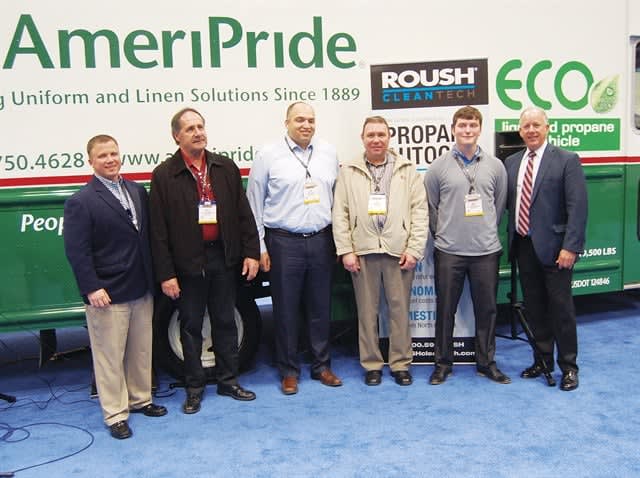
Todd Mouw (far left) of ROUSH CleanTech and AmeriPride Fleet Manager Banny Allison (third from left) were on hand to unveil the fleet’s new propane-autogas step vans. The company will be adding 20 of these vans to its California operations. Photo by Chris Wolski.
Textile and rental supply company AmeriPride announced during the recent NTEA Work Truck Show 2015 it will be adding 20 new propane-autogas step vans to its fleet operations in Northern California by the end of the year.
Ad Loading...
The company operates 1,800-plus vehicles, with a mix of step vans, box trucks, sedans, cargo vans, and tractor trailers.
Ad Loading...
The announcement comes after the successful pilot of five propane-autogas step vans at AmeriPride’s Topeka, Kansas, operations. The vans are being built on the Ford F-59 chassis with bodies supplied by Morgan Olson. ROUSH CleanTech, which handled the conversions for the pilot vehicles in Topeka, will perform conversions for the new vans.
ROUSH CleanTech is Ford’s only qualified vehicle modifier (QVM) for propane autogas, and, thus, retains the same Ford performance characteristics. It also means the chassis warranty is unaffected by the modification, one of AmeriPride’s criteria for choosing an alt-fuel vehicle. The vehicles meet Environmental Protection Agency (EPA) and California Air Resources Board (CARB) certification requirements.
Each of AmeriPride’s propane-autogas trucks is expected to emit about 95,000 fewer pounds of carbon dioxide emissions over its lifetime. Propane autogas emits about 25-percent fewer greenhouse gases, 60-percent fewer carbon monoxide emissions, and 20-percent fewer nitrogen oxide emissions, according to ROUSH CleanTech.
At A Glance Over the past three years, AmeriPride’s fleet has become more sustainable. The fleet has been testing a number of alt-fuel types, including:
Propane autogas.
Hybrid-electric powertrains.
Compressed natural gas.
Battery-electric powertrains.
During the conversion process ROUSH CleanTech worked with AmeriPride to deliver a vehicle that fit the fleet’s operational needs.
“From our perspective, we worked with AmeriPride to understand the range and the duty cycle the fleet needed, such as if they are coming back to a central depot at night, and whether they are putting in a central fueling station at their depot, so we checked all the boxes that made sense,” said Todd Mouw, vice president of sales and marketing for ROUSH CleanTech. “It’s a very analytical and very data-driven process, which is good. The company knew what their baseline was for gasoline, and what they were trying to get to if they moved to an alternative-fuel source.”
Ad Loading...
Make the Alt-Fuel Grade
According to Fleet Manager Banny Allison, the 20 new propane-autogas step vans will be evenly distributed between AmeriPride’s operations in Fresno and Sacramento, Calif., in October and December respectively.
In order to make the grade for the fleet, the alternative-fuel vehicle and type has to meet a number of criteria.
“The vehicle has to have an OEM warranty, so we only use new vehicles. There has to be a fueling capability nearby. We can’t be going three to five miles out of the way to fuel, so it can’t disrupt our regular operations. There has to be a financial break-even or payback. Finally, we have to have maintenance available for that alt-fuel,” Allison said.
Propane autogas fit all of those criteria in the markets where the company is rolling out the trucks, so it was a good fit for the fleet.
Fueling infrastructure, however, was probably one of the key factors driving Allison’s decision to pilot the propane-autogas vans in the first place.
Ad Loading...
Importance of Infrastructure
Allison said that the reason the company chose Topeka for the propane-autogas trial was because it had a rural, high-mileage route.
“We wanted to see how propane-autogas vans would perform on higher-mileage routes,” he said.
But, the lack of compressed natural gas (CNG) infrastructure also was a determining factor. Allison noted CNG has some performance and pricing advantages over propane autogas, but the lack of infrastructure made it impractical for a Kansas pilot.
The Kansas operation added onsite propane-autogas fueling, which consisted of a 1,000-gallon tank, to centrally fuel the vans. The fleet paid about $1.55 per gallon for propane autogas, as of April 2015.
“They ran the trucks for about a year, and the feedback on cost per mile and emissions aligned with their corporate strategy and the next step was, ‘We really liked this — now, where else can we deploy them?’, and that’s what drove the announcement at the NTEA Work Truck Show,” said Mouw of ROUSH CleanTech.
Ad Loading...
The soon-to-be-added vans in California will be operating in areas where there is CNG infrastructure, but would be disruptive to normal operations to fuel at these stations.
As in Kansas, AmeriPride will be providing onsite fueling. Allison expects to pay about $1.32 per gallon for propane autogas in California.
A Company-Wide Effort
The greening of the AmeriPride fleet is part of the company’s overall sustainability efforts.
“It is a big part of our sustainability efforts company wide — it’s not the only part, but it is a big part of it,” said Ben Saukko, director of communications for AmeriPride. “Our sustainability efforts companywide are looking at equipment replacement at our plants. In addition, we installed solar panels in one of our plants, so we’re piloting that. Greening the fleet is part of a larger sustainability effort, because we have 1,800-plus trucks out on the road, and it’s a place where we can have a big impact on the environment.”
Allison echoed Saukko about the reason for the commitment to sustainability, which also has a benefit for fleet efficiency.
Ad Loading...
“We really started looking at greening the fleet three years ago, and it’s a responsible thing to do environmentally, because we are in so many areas in North America and we want to make sure we’re protecting the environment for our customers and people in the area, and also as a long-term strategy we think it’s a good way to control fuel costs and diversify our fuel sources,” he said.
Allison said that there is an internal goal to continue converting a portion of the 1,800-plus vehicle fleet over the next decade. Again, fueling infrastructure is the major constraint Allison sees in making this goal a reality.
Fundamentally, AmeriPride’s sustainability efforts were driven by its key stakeholders.
“We were getting a lot of questions about our sustainability efforts from our customers and prospects about what we were doing to be more sustainable,” Saukko said. “It was becoming more important to our employees as well as our family ownership. We’re a family-owned company and, for a large number of these owners, sustainability is important. If it’s important to our customers, our employees, and our family owners, it’s important to us. Our goal is to be the leader in our industry in sustainability.”
While propane autogas has been a good fit for the AmeriPride fleet, Allison said that he’ll continue looking at other alt-fuel options as well.
Ad Loading...
“I don’t think there’s one fuel that’s going to work everywhere. That’s why we do all the different types — propane autogas, CNG, hybrid, and we’ll be testing some battery-electric models later this year. There’s a place for everything — it’s just how well it fits into the parameters,” Allison said.
From millions in operating savings to hundreds of millions of EV miles, Merchants Fleet’s latest report reveals what’s working and what’s changing in fleet electrification.
A recent media and client event, studded with electric vehicles dressed up on platforms, planted a new position for the manufacturer in the wider EV market. Fleets will find cost-saving advantages.
Inspiration Mobility Group has acquired select assets of Electrada, adding the fleet electrification provider's team, technology, and charging infrastructure development capabilities to its energy management business.
Fleet leaders have more data than ever, but turning that data into clear, actionable decisions remains a challenge. This white paper shows how leading organizations are using connected vehicle data to improve safety, reduce costs, and optimize fleet performance. Learn how to turn insight into action across your fleet.
Bobit Business Media surveyed 190 fleet professionals and found that while most fleets are tracking costs, fragmented systems and data gaps are keeping true TCO visibility out of reach. With rising pressure to control spend in an increasingly volatile environment, the gap between what fleets think they know and what the data actually shows is wider than you might expect. See how your peers are managing costs today and where the industry still has room to improve.