




6 Ways to Save Fuel Now
Try these six strategies to get more mpg from light- and medium-duty trucks right now.

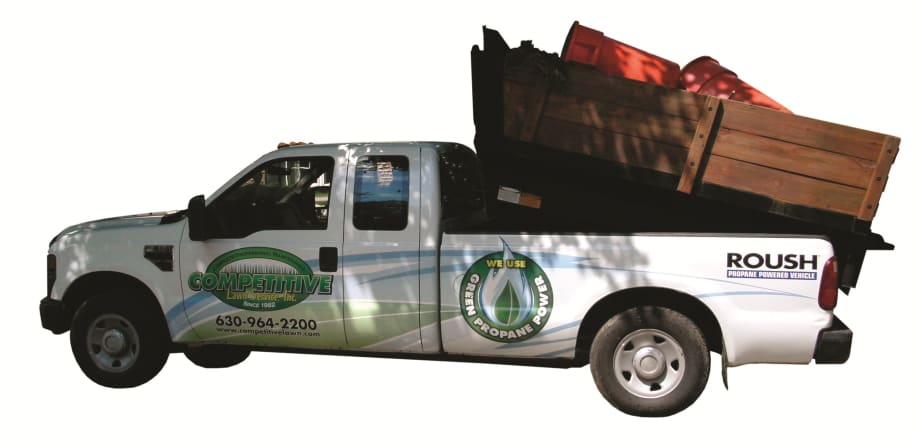
A slide-in dump unit allowed Eric Hansen of Competitive Lawn Services to select this Ford F-350 over a medium-duty dump truck.
A slide-in dump unit allowed Eric Hansen of Competitive Lawn Services to select this Ford F-350 over a medium-duty dump truck.
At A Glance
Tips truck fleet managers looking to save on fuel expenses can utilize include:
● Downsize vehicles.
● Tailor equipment to the task.
● Adjust top speed and shift points.
● Institute an idle cut-off.
● Utilize low rolling resistance tires.
● Use aerodynamic cab fairings.
The future is bright for work trucks. Advances in vehicle technology and alternative fuels hold the promise for a new era in which the light- and medium-duty workhorses of the American economy are no longer the fossil-fuel-burning smog machines they once were.
Meanwhile, fallout from the recent economic crisis has forward-thinking fleet managers and business owners stuck in neutral. Tight budgets have forced them to keep trucks in service well beyond their projected lifecycles. And for many of those in a position to cycle in new trucks, the up-front cost of greener vehicles remains prohibitive.
"On average, we'd buy two dozen new vehicles a year," said Doug Flesher, fleet manager for Golden Valley, Minn.-based Wessin Transport Inc. "We haven't bought a new vehicle since August 2007. For the class of truck we're running, basically a 12,000-lb. GVW, there's no hybrid that fits our needs that's cost effective. Even if we wanted to convert to something like compressed natural gas, [our vehicles] are just too old."
The good news? There are a number of strategies fleet managers can implement immediately to improve the fuel economy of light- and medium-duty gas- and diesel-powered fleet vehicles.
Downsize for Savings
If adding trucks to fleet this year but a company doesn't have an extra $20,000 to $40,000 to invest in the hybrid version or can't wait for the ROI, what are the alternatives?
Jason Mathers is project manager for corporate partnerships at the Environmental Defense Fund (EDF) in Boston. He recently published a white paper, available as a free download at www.edf.org, that details the green initiatives of several large, medium-duty truck fleets. He said vehicle selection is the first step toward reducing fuel costs. "The biggest environmental decision a fleet manager can make is deciding which vehicles to add to your fleet," Mathers said. "It's the same for fleets of 10,000 or 15."
Mathers' paper profiles companies such as Farmington, Conn.-based Carrier Corp. For years, the HVAC systems manufacturer relied on the cargo space afforded by Ford E-250 service vans. The company wanted to build a more fuel-efficient fleet and maintain its partnership with Ford. Its solution was to convert part of the van fleet over to Ford F-150 pickups.
"You may not think of F-150s as environmentally friendly," Mathers said, "but if it's more efficient and does the job, you're moving in the right direction."
Even downsizing one vehicle can yield substantial fleet savings:

[PAGEBREAK]
Tailor Equipment to the Task
Eric Hansen, owner of Competitive Lawn Service Inc. in Downers Grove, Ill., was looking for a way to eliminate the hours required to shovel out dirt and other fill, but couldn't make the math work for a medium-duty dump truck. The solution: He installed a dump insert from EZ Dumper in the bed of his Ford F-350 pickup to haul loads.
Hansen said that although a dually dump truck allows for twice the payload, the added capacity is overkill. He gets 3 to 5 more miles per gallon with the pickup and dump insert, which contributes to substantial savings with the number of daily miles the trucks travel.
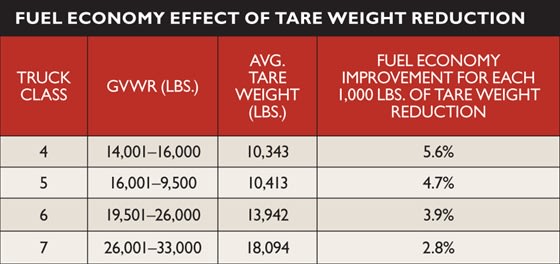
But what about the miles where a truck isn't hauling or towing anything? That's where the vehicle's "tare," or curb weight, comes into play. Lightweight components, such as aluminum rims, lift gates, and jockey boxes also help reduce weight, but vehicle selection is still the key.
Adjust Top Speed and Shift Points
It's a fact: High speeds and jackrabbit starts burn fuel. However, driver behavior is hard to control once they leave the office. That problem was addressed by Mike Payette, fleet manager for Framingham, Mass.-based Staples Inc., by reprogramming the electronic control module (ECM) on the company's Isuzu N-Series delivery trucks.
When Payette first sought a technical solution, he was met with resistance from his OEM. Undaunted, he started experimenting. His first stop was the fuel pump.
"We picked up a used fuel pump and started making adjustments that would reduce the amount of fuel going to the engine," Payette recalled. "We found that it was going to be kind of a hit-or-miss, and it would not have been practical to pull trucks off the road for days at a time. The majority of our fleet is leased; at the end of the lease, you have to return them to whatever their normal settings were for resale."
Payette then sought expertise from Hypertech Inc. in Bartlett, Tenn., a company known as an industry leader on the computing side of automotive performance. Hypertech said it was possible to reprogram the ECM to reduce the trucks' peak torque and top speed.
Payette took Hypertech's report back to Isuzu, and the manufacturer relented. Isuzu sent him a specially programmed Tech 2 diagnostic device that could be plugged into each truck's OBD port, allowing him to manually adjust the N-Series' top speed to 60 mph. The results? The adjusted trucks now consistently achieve more than 11 mpg, well above the established baseline of 8.5 mpg.
One problem remained, however. The Tech 2 could only be used on ECMs from 2005-MY and newer, and Payette still had plenty of older trucks in service. For the 2004 models on down, the solution had to be mechanical.
Payette solved the problem by adjusting the throttle stop bolt on the gas pedal, allowing the pedal to be depressed only three-quarters of the way. This kept the truck at a top speed of 60 mph and forced the transmission to shift from first gear to second early, at 12 miles per hour. "With the mechanical solution, we started saving fuel on every upshift," Payette said.
As the adjustments were under way, Payette began to wonder if his fuel savings could be wiped out by overtime pay incurred by drivers spending more time on the road. He soon learned that improved fuel economy led to fewer stops at the gas station, negating time lost to slower speeds.
"After we made the changes, they were stopping every third day rather than every other day. Each fuel stop takes about 20 minutes. In a 10-hour day, [the reduced top speed] added seven and a half minutes to the driver's day. So the extra seven minutes on Monday, Tuesday, and Wednesday was already offset by not stopping for fuel on Tuesday. Our labor line was absolutely flat, and we got the fuel savings we were looking for," said Payette.
Janet Powell is the fleet manager for PoolCorp. in Covington, La. Similar to Payette, she is in charge of a nationwide delivery fleet and was looking for ways to reduce fuel spend. She reduced the top vehicle speed to 70 mph - 65 on cruise control - for all Class 5-and-above trucks. Her experience was also similar to Payette's. What she assumed would be a simple fix turned out to be more complicated.
"We did it [by adjusting] the ECM settings," Powell said. "The dealerships had set a password, and that was something we had to learn along the way. In the beginning, we thought it would be easy. 'Take it in to get an oil change, plug it into the diagnostic board, type in your parameters, and you're done.' It wasn't that simple. Just because someone can read the code does not mean they can adjust the ECM settings."
To complete the adjustments, Powell worked closely with PoolCorps OEMs and fleet management company. At the time, she was looking forward to cycling in more trucks.
"We thought, 'Well, when the new trucks come from the factory, they'll come set the way we want,' " she said. "But then the economy went the way it did, and we haven't been able to order any new trucks."
[PAGEBREAK]
Utilize Idle Cutoff Systems
Nothing burns more fuel at a lower rate of return than running an engine at zero mpg. Staples' Payette managed to net another 5 percent fuel economy savings by installing a three-minute idle shutdown made by Mentor, Ohio-based Malone Specialties Inc. In addition to shutting the trucks off, the system tells him how many times it kicked in.
"We download that and sit the drivers down and say, 'You're supposed to be turning the truck off. Why is the system turning the truck off?' "
"We set the idle cutoff to five minutes," said PoolCorp's Powell. "We were concerned with our drivers making a 45-minute delivery and not shutting the engine off because they didn't want to lose the A/C."
Of course, it's not always a question of driver behavior. Upfits that include hydraulics, power lift gates, and other features that run on power takeoff (PTO) also keep engines running while the trucks are parked. For those, separate electric motors and other emerging technologies such as cold plates can often serve as a greener alternative.
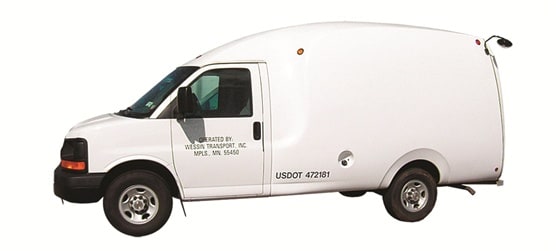
Many fleet managers have experienced a buying freeze on fleet vehicles and hybrid units aren't always an option. Wessin Transport is utilizing trucks upfitted by Unicell to decrease aerodyamic drag and reduce overall fuel consumption.
Low-Rolling Resistance Tires Can Save Fuel
Fleet managers already know under- or overinflated tires are detrimental to fuel efficiency and driver safety. However, recent studies prove the right set of tires can actually boost vehicle mpg. As tires roll along, they flatten against the road surface and then re-expand, generating heat and friction. The more resistance, the harder the engine has to work. Low-rolling resistance tires use precise design, advanced tread compounds, and manufacturing processes to minimize resistance and save fuel.
Just how much fuel they can save is still up for debate, but tests by the California Energy Commission, Society of Automotive Engineers, Consumer Reports, and others have found that switching to low-rolling resistance tires can result in a fuel efficiency improvement as low as 1 percent and as high as 5 percent.
Using Cab Fairings for Aerodynamics
Aerodynamic drag slows vehicles down and makes their engines work harder. That's why big rig operators install fiberglass cab fairings - also known as nose cones - to create a curved line between the top of the windshield and the leading edge of the trailer.
Can the same principle apply to medium-duty trucks? According to fleet managers Flesher and Payette, the answer is "yes."
Wessin Transport's Flesher recently began investing in trucks upfitted by Unicell Body Co. in Buffalo, N.Y. The company builds molded, all-fiberglass bodies with an integrated fairing for improved aerodynamics. Flesher has been impressed by the fuel savings - and the performance of the lightweight fiberglass shell.
"I've had a couple of these things actually roll over, and that didn't even crack the fiberglass," he said. "I thought the shell would have exploded. Not even close."
Staples' Payette also experimented with aerodynamics. After establishing a baseline of 8.5 mpg, he installed a $500 cab fairing on one of his fleet's N-Series delivery trucks. The truck's speed was not governed, and Payette told the driver to drive as he normally would. The N-Series for which the top speed had been limited to 60 mph consistently achieved more than 11 mpg. The truck with the cab fairing also achieved better mileage, but not as much.
"The one with the nose cone went a little above nine miles per gallon, so we did see some improvement," Payette said. "But, of course, the driver was still rattling down the highway at 70 miles per hour."
More Fuel
Fuel Prices Surge in September | September Fuel Update
September brought major fuel price swings, including diesel crossing $6 a gallon. Here’s how gas and diesel prices changed throughout the month, and where they stood heading into October.
Read More →
Turning Fleet Payment Data into Executive Insights
Ramel Lindsay of U.S. Bank Voyager discusses how fleets can transform payment and transaction data into actionable intelligence to reduce costs, improve oversight, and support executive decision-making.
Read More →
Why the IRS Raised Its Mileage Rate in the Middle of 2026
Fuel-price volatility drove the rare increase to 76 cents per mile, the fifth midyear adjustment since 2000.
Read More →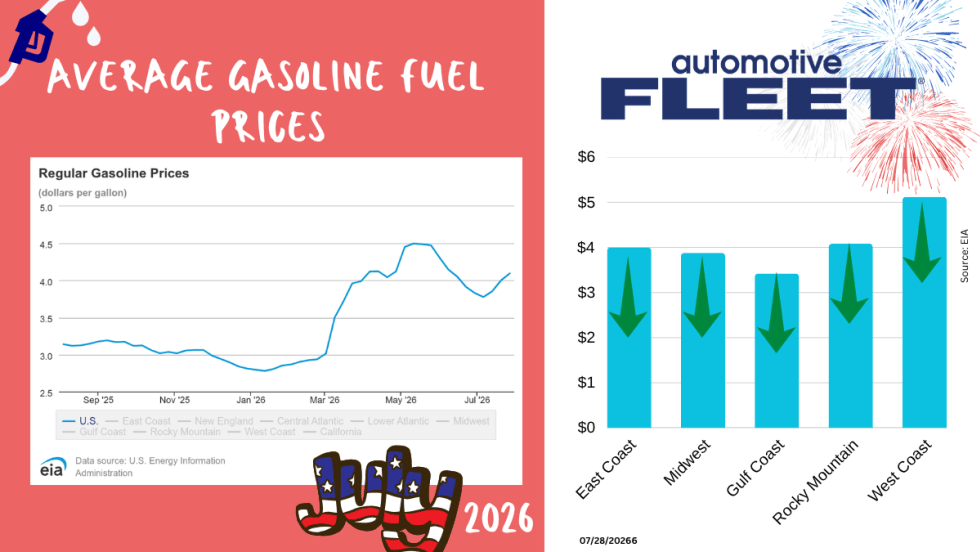
July Fuel Update: Prices Keep Rising in Light of More Conflict
Gas prices continue to rise as more and more conflicts do, too.
Read More →
Bob Adamsky on Fuel Volatility: "Don't Panic, Have a Plan."
When it comes to up and down fuel prices, Adamsky has a message for fleets: “Don’t panic.”
Read More →
How Fleets Can Gain Control of Non-Fuel Spend
Fuel often gets the spotlight, but non-fuel expenses can have a major impact on fleet costs. Ramel Lindsay of U.S. Bank Voyager discusses how fleets can gain better visibility and control over these often-overlooked expenditures.
Read More →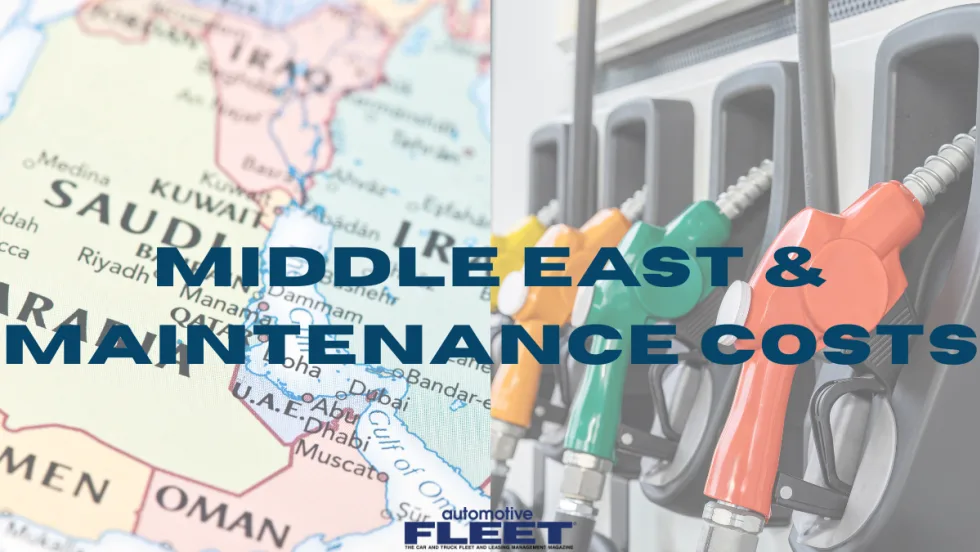
Fuel is Just the Start: How Middle East Tensions are Driving Up Fleet Maintenance Costs
The Middle East conflict is doing more than pushing up fuel prices. It’s also raising the cost of key maintenance products your fleet depends on, from motor oil to tires to windshield wipers. Here’s what you need to know about this budget-busting situation.
Read More →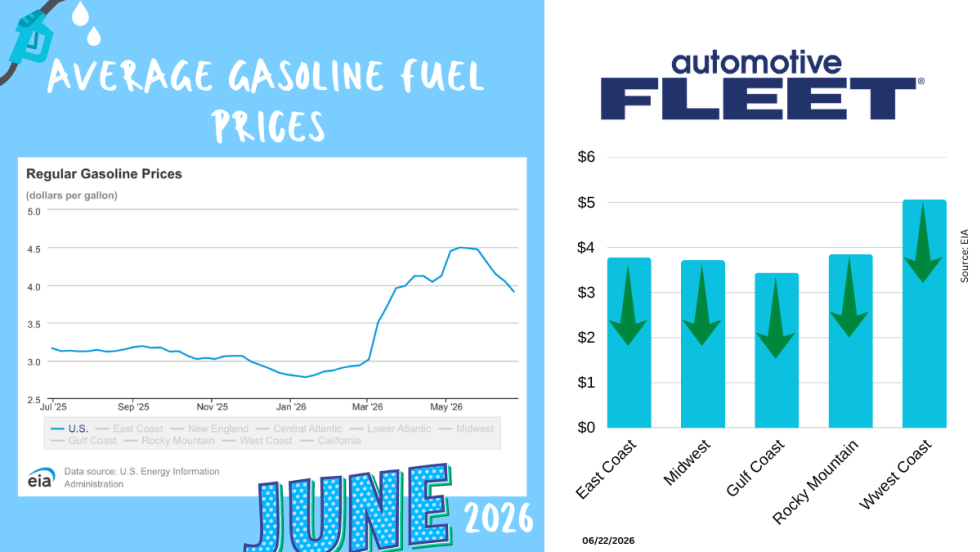
June Fuel Update: Prices Fall Below $4
Drivers are finally getting some relief at the pump. The national average gas price has dropped below $4 a gallon for the first time in months, with prices falling in 47 states as oil markets react to developments in U.S.-Iran negotiations.
Read More →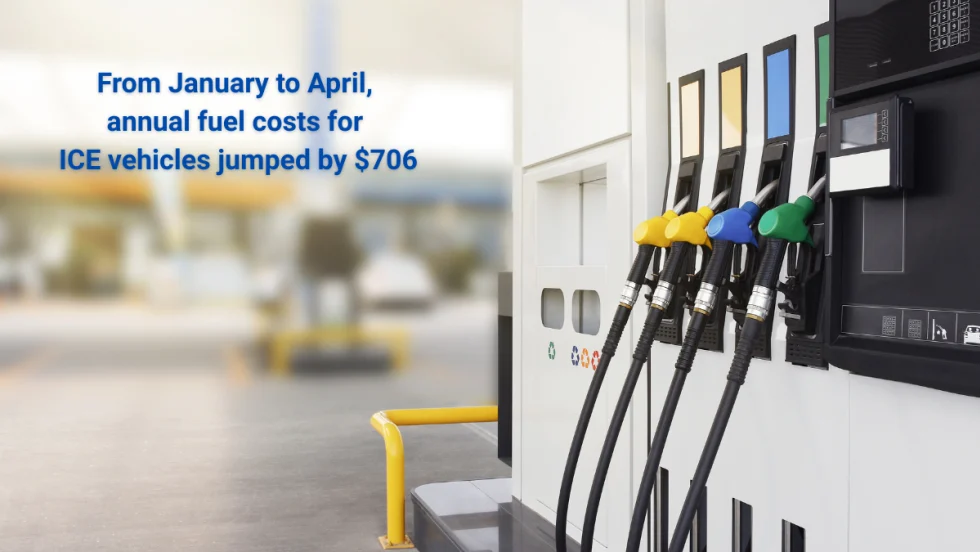
Study: How 2026's Gas Price Hikes Affect Different Vehicle Types
New data from iSeeCars reveals how rising fuel costs have affected different vehicle segments as gasoline prices climbed nearly 46% over the past four months.
Read More →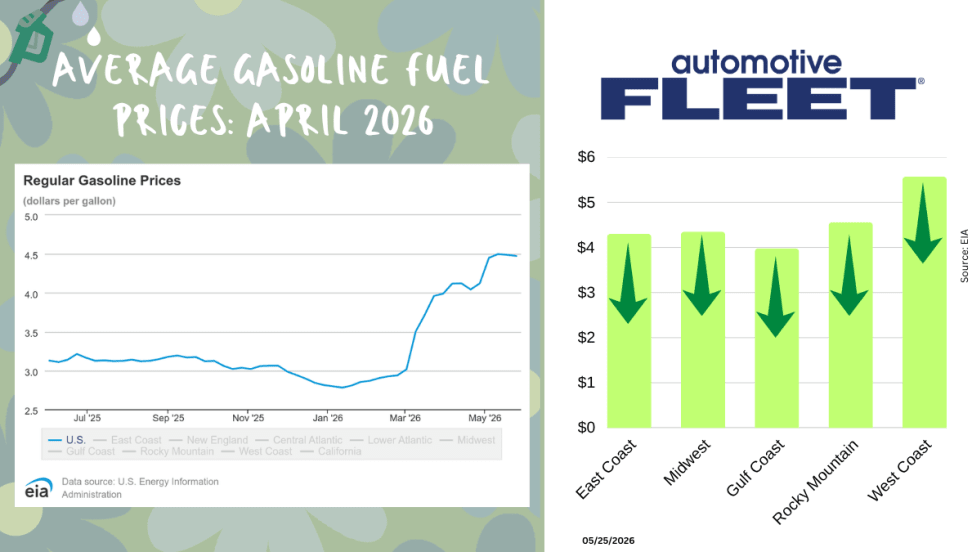
May Fuel Update: All Regions Experience Declines
Gas prices are finally easing in much of the country, but experts warn global tensions could quickly reverse the trend as the national average remains well above last month’s levels.
Read More →