




6 Keys to An Effective Cell Phone Policy
Employee education and managerial support are vital steps toward preventing the dangerous practice of distracted driving.



It shouldn’t take an accident followed by an expensive trial to convince businesses to implement effective policies on distracted driving. And, even if the company has a policy, it also shouldn’t take a distracted driving case to make the business enforce it.
David Bobrosky and Sue Bendavid are attorneys specializing in personal injury and employment, respectively, at the law firm of Lewitt, Hackman, Shapiro, Marshall & Harlan in Encino, Calif. Both cite that all too often employers wish they had implemented a policy after an accident occurs. “From the plaintiff side, that’s what we look for: Did they really enforce the policy?” Bobrosky said. “That’s what the Occupational Safety & Health Administration (OSHA) wants to see, too.”
Negligence in not effectively enforcing a policy will put the company’s fleet on the losing side, and cases are surfacing to prove it. In Ford v. McGrogan & International Paper, for example, a woman’s arm had to be amputated after a driver for International Paper allegedly rear-ended the plaintiff’s car while on a cell phone in 2008. The company had a policy banning employees from using cell phones while driving, but still had to pay $5.2 million to settle the case.
Cases where a company had a policy but an employee ignored it can be avoided.
Gaining Consensus
John Kenner, executive vice president of The Jankovich Company, a Southern California-based petroleum distributor, makes “safety first” the company’s mantra. Jankovich installed iZup in each of its 30 fleet vehicles. The smartphone software allows operators to control cell-phone use while on the road. The company has set the software to prohibit all cell-phone use, including hands-free. It consistently reviews data from iZup to ensure employees are using it correctly and not trying to override the control functions while driving.
Before implementing the software, Jankovich had extensive safety measures in place. For example, Kenner created an employee incentive program, where groups competed for a $250 bonus for being incident free. “Everyone got the bonus,” he said, adding that when he began implementing the safety tracking protocols he was sure to include the drivers in the discussions.
Employee response to the software and policy was “90-percent positive,” according to Kenner. “It has taken a little relief off the temptation to communicate while driving.”
Some worried the ban would affect dispatchers’ ability to change or cancel a delivery on the fly. Kenner countered: “I’d rather have [to wait] to turn the truck around than have the driver kill someone in Bakersfield for the efficiency factor.”
In fact, studies reveal the loss of productivity may be overblown. A 2009 National Safety Council (NSC) survey reported that 99 percent of companies that banned cell phone use while driving cited no decrease in productivity; many respondents actually experienced an increase.
Kenner said Jankovich underwent a similar change when it implemented the policy and software. Since iZup runs on smartphones, the company bought BlackBerrys for its drivers, who previously were issued basic flip phones. Drivers were now able to take advantage of the BlackBerry’s e-mail functionality for work tasks and updates while off the road. “At the end of the day, it addressed one thing, and then we got a secondary surprise because it pushed us into e-mail,” he said.
This type of safety technology implementation requires buy-in across the board. Matt Howard, co-founder and CEO of ZoomSafer, a Herndon, Va.-based developer of safe driving software for mobile phones, recalls one client that canceled the program after a month. “They had a revolt from their salespeople,” said Howard, who believes the main problem was the client’s failure in forewarning its employees and dictating the policy without any educational workshops or training sessions.
Dan Ross, CEO of Needham, Mass.-based Illume Software, the maker of iZup, partners with several organizations working to prevent distracted driving. “We try to address behavior, and you can change behavior with education,” Ross said.
Creating the Policy
The following steps will help prevent distracted driving in the workplace:
1 - Engage in internal communications. Tell employees that a cell-phone policy is going to be issued. Hold open meetings, show examples from other companies, and get feedback on appropriate penalties. Review distracted driving facts and show that top management supports it.
2 - Make safety part of your company’s credo. According to a Network of Employers for Traffic Safety (NETS) survey, companies with the lowest crashes per million miles (CPMM) issue monthly reports to their employees, track crashes, have safety-oriented messages throughout company statements and training, issue full bans on cell phones while driving, and share the details of any accident — whether or not it involves an injury — with the entire staff.
3 - Plan tracking protocols. How will your company keep track of employee cell-phone use? Besides considering safety software, employment and personal injury attorney Bendavid suggested reviewing call logs for company-issued phones.
4 - Write out a policy. Make sure to follow individual state laws. Assess severity of punishment: 83 percent of companies with low CPMM respond with disciplinary action, not just a warning, according to NETS, which also suggested implementing the strictest option: termination. Once the policy is finalized, send out an internal press release and a company-wide voicemail. Sample policies can be found at nsc.org and trafficsafety.org.
5 - Build staff buy-in. Having employees sign the policy is a good start, but it’s not enough. When introducing policy, use real stories of people who have been killed in distracted driving incidents. The official government website www.distraction.gov has videos and keeps track of distracted driving accidents and fatalities. Create and distribute a sheet explaining why the company has decided to implement the policy. Remind employees that signing the policy opens them up to liability as well; if they violate the policy, the company can take legal action against them.
6 - Enforce the policy. After education and buy-in, stick by their fleet’s measurement protocols and incentive programs, and keep employees in the loop about results. Gather survey information about individual productivity, especially since the effects are likely to be positive. Other tactics include reminders in fleet vehicles, such as NSC’s “Pull Over and Park” poster, and pocket cards for each employee with a summary of the policy. Make sure there are clear chains of command so there are alternative contacts if someone is on the road.
About the Author
Joanne Tucker is the associate editor for Business Fleet, Automotive Fleet’s sister magazine. She can be reached at joanne.tucker@bobit.com.
More Safety

Does Your Fleet's Culture Encourage Distracted Driving?
What happens when the people responsible for enforcing safety rules are the ones setting the wrong example? The answer may reveal why some of the biggest risks to fleet drivers have little to do with what's written in the employee handbook.
Read More →
Fleet Manager’s Ultimate Playbook: Navigating the New Standard in OEM Connectivity
Rising operating costs, driver safety concerns, and unplanned downtime are putting unprecedented pressure on modern fleets. Discover how fleet managers use embedded OEM connectivity and real-time vehicle data to cut TCO, prevent downtime, and protect drivers without aftermarket telematics hardware.
Read More →
From Driver Well-Being to EV Charging | AF News Recap
Mental health belongs in the fleet safety conversation. This week, we’re looking at five ways fleets can support employee well-being before a crisis, plus Holman’s expansion in Mexico, new one-day Fleet Forward passes, and why EV charging demand is outpacing infrastructure growth.
Read More →
Nexar-Nauto Merger Aims to Give Fleets Better Safety Intelligence Through Larger Driving Dataset
Stefan Heck tells Automotive Fleet that combining more than 10 billion miles of driving history with Nexar's AI models will give fleets deeper insights into driver risk and roadway conditions than either company could provide independently.
Read More →
Don't Wait for a Crisis: 5 Ways to Build Mental Health Into Your Fleet Safety Program
For Suicide Prevention Month, fleet and safety leaders have an opportunity to put mental health where it belongs: at the center of workplace safety.
Read More →
How Camera Data Can Strengthen a Fleet’s Insurance Renewal
Insights from a commercial insurance carrier and a broker show how fleets can turn video telematic data, driver coaching, and improved claims results into a stronger case at insurance renewal.
Read More →
The Safest Fleets Aren’t the Ones with the Most Technology
You’ve made the telematics investment. Here’s how to capture the other half of its value and build the safest fleet on the road.
Read More →
Hidden in Plain Sight: Fleet Compliance Risks
Fleet compliance isn't just about having policies — it's about consistently enforcing them. This practical guide reveals six hidden compliance risks common in public sector and shared fleet operations and outlines proven strategies to improve visibility, accountability, and audit readiness
Read More →
NETS Sets 2026 Fleet Safety Benchmark Conference for Indianapolis
The Sept. 15–17 program will feature fleet benchmarking data, case studies, emerging technologies, and implementation strategies while running alongside the NSC Safety Congress & Expo.
Read More →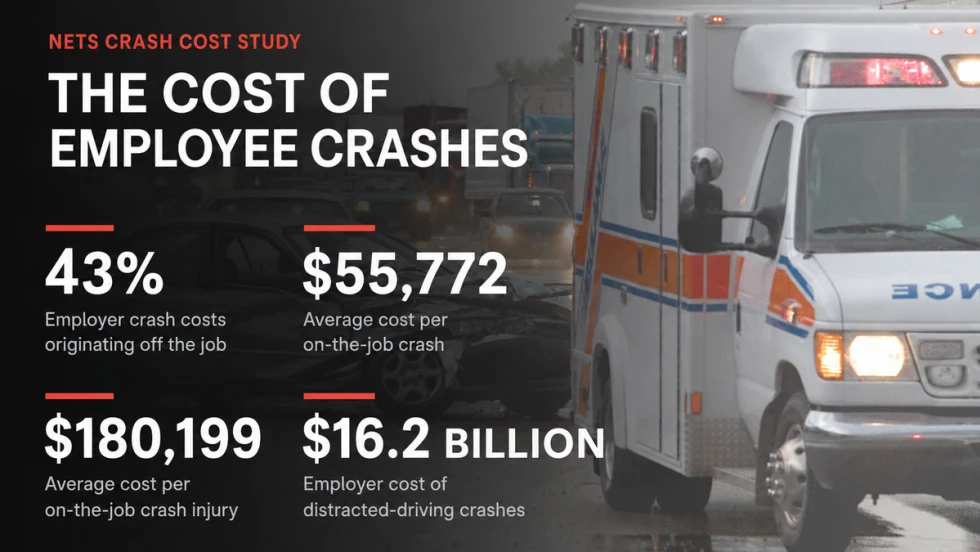
Off-the-Job Crashes Account for 43% of Employers’ $61.7 Billion Crash Burden
NETS quantifies costs dispersed across fleet, risk, HR, and other departments while providing new per-crash benchmarks for employers.
Read More →