




Keep Reading: Forecast for the 2015 Medium-Duty Truck Resale Market
2014 Forecast of Class 4-7 Truck Resale Market: Status Quo
After a steeper decline to start 2014, depreciation is expected to settle into the range of 1% to 1.5% per month for the rest of the year.
by Charles Pannunzio
September 2, 2014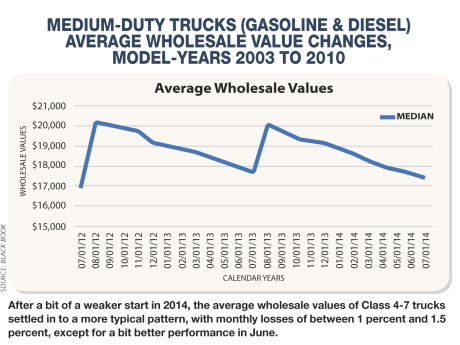
Credit: Black Book
4 min to read
In the absence of any dramatic change in the economy, resale values for medium-duty trucks will continue the slight decline experienced earlier this year.
Ricky Beggs, senior vice president and editorial director of Black Book, said everything he is seeing points to the status quo for buyers and sellers of used trucks.
“Of course, it’s always up in the air because you never know what’s going to happen going forward,” Beggs said. “But, just based on new orders, the volume of used trucks that are out there, and the activity that we see in the marketplace, we feel that depreciation levels will probably increase a little bit from what has been occurring.”
The average wholesale value of trucks in Classes 4-7 dropped 1% from July 1 to August 1, 2014, on the heels of a 1.1% dip from June to July, when the median value for trucks in model-years 2003 to 2010 was $17,446. The decline had been 0.7% between May and June.
“We think the level of depreciation for the rest of the year will be anywhere from 1% to 1.5% per month,” Beggs said. “And, that’s pretty much in line with what we saw in the first half of the year.”
The wholesale value of the 2003-2010 model-year trucks took a big hit in the first quarter of 2014, with the median price falling from $18,879 to $18,016. The drop over the intervening four months has not been as steep.
“So, you’ve got a little bit of movement that says the market is a little softer than it was (in June), but when you look at three or four or five months before that, it’s actually a better market than it was then,” Beggs said.
Get More Life from Vehicles
Fleet managers can squeeze more life out of vehicles when the economy dictates, according to Beggs.
“They’ll hang on to them, they will get by with a slightly older truck, they’ll put a few more miles on the vehicle, and they’ll work it a little harder than they might normally,” he said. “Even though the economy has picked up a little bit, which has helped the market somewhat, there are still some doubts out there. Is the economy as good as some people want it to be?”
A flurry of new orders at the end of 2012 led to a dip in used-truck prices. The month-over-month change was not nearly as dramatic in 2013 or the first half of 2014.
“And that was a sign when the economy first made its turn, and things started to pick up a little bit, and people just felt a little better. It was a case then that those trucks that they had been using had really gotten older,” Beggs said. “The industry was thinking, ‘You know what, we’ve got to replace some of these, we have a little bit of an uptick, let’s do it now.’”
That seems to be changing, Beggs said.
“Maybe that pent-up demand, that level of need has somewhat been met, so the market for orders has slowed down just a little bit,” he added.
One of the factors that makes the medium-duty truck market unique, especially in comparison to cars and light-duty vehicles, is that buyers are willing to cast a wider net to find what they want, Beggs said.
“Someone who is looking for a certain type of truck can put in that criteria and spread out the mileage or the range they are willing to look, and they can find the vehicles that they are actually looking for,” he noted. “And, in this market, where you don’t have as many to choose from, then they are not afraid to travel, and to go to those areas to find it.”
Effects of Wear & Tear
A bigger factor in the cost and desirability of trucks in this class is how they are used, Beggs said.
Something that has not faced heavy industrial use “might have a tremendous amount of life left in it in relation to a five- or six-year-old truck that was used in an oil field, that was used in a mining operation,” Beggs said. “That buyer there might think, ‘I can buy that five- or six-year-old truck that still has a tremendous amount of life in it because of how it was used, and put it in my oil field application and meet my needs.’ ”
Online sales are particularly attractive to buyers considering the distance they might have to travel to find what they are looking for, Beggs said.
“It is sight unseen as far as your eyes laying on it, but every one of these sales that they list vehicles online or they sell them online, or in conjunction with a physical sale, there is a pretty solid condition report that describes that vehicle,” he noted. “So, the confidence in the buyer is there because of that condition report, and it eliminates a little bit of that concern about sight unseen.”
Topics:Truck ValuesTruck ResaleBlack BookClass 7Truck AuctionRemarketingMedium-Duty TrucksClass 4AuctionsGlobal Fleet
Originally posted on Work Truck Online
Subscribe to Our Newsletter
More Global Fleet

Holman Takes Full Ownership of ARIZA in Mexico
Holman is bringing its Mexican fleet management operation fully under its own brand after more than 30 years as a joint venture. The change gives multinational fleet customers a single Holman operation across the U.S., Canada, and Mexico.
Read More →
Proven Ways to Reduce Work Truck Downtime
The age-old problem of downtime will always be a reality, but with new strategies at hand, fleets have more ways to keep trucks on the road longer.
Read More →
Sponsored•July 23, 2026
The Top 300 Commercial Fleets
The Top 300 Commercial Fleets: See the List
Read More →

Cameras, Safety and Insurance: From Reactive Claims to Real-Time Prevention (Part 2 of 2)
Part Two: Commercial auto remains one of the most challenging and costly lines of coverage for fleet operators and insurers alike. Continue learning more about how to effectively address these issues from Onur Aksan, Enterprise Business Development Executive, Geotab
Read More →
Cameras, Safety and Insurance: From Reactive Claims to Real-time Prevention
Commercial auto remains one of the most challenging and costly lines of coverage for fleet operators and insurers alike. Learn more about how to effectively address these issues from Onur Aksan, Enterprise Business Development Executive, Geotab.
Read More →
Sponsored•May 6, 2026
Fleet Costs Are Rising: Here’s How Leaders Are Responding
Fleet leaders are under pressure to reduce costs, adapt to economic uncertainty, and make smarter decisions. See how peers across North America are responding with real data, proven strategies, and forward-looking insights. Download the 2026 Market Pulse Report to benchmark your strategy and uncover where you can gain an edge.
Read More →
Enterprise Fleet Management Surpasses 900,000 Vehicles in U.S. & Canada
Enterprise Mobility connects with mobility solutions around the globe
Read More →
Sponsored•October 14, 2025
Automotive Fleet's Guide to Fleet Electrification
Unlock the secrets to a successful transition to electric fleets with Automotive Fleet's comprehensive Fleet Electrification Guide!
Read More →
Sumitomo Rubber Industries to Acquire Viaduct
Viaduct will join Sumitomo as an independent subsidiary. Partnership strengthens global reach and accelerates AI-driven innovation for fleets and manufacturing.
Read More →