





Related Article: Why Used Vehicle Values Will Not Crash
10 Predictions for the 2022 U.S. Vehicle Market
The Cox Automotive Insights team looks at key industry trends ahead that overall point to a healthy year.
January 13, 2022
Vehicle inventory will continue to be challenged in the first half of 2022 but should improve in the second half. Unlike 2021, the second half of 2022 will likely be stronger than the first half.
Source: Cox Automotive
6 min to read
The Cox Automotive Industry Insights team outlined 10 trends on Jan. 13 that they predict will shape the auto industry in the year ahead, giving reasons for industry optimism.
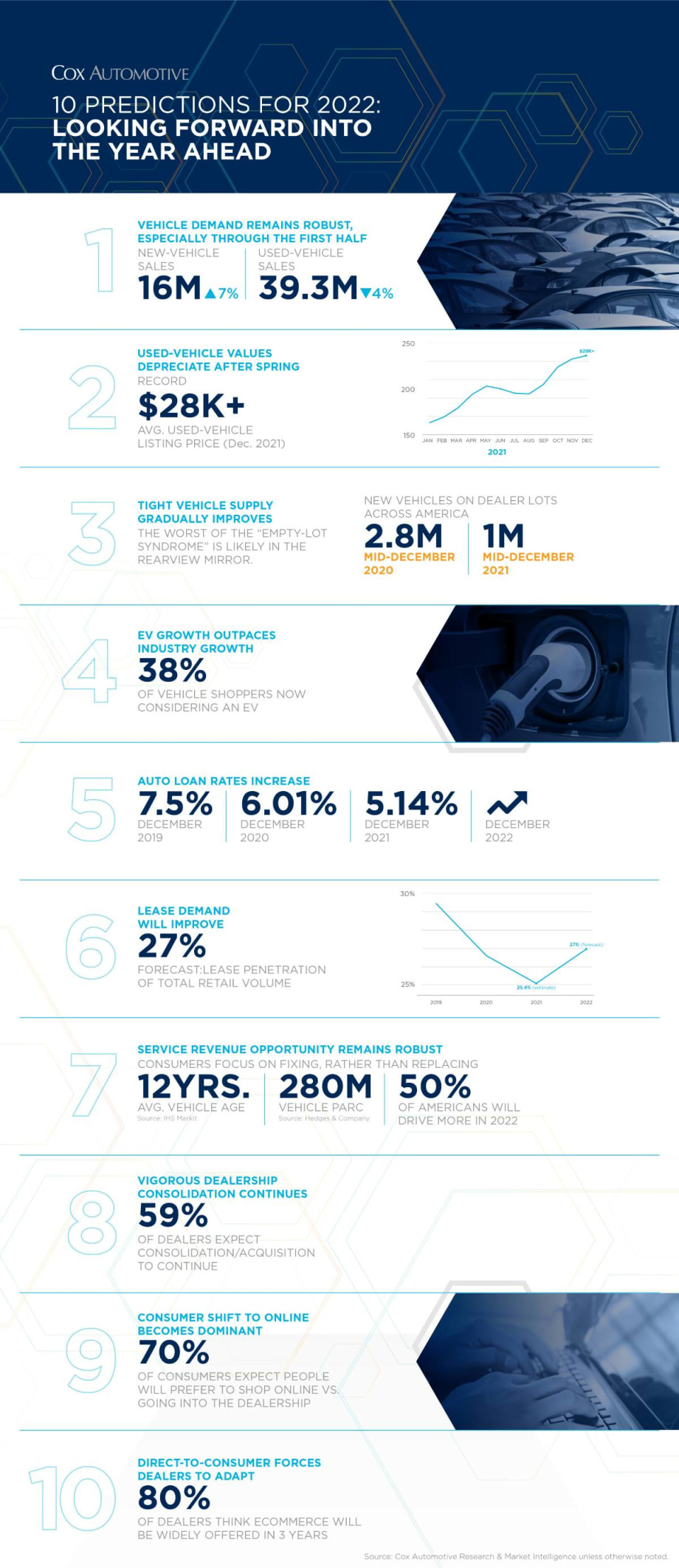
New-vehicle sales are expected to reach 16 million, an increase of more than 7% from 2021, while used-vehicle sales will remain strong and above 39 million. Inventory will continue to be challenged in the first half of 2022 but should improve in the second half. Unlike 2021, the second half of 2022 will likely be stronger than the first half.
When it comes to crystal balls and predictions, however, even the Cox Automotive Industry Insights team knows that looking forward and into the future is never easy.
“As we move into 2022, our team has a number of expectations for the industry,” notes Cox Automotive Chief Economist Jonathan Smoke, in a news release. “We believe the auto business is in for a healthy year. Yes, there will be unexpected pitfalls, but those who remain flexible and agile will manage just fine in the year ahead.”
The Cox Automotive Industry Insights team will be particularly focused on these 10 trends, summed up in a recent news release, that will shape the auto business in 2022.
#1: Vehicle Demand Will Remain Robust, Especially Through the First Half
While the pandemic has been rough on many U.S. consumers, there is sufficient demand in the market to support healthy new- and used-vehicle sales in the year ahead. Recent surveys indicate consumers are expecting higher vehicle prices in 2022, but enough buyers will be in market to support 16 million new-vehicle sales, according to the Cox Automotive 2022 forecast. Total used-vehicle sales are forecast to be 39.3 million, down slightly from 2021 but still a healthy volume.
#2: Used-Vehicle Values Will Depreciate Again, After the Spring
Last year, with new-vehicle inventory historically low, used-vehicle demand increased notably, driving prices higher. At auction, used-vehicle values set new records in each of the final four months of 2021, according to the Manheim Used Vehicle Value Index. Retail prices followed, with the average used-vehicle listing price above $28,000 in December 2021, a record. Used-vehicle prices normally increase in the spring, so the market will see further gains. In the second half of 2022, however, the team is forecasting price increases to end, and a more normal pattern of depreciation to resume.
#3: Tight Vehicle Supply Will Gradually Improve
The central story for the auto industry in 2021 was tight inventory. Supply chain disruptions and production slowdowns due to COVID outbreaks wreaked havoc on product availability, and never in memory was new-vehicle inventory lower. In the second half of 2021, inventory was roughly one-third of the pre-pandemic level, dropping below one million units. The process will be slow, but the Cox Automotive team believes new vehicle inventory issues will gradually improve in the year ahead: The worst of the ‘empty-lot syndrome’ is likely in the rearview mirror.
#4: EV Growth Will Outpace Industry Growth
While the overall new-vehicle market struggled in 2021 and was up only 3.5% from a rough 2020, the market for electrified vehicles boomed. Hybrids, plug-in hybrids and pure battery electric vehicles sales surged, with new entries and plenty of newly interested buyers. Tesla is still the dominant brand in the pure EV market, but new product from Ford, Hyundai, Kia, Volkswagen and Volvo are driving solid growth. Gas prices are elevated going into 2022, and 38% of new-vehicle shoppers are now considering an EV. In 2022, further strong growth is expected, especially as high-profile EV pickups begin to enter the market. Production of the new Rivian RT1 pickup is underway; the Ford F-150 Lightning is scheduled to be on the road by spring.
#5: Auto Loan Rates Will Rise
Low auto loan interest rates have helped take the sting out of rapidly rising vehicle prices. Unfortunately, the end is near. Inflation is at the highest level since 1982, and the Federal Reserve Bank is ready to address that with expectations for three, quarter-point rate increases in 2022, followed by three in 2023 and two more in 2024. Generally speaking, the Cox Automotive team expects auto loan rates to be higher by the end of 2022. From a historical perspective, rates would still be low and attractive. However, the increase would mean an end to the 2021 financing trend that helped mitigate some of the vehicle price inflation.
#6: Lease Demand Will Improve in 2022
Lease penetration of the retail market had moved above 30% in 2019 but has been notably lower through the pandemic and below 25% in the second half of 2021, the lowest point since 2013. The Cox Automotive team is forecasting the share of leases will increase as inventory rebuilds and consumers hunt for ways to lower monthly payments. In a recent Cox Automotive survey, 69% of consumers agree that the average price will increase to where new vehicle ownership is out of reach for the average consumer, up from 51% in 2021. Leasing may offer a solution for some, with lower monthly payments. An increase in leasing in 2022 will help the used-vehicle market mid-decade as well.
#7: The Service Revenue Opportunity Will Continue To Be Robust For Dealers
The average vehicle on the road today is more than 12 years old, according to research firm IHS, and the vehicle parc (all registered vehicles within a defined geographic region) is at a record level, in excess of 280 million. With new-vehicle prices higher than ever, research from Cox Automotive indicates more consumers will be focused on fixing, rather than replacing. Further, while the traditional commute may be a thing of the past, our research shows that 50% of Americans expect to drive more in 2022 than they did last year — avoiding public transportation, driving instead of flying, returning to a hybrid work situation. With the added miles, service visits are expected to increase as well. All-in-all, the service lanes should continue to be an important part of the franchised dealer business equation.
#8: Robust Dealership Consolidation Will Continue
While dealership profitability soared in 2021, so did consolidation activity. Tight inventory and rising costs are leading auto dealers to reassess their competitive position and consider the benefits of becoming part of a larger operation. Larger dealer groups have better access to capital, technology and human resources, many experts suggest. According to Cox Automotive research, 59% of dealers expect the consolidation or acquisition trend to continue in the year ahead. This story is far from over and will be one to watch carefully in 2022.
#9: Consumer Shift To Online Becomes Dominant
While the global COVID pandemic has turned life upside down, it has in fact made the vehicle-buying process more satisfactory. In recent Car Buyer Journey studies from Cox Automotive, two trends are clear. First, consumers are completing more car-buying steps online. Second, overall satisfaction with car buying, and specifically, satisfaction with the dealership experience, has improved. Importantly, consumer preference for online shopping is not expected to wane this year, with 70% of consumers preferring to shop online versus physically going into a dealership, essentially unchanged from 2021.
#10: Direct-To-Consumer Model Will Force Dealers To Adapt
It began in earnest with Tesla’s direct-to-consumer sales model, with no franchised dealerships. In 2021, Tesla delivered more than 300,000 vehicles in the U.S. And now comes Lucid, Rivian and others, additional start-up EV companies following Tesla’s lead. The traditional dealership model in the U.S. is strong and providing a high level of satisfaction among buyers as the sales process becomes increasingly digital, according to recent surveys. Most consumers value access to a franchise network. Still, the Cox Automotive team believes the industry — and national franchise laws — will continue to evolve in ways that ultimately improve efficiency and consumer satisfaction. That evolution will include an increase in direct-to-consumer vehicle sales.
Originally posted on Vehicle Remarketing
Subscribe to Our Newsletter
More Operations
Here's When You Should Make an Exception to Fleet Policy
Fleet policies are designed to create consistency, but not every driver or situation fits neatly within standard rules.
Read More →
AI-Native or AI-Acquired: What Should Fleet Managers Look for in an AI Platform?
Six questions can help fleet managers look beyond AI marketing claims to evaluate integration, data access, and real-world operational performance.
Read More →
Sponsored•October 14, 2026
A buyer's guide to fleet management software in 2027
Buying fleet management software in 2027 means looking beyond features and price. As fleet operations, technology and expectations evolve, this guide explores what today’s fleet professionals should consider when choosing a system that can deliver value now and adapt to what comes next.
Read More →

What Will Shape the Next Era of Fleet Management?
EVs, AI, and autonomous vehicles are reshaping fleet management. Discover what’s ahead—and how fleet leaders can prepare for the next era.
Read More →
How Fleets Can Recruit and Train Veterans for Technician Roles
Here's how the technician shortage has affected uptime for fleets, and what to do about it.
Read More →
Avis Budget Group Deploys Neology Toll Management Technology Across Major Brands
Neology’s neoFleet platform will manage toll transactions and toll-authority operations for vehicles across Avis, Budget, Payless, Budget Truck and Zipcar.
Read More →
Fleet Personal-Use Charges Edge Higher in 2026
Nearly eight in 10 surveyed fleets allow personal use of company vehicles, while just over half of respondents report charging employees for the privilege.
Read More →
The Future of Fleet + What’s Changing Right Now | AF News Recap
Could developments overseas offer a preview of what’s coming for U.S. fleets? This week, we’re looking at the future of AI, autonomy, and electrification, plus Ford Pro’s new certified pre-owned program, smarter vehicle offboarding, and a new way for fleets to manage toll expenses.
Read More →
How to Handle Vehicle Offboarding
What do fleet managers need to do when a driver leaves?
Read More →
Sponsored•October 1, 2026
Fleet Manager’s Ultimate Playbook: Navigating the New Standard in OEM Connectivity
Rising operating costs, driver safety concerns, and unplanned downtime are putting unprecedented pressure on modern fleets. Discover how fleet managers use embedded OEM connectivity and real-time vehicle data to cut TCO, prevent downtime, and protect drivers without aftermarket telematics hardware.
Read More →