MUNICH, GERMANY - BMW packed the new 7-Series sedan with optional gadgets ranging from radar-assisted cruise control to blind spot detection.
by Staff
October 26, 2009
5 min to read
MUNICH, GERMANY - BMW packed the new 7-Series sedan with optional gadgets ranging from radar-assisted cruise control to blind spot detection. There's even a heads-up display. Pick all the high-tech options and you'll add $26,000 to the car's already hefty price tag. But the coolest feature is the new night-vision system that likens a twilight drive to a Special Forces recon mission.
The Night Vision with Pedestrian Detection system significantly advances the first-gen system found in the last 7-series by adding people-spotting technology that distinguishes between animals and humans. The system was developed by the Swedish firm Autoliv Electronics. It is the latest evolution of technology that Lexus and Mercedes-Benz also have offered since Cadillac brought it to the automotive sector in the 2000 Deville sedan.
Ad Loading...
Since then, thermal imaging has made way for far- and near-infrared cameras that detect even the smallest changes in temperature. BMW's passive system uses far-infrared technology to scan for heat, whereas Mercedes' near-infrared system illuminates the road with projected infrared light. The BMW system stands apart for its extreme depth, clarity in rain and ability to minimize extraneous information. Despite the added safety such systems offer, Cadillac and Lexus dropped them because few people bought them. But BMW, like Mercedes, still sees a market for it.
The system does a great job of helping you see in the dark, but it is not without flaws.
BMW isn't suggesting drivers switch off their headlights. The $2,600 option compliments the 7-Series' adaptive headlights, which follow your steering inputs to help you see around that turn. The system provides a crisp, clear picture of 1,000 feet of pavement ahead of you, a distance Autoliv says is twice the range of the headlights. That can mean the difference between avoiding that deer and totaling your $110,000 Beemer Bimmer.
"The new system is like an extra set of eyes - a very complex processing unit is constantly monitoring video of the road ahead," says Stuart Klapper, night vision business director at Autoliv.
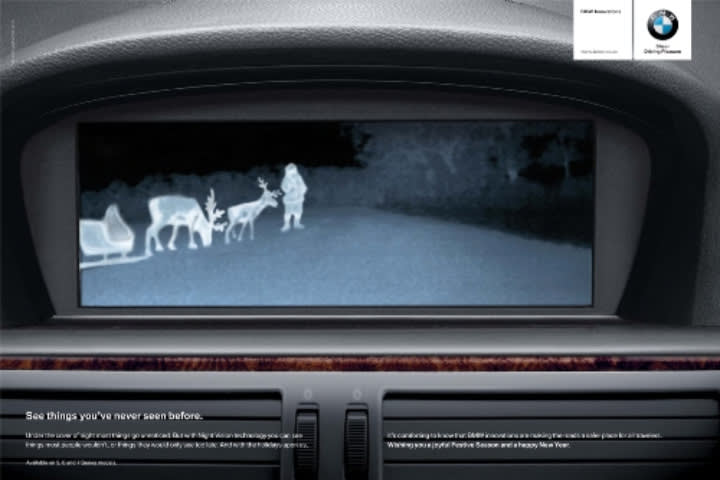
A silver dollar-size far-infrared camera in the grille detects the temperature of everything ahead. A computer converts the data into an image (shown at right) that appears on the dashboard's i-Drive navigation display. Warmer objects like a pedestrian or moose are white, while cooler objects like a parked car are black. The pedestrian-detection feature kicks in when the car exceeds 25 mph, scanning the road 10 to 100 yards ahead of you. Pedestrians appear with a yellow tint, helping you figure out if that dark shape is a kid on a bike or a dog in the road. The system also monitors your speed and trajectory to warn you if you're on a collision course.
Ad Loading...
BMW designed the system to account for country and city driving conditions. When driving at slower speeds in the city, where higher pedestrian traffic is expected, the system monitors a smaller area ahead of you so it isn't warning you about the drunk staggering across the street three blocks ahead.
We tested the system during a weekend in Manhattan and the Berkshire Mountains, about 150 miles from the Big Apple. We did more than 500 miles behind the heated, leather-wrapped steering wheel of the big Bimmer and have mixed feelings about the system's execution.
The system is remarkable for the crisp, clear picture that it projects. It's like watching a black and white movie on a nice TV. The more time you spend with it, the more you appreciate how well it highlights everything from a couple walking down the street to an oncoming car. Things you couldn't see through the windshield appear clearly and vibrantly on the screen. This was particularly helpful driving a tight country road. A motorist had pulled over on the side of the road and, thanks to the bright image on the screen, was easily spotted. That might have prevented an accident.
That said, the system provided a few false warnings on the run from Sandisfield, Massachusetts, to Becket on Route 8, a winding road with plenty of tight turns and blind corners. It's exactly the kind of road where you'd want the system to work flawlessly, yet it continued to warn of dangers that weren't there. We suspect that, as the car rounded a corner and its nose pointed ever-so-briefly away from the road, the sensors detected something at the side of the road.
"It is possible that an animal or another warm object may have triggered the alert. In the 7-series, a false warning can occur," Klapper says. "In the new 5-series, we have fine-tuned the warning algorithms to eliminate most false warnings."
Ad Loading...
That's all well and good, but the one time a deer did cross our path, there was no warning because we weren't going fast enough to activate the pedestrian/animal warning. But we did find that the system is far more effective - and useful - in the city.
The biggest problem is that you have to take your eyes off the road to use it. You have to wonder why the display wasn't mounted closer to the driver's line of sight as it is in Mercedes S-Class models with Night View Assist Plus. Klapper says BMW wanted to take advantage of its high-resolution iDrive navigation display. That may be, but it detracts from any safety advantage the system might provide.
BMW's done a good job advancing in-car night vision, but it remains to be seen whether consumers will embrace it with the same fervor as navigation systems and voice-activated controls. The technology's future isn't as clear as the image on the screen in the car.
A side-by-side comparison of what you see through the windshield and what you see on the i-Drive screen.
Fleet drivers face constant visual, cognitive, and environmental interruptions the moment they hit the road. From roadside chaos to mental fatigue and digital overload, today’s biggest driving risks often come from outside the vehicle itself.
FLASH Weather AI has launched a first-of-its-kind hail prediction model capable of forecasting hail size and arrival time at 1-kilometer resolution up to 55 minutes ahead, giving fleets and insurers critical time to prepare for severe storms.
As litigation risk rises, vehicles are increasingly targeted. This Coca-Cola bottler shares how it’s reducing exposure through driver training, technology, and a proactive risk management approach.
From identity management to third-party certifications, the right technology partner should make security easier to manage. Here are the three building blocks that fleet managers need to stay in control as connected systems scale.
Distracted driving remains one of the most persistent risks in fleet operations. New approaches focus on removing mobile device use entirely while adding real-time safety support.
As distraction risks evolve, fleets are turning to smarter, more connected technologies to better understand what’s happening behind the wheel. Part 2 explores how these tools are helping identify risky behaviors and improve visibility across operations.
Distracted driving is often measured by what we can see—phones in hand, eyes off the road. But what about the distractions we can’t? A recent incident raises a bigger question about awareness, attention, and why subtle risks so often go unnoticed.