GM’s Ed Peper Discusses the Commercial Fleet Market
Peper talked about GM’s re-entry into the low-cab forward market, along with its suite of other commercial products. He reaffirmed continued production of Express/Savana, as evidenced by new powertrain upgrades in the pipeline.
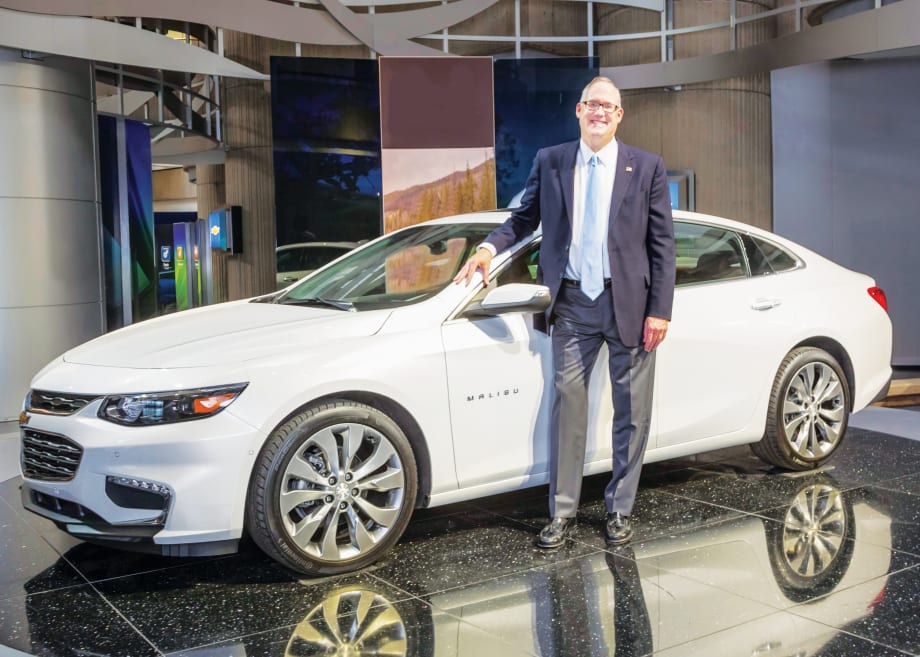
Photo of Ed Peper by a 2016 Chevrolet Malibu courtesy of General Motors.
7 min to read
Photo of Ed Peper by a 2016 Chevrolet Malibu courtesy of General Motors.
Chevrolet now offers seven low-cab forward medium-duty trucks in the U.S.
Ad Loading...
The seven new models — Chevrolet 3500, 3500HD, 4500, 4500HD, 4500HDX, 5500HD, and 5500HDX — are based on the Isuzu N-Series, which General Motors will procure from Isuzu and distribute through Chevrolet dealers.
Ad Loading...
In addition to the new low-cab forward trucks, Chevrolet’s fleet and commercial choices include the full-size Silverado lineup, the Silverado 2500HD and 3500HD full-size chassis cab models, and the mid-size Colorado, as well as the City Express small van and Express/Savana full-size vans.
At the recent Work Truck Show in Indianapolis, AF had an opportunity to sit down with Ed Peper, vice president of General Motors Fleet, to discuss the commercial fleet market.
AF: What is your assessment of today’s commercial truck market?
Peper: It continues to be strong. We see a lot of opportunities in the commercial truck market.
I like the way General Motors Fleet is positioned and the way we’re tackling the market right now. Our strategic and focused approach for the commercial and government segments is centered on selling value. This approach is based on great products, innovative business solutions, and providing the most exceptional customer experience we can provide. In other words, the customer is at the center of everything we do.
Ad Loading...
I am also very pleased that General Motors Fleet, and namely Chevrolet, is back in the medium-duty truck market. We have formed a newly created medium-duty truck advisory board comprised of 10 of our commercial dealers. In fact, we met this morning, and then we walked the show with them. This advisory board is really going to help us with their insight as we come to market with our new medium-duty products.
At A Glance
Chevrolet offers seven low-cab forward medium-duty trucks in the U.S. that are sold at more than 200 Chevrolet dealers.
A cornerstone to GM’s fleet truck strategy is its three-truck portfolio, which also includes the Chevrolet Silverado and GMC Sierra full-size light and heavy-duty pickups, and the mid-size Chevrolet Colorado.
The long- and short-wheelbase models in the 2500 and 3500 series for the Chevrolet Express and GMC Savana now offer the 2.8L Duramax turbo-diesel with an 8-speed transmission.
AF: Which dealers will sell the medium-duty product?
Peper: Chevrolet dealers only. We have signed over 200 dealers, literally in all the market-places that we need to be in, with great geographic coverage to make sure we take care of the customers.
We’re talking to many different prospective customers about buying our medium-duty products. We will have product on the ground in August and we will be very active in the marketplace. It will be very exciting to see the Chevrolet bowtie on medium-duty products again.
AF: Where do you see the low cab forward models fitting in the market? What vocational segments are you targeting?
Ad Loading...
Peper: First of all, the low cab forward product is a very good vehicle for use in urban settings. Delivery and service fleets will love this product.
In addition, you will see a lot of landscaping companies, particularly in major markets, wanting this low cab forward truck. The maneuverability and driver visibility of this product is absolutely great.
We are excited to offer our Chevrolet 3500, 4500, and 5500 series medium-duty trucks. Our dealers love the size of these vehicles and what they offer in terms of the various vocations that they will be sold to. They love the capability and the GVW that we’re going to be able to provide with these products. It’s going to be really exciting.
The attractive thing about the low cab forward is we’re going to be the only domestic competitor in the marketplace that’s offering a low cab forward truck. We think the low cab forward series has tremendous opportunity, particularly in larger cities where maneuverability and parking is very important.
AF: Do you see market growth in the medium-duty segment?
Ad Loading...
Peper: We do. We’ve seen very good growth in the 3500, 4500, and 5500 segments. We’ve also seen nice growth within the low cab forward segment.
In general, the light-duty truck market, for the last year, was one of the hottest markets in the United States. In addition, our trucks, and crossover sales were up last year. We continue to see a lot of opportunity within the truck and crossover markets.
We’re very strong in the truck segment with our Chevrolet and GMC brands.
AF: Do you foresee crossovers as a growing segment in the commercial fleet side of the business?
Peper: As we look at our growth last year, we had great growth in large pickups as we were up 26% year-over-year.
Ad Loading...
We are the market leader in mid-pickups with a 37% market-share. We beat both Nissan and Toyota. And, of course, Ford and FCA don’t have entries in this segment.
We had over 20% year-over-year growth with our small utilities, the Chevrolet Equinox and the GMC Terrain. Our mid-SUVs — Chevrolet Traverse and GMC Acadia — had solid growth of 13% year-over-year. We are seeing a steady uptick in small utilities and our mid-SUVs.
We see the commercial truck business as far more than just pickups and vans, although they are a huge part of it.
We are also getting very aggressive and focusing on increasing our car sales to fleets. We have the brand-new Malibu that is entering the market right now and we are aggressively selling against and targeting the Fusion in the mid-car segment.
We have had many larger companies who have expressed keen interest in our new Malibu. They are interested because of the Malibu’s looks, the value and the fuel economy of the standard 1.5L, four-cylinder turbo engine. With a combined city and highway fuel economy of 31 miles per gallon, we have a huge advantage to sell over the competition. The Malibu has a fuel economy advantage when compared to the Fusion, which impacts the total cost of ownership in favor of the Malibu. We’re really looking forward to getting more Malibus into the market.
Ad Loading...
Plus, we have a brand-new Chevrolet Cruze that is coming. We’ve sold thousands of Cruzes during the past few years. It’s a very good vehicle for the health and healthcare industry. Even some pharmas have gone from mid-size cars to smaller cars, such as the Cruze.
AF: What do you see happening in the minivan and full-size van market?
Peper: We’ve had really steady sales with Chevrolet City Express. The City Express has been a solid addition to our portfolio. There are a variety of different companies buying the City Express, such as delivery services, catering companies, and bakeries. For our full-size vans, we were very excited to announce at the Work Truck Show, that the 2.8L Duramax turbo-diesel will be offered with an 8-speed transmission and will be available on long and short wheelbase models in the 2500 and 3500 series for the Chevrolet Express and GMC Savana Passenger and Cargo vans. This is the first small diesel engine that is offered in a traditional, body-on-frame, full-size van.
There may be companies out there thinking how much longer are they going to build the Chevrolet Express and GMC Savana full-size vans? We hopefully have sent the message that we have powertrain upgrades coming in the future for both. Many companies prefer the body-on-frame architecture of Chevrolet Express and GMC Savana.
We will continue to improve the fuel economy and product features in the Chevrolet Express and GMC Savana. I like the size of our vans. I like the tried-and-true capability and durability of these vehicles. In addition, we’re always looking at ways we can be disruptive in the van segment. There’s a lot going on and this segment is obviously very important to us.
Ad Loading...
Within the full size van segment we continue to see increased demand for our cutaways. We have several major customers that consistently purchase from us, for many of the reasons I previously mentioned; dependability, durability, and total cost of ownership.
AF: When you look at being disruptive would that be with another van, would it be bigger than Express or smaller than the City Express?
Peper: I think there’s an opportunity to be very disruptive within the van market. We always have multiple future product plans on the drawing board, and we will continue to pursue all opportunities to increase our market share and increase sales, while continuing to build our portfolio. I can’t comment specifically about future products, but I can tell you that we are going to continue to be disruptive in this space.
AF: What do you think about the compact SUV market? Do they have a place in commercial fleets?
Peper: Once you get below the size of the Chevrolet Equinox and GMC Terrain, it’s a bit more selective. Although, we are finding we’re getting more interest in the new Chevrolet Trax, which is just below the size of Equinox and Terrain. I think when companies have a choice between a compact and small utility, they’re going to pick the Equinox and Terrain.
Ad Loading...
AF: Where is the fleet interest coming from for the Trax?
Peper: Pharma is one, because they’re driving all day long. They need to have reasonably good capacity in the back to carry samples and other materials. But more customers are starting to consider compact SUVs as a good, economical and useful vehicle option.
General Motors Fleet has a variety of vehicle options available to fleets. We’re giving customers a choice of 60 different vehicles to take a look at across our portfolio. We have a tremendous amount to offer to any fleet, any size.
Neology’s neoFleet platform will manage toll transactions and toll-authority operations for vehicles across Avis, Budget, Payless, Budget Truck and Zipcar.
Nearly eight in 10 surveyed fleets allow personal use of company vehicles, while just over half of respondents report charging employees for the privilege.
Could developments overseas offer a preview of what’s coming for U.S. fleets? This week, we’re looking at the future of AI, autonomy, and electrification, plus Ford Pro’s new certified pre-owned program, smarter vehicle offboarding, and a new way for fleets to manage toll expenses.
Rising operating costs, driver safety concerns, and unplanned downtime are putting unprecedented pressure on modern fleets. Discover how fleet managers use embedded OEM connectivity and real-time vehicle data to cut TCO, prevent downtime, and protect drivers without aftermarket telematics hardware.
ADAS-equipped vehicles may crash less often, but they can cost more when they do. This week, we’re breaking down what that tradeoff means for fleets, plus Subaru’s first Forester Wilderness Hybrid, Nissan’s new e-POWER Rogue, and why Calstart has become Catalyst Mobility.
Iorillo brings nearly 20 years of fleet management and sales experience to the role, including previous positions at Element Fleet Management, CEI, Donlen and Ryder.
Where will fleet’s next generation of leaders come from? This week, we’re looking at the industry’s talent pipeline, what certification can add to a fleet career, how to build an award-worthy track record, and the return of Automotive Fleet’s Personal Use Survey.