





Why Are Compact Trucks Popular in Fleets?
Compact Vans Fill the Urban Need
The smaller size of compact work vans fit in more compact urban environments, while still providing abundant cargo capacity and myriad configurations for vocational fleet requirements.
April 12, 2016
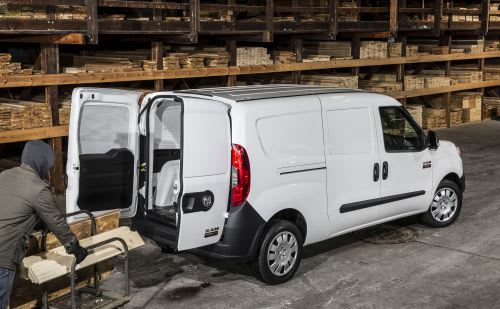
The ProMaster City is Ram’s Class 1 van offering available in four versions and featuring a standard, 9-speed automatic transmission.
PHOTO: FCA US
6 min to read
There are five compact van models new and improved for the 2016 model-year. If you are looking to a cargo hauling alternative to a pickup truck, look no further.
Work Truck magazine breaks down the van models into what matters most for vocational fleet manager needs.
Chevrolet City Express
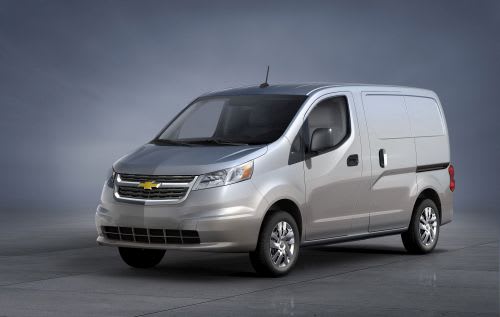
The City Express’s cargo area is designed to accommodate large and bulky items, with 4 feet x 6 inches of space from side wall to side wall.
Photo: GM
The 2016 Chevrolet City Express is offered in two trims — LS and LT — and offers 122.7 cubic feet of customizable cargo space, a turning diameter of only 36.7 feet, and a payload capacity of 1,500 pounds.
The City Express’s DOHC 2.0L, I-4 engine with variable valve timing (VVT) is rated at 131 hp and 139 lb.-ft. of torque.
Standard features include dual rear sliding doors, power windows, 40/60 split rear cargo doors that open 90 and 180 degrees, solid rear doors with available tinted-glass windows, center console storage with a standard file folder bin, fold-down mobile workspace passenger seat, 20 interior cargo-mounting points, six floor-mounted D-rings, and six exterior roof rack mounting points.
The City Express’s cargo area is designed to accommodate large and bulky items, with 4 feet x 6 inches of space from side wall to side wall. There’s also 6 feet x 10 inches of room from the rear doors to the back of the front seats, and when the passenger seat is folded, the length for longer items grows to 9 feet 8 inches.
The rear doors are a 40/60-split design, with the 60% side on the right side for easy access from a sidewalk. The 40% left-side door is shorter, reducing potential intrusion into the street when open. City Express also offers driver- and passenger-side sliding door windows and windows for the rear doors.
A technology package available on LT models includes a 5.8-inch touch screen, navigation, Sirius/XM Satellite Radio (with free trial period), upgraded Bluetooth phone connectivity, a USB input, and a rear-view camera system.
The City Express also comes with six standard air bags: dual-stage frontal, side-impact supplemental, and roof-mounted curtain for side-impact and rollover protection.
Ford Transit Connect
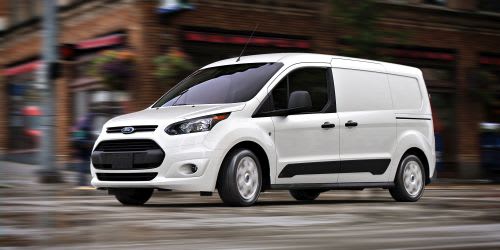
Offered in two wheelbases and two series levels, the Ford Transit Connect can tow as much as 2,000 pounds when properly equipped.
Photo: Ford
The Ford Transit Connect, America’s best-selling compact van, is available as the Transit Connect van for cargo and Transit Connect Wagon for passengers. Transit Connect has been recognized for outstanding retained value by TrueCar and fleet value by Vincentric.
The Transit Connect is offered in two wheelbase choices, with a best-in-class turning radius of 36.1 inches for the short wheelbase.
The long-wheelbase van offers a maximum cargo capacity of 149 cubic feet with the front passenger seat folded down as a workstation. Transit Connect handles 1,620 pounds of payload.
Towing capacity is an unsurpassed 2,000 pounds with the optional Trailer Tow Package.
Transit Connect offers the choice of cargo doors that swing out 180 degrees or a single lift gate. Customers can customize vans to fit vocational needs, working with Ford’s upfitter community, including Adrian Steel, Leggett & Platt, and Knapheide.
The Transit Connect is also available SYNC with MyFord Touch comes with a 6.5-inch touch screen.
The 2.5L Duratec engine delivers a U.S. Environmental Protection Agency (EPA)-estimated 28 mpg highway and its E-85 flex-fuel system enables the vehicle to run on E-85 or gasoline. A compressed natural gas (CNG)/propane autogas gaseous engine prep package is also available.
Mercedes-Benz Metris Cargo Van
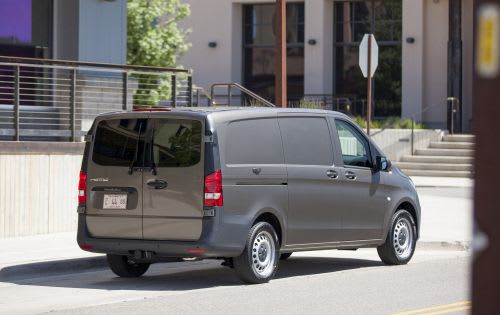
Featuring two rear door options (standard opening or a single flip-up tailgate) the Mercedes-Benz Metris offers 186 cubic feet of cargo volume.
Photo: Mercedes-Benz Vans
The Metris mid-sized commercial cargo van is available with a 2.0L four-cylinder gasoline engine that achieves 208 hp and 258 lb.-ft. of torque, mated to a 7-speed automatic transmission with rear-wheel drive.
The cargo van offers 186 cubic feet of cargo volume (enough room to stow 75 sheets of 4- x 8- foot plywood) and a towing capability of 4,960 pounds. Its 75.2-inch height 38.7-inch turning radius enables it to fit in most suburban areas, including parking structures and garages.
Sliding side doors open up to 37.8 inches. Two rear door options are available, standard 270 degree and 180 degree opening rear doors, or a single flip-up tailgate.
The powertrain application, with optional ECO start/stop, and has a service interval of up to 15,000 miles.
The cargo van also offers a factory partition with extended loading feature.
The Metris will feature 6 air bags for the Cargo Van variant as well as standard ATTENTION ASSIST, Crosswind Assist, and load-adaptive ESP. Optional safety features include active parking assist, lane keeping assist, PARKTRONIC, collision prevention assist, blind spot assist, and a rear-view camera.
Nissan NV200
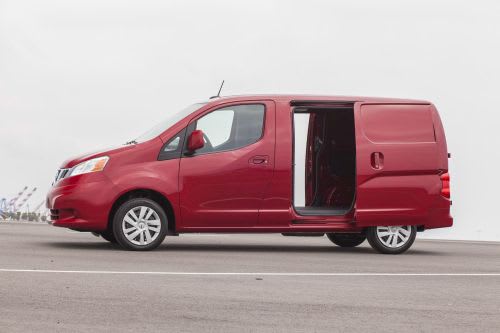
The NV200 Compact Cargo is more than 4.5-feet shorter in length and 2.5-feet lower in height than the Nissan NV 2500/3500 High Roof.
Photo: Nissan
The 2016 Nissan NV200 Compact Cargo is available in two models: NV200 S and NV200 SV.
The Nissan NV200 Compact Cargo, is produced in Cuernavaca, Mexico, and comes standard with a five-year/100,000-mile bumper-to-bumper limited warranty as well as Roadside Assistance with Trip Interruption service.
The van is built on Nissan’s compact commercial platform and features a 2.0L 16-valve DOHC four-cylinder engine rated at 131 hp and 139 lb.-ft. of torque, mated to a next-generation Xtronic transmission. Fuel economy is rated at 24 mpg city, 26 mpg highway, and 25 mpg combined.
The combination of a 115.2-inch wheelbase with a 186.3-inch overall length provides an 82.8-inch cargo length, 54.8-inch cargo width (48 inches between the rear wheel wells), and 53-inch cargo area height. It offers a cargo capacity of 122.7 cubic feet and an estimated payload is estimated of 1,480 pounds (S model).
The rear doors are a 40/60-split design, with the 60% side on the right (curb) side for easy access from a sidewalk. The 40% left side door reduces potential intrusion into the street when open. Both rear doors feature dual opening positions of 90 degrees and 180 degrees. The standard sliding side doors are designed for low effort. All doors are solid (no windows) with available privacy door glass.
Twenty standard, integrated, and reinforced cargo-mounting points allow the installation of racks and shelves without drilling into the sidewalls, in addition to six available floor-mounted cargo hooks (standard on SV models) in the cargo area. Six exterior roof rack mounting points are also standard.
The Nissan NV200 Compact Cargo offers mobile office functionality with a center console. Recessed storage areas are provided on the upper instrument panel for folders and documents. In addition, the passenger seat folds down to serve as a worktop or lunch table, or to extend the cargo space for hauling longer items such as pipe or lumber,
Standard safety features include the Nissan Advanced Air Bag System (AABS), roof-mounted curtain side impact supplemental air bags, front seat-mounted driver and passenger side impact supplemental air bags, Vehicle Dynamic Control (VDC), and tire pressure monitoring system (TPMS).
Ram ProMaster City
Replacing the Ram C/V as a Ram Truck’s Class 1 van offering, the Ram ProMaster City van is available in four versions: Tradesman Cargo Van, Tradesman SLT Cargo Van, Wagon, and Wagon SLT for a total of eight different configurations.
The Ram ProMaster City is powered by the 2.4L Tigershark I-4 engine, which generates 178 hp at 6,400 rpm with a peak torque of 174 lb.-ft., and features a standard, 9-speed automatic transmission, also known as the 948TE.
The van’s steel unibody architecture helps minimize curb weight and offers a payload capability of 1,883 pounds.
The ProMaster City features nearly vertical side panels for a width of 60.4 inches. Combined with an interior roof height of 51.8 inches, the cargo van offers 131.7 cubic feet of cargo space. The vertical side panels are upfitter-friendly and help simplify the attachment of shelves or storage racks.
Each side of the Ram ProMaster City cargo van is fitted with a sliding door with a 26-inch opening to access cargo. The roof of the Ram ProMaster City is prepped for load rails or roof racks, available through Mopar, with a weight capacity of 154 pounds.
The full-size van is fitted with 60/40 split doors. The larger door swings open toward the traffic/driver side of the van, easing access to larger cargo items and limiting curbside blockage. Check out more info on the 2022 Ram ProMaster as well!
Topics:Cargo VansCompact VansRam ProMaster CityNissan NV200Mercedes-Benz MetrisFord Transit ConnectChevrolet City ExpressOperationsVehicle Research
Originally posted on Work Truck Online
Subscribe to Our Newsletter
More Operations

Avis Budget Group Deploys Neology Toll Management Technology Across Major Brands
Neology’s neoFleet platform will manage toll transactions and toll-authority operations for vehicles across Avis, Budget, Payless, Budget Truck and Zipcar.
Read More →
Fleet Personal-Use Charges Edge Higher in 2026
Nearly eight in 10 surveyed fleets allow personal use of company vehicles, while just over half of respondents report charging employees for the privilege.
Read More →
The Future of Fleet + What’s Changing Right Now | AF News Recap
Could developments overseas offer a preview of what’s coming for U.S. fleets? This week, we’re looking at the future of AI, autonomy, and electrification, plus Ford Pro’s new certified pre-owned program, smarter vehicle offboarding, and a new way for fleets to manage toll expenses.
Read More →
How to Handle Vehicle Offboarding
What do fleet managers need to do when a driver leaves?
Read More →
Sponsored•October 1, 2026
Fleet Manager’s Ultimate Playbook: Navigating the New Standard in OEM Connectivity
Rising operating costs, driver safety concerns, and unplanned downtime are putting unprecedented pressure on modern fleets. Discover how fleet managers use embedded OEM connectivity and real-time vehicle data to cut TCO, prevent downtime, and protect drivers without aftermarket telematics hardware.
Read More →
U.S. Bank Adds Verra Mobility Toll Management to Voyager Fleet Platform
The integration allows U.S. Bank Voyager fleet customers to manage toll payments and violations alongside fuel, EV charging and maintenance expenses.
Read More →
ADAS Prevents Crashes. But Repairs Cost More | AF News Recap
ADAS-equipped vehicles may crash less often, but they can cost more when they do. This week, we’re breaking down what that tradeoff means for fleets, plus Subaru’s first Forester Wilderness Hybrid, Nissan’s new e-POWER Rogue, and why Calstart has become Catalyst Mobility.
Read More →
Moventum Fleet Management Names Mark Iorillo Head of Sales
Iorillo brings nearly 20 years of fleet management and sales experience to the role, including previous positions at Element Fleet Management, CEI, Donlen and Ryder.
Read More →
Fleet Has a Talent Pipeline Problem. What Comes Next? | AF News Recap
Where will fleet’s next generation of leaders come from? This week, we’re looking at the industry’s talent pipeline, what certification can add to a fleet career, how to build an award-worthy track record, and the return of Automotive Fleet’s Personal Use Survey.
Read More →
Smith System Launches Driver Risk Management Program
Fleets have more driver data than ever, but identifying risky behavior doesn't necessarily correct it. Smith System's new Driver Risk Management program combines monitoring, training, and follow-up coaching to help fleets connect risk signals with driver intervention.
Read More →