




Baxter Healthcare Fleet Manager Lowered Accident Rate 22-Percent
Fleet Manager Kristin O'Driscoll, who oversees a fleet of 1,000 vehicles, received the 2014 Fleet Safety Award. Since 2012, the company has also lowered its injury rate significantly.

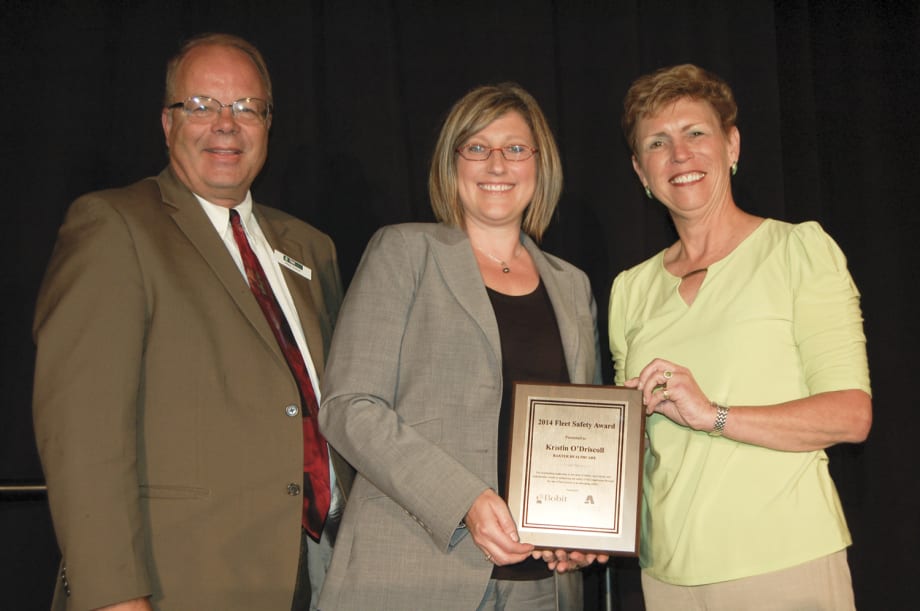
Editor Mike Antich and AALA Executive Director Pam Sederholm (right) flank Fleet Safety Award winner Kristin O’Driscoll during a private ceremony on July 22. Photo by Chris Wolski.
Editor Mike Antich and AALA Executive Director Pam Sederholm (right) flank Fleet Safety Award winner Kristin O’Driscoll during a private ceremony on July 22. Photo by Chris Wolski.
Kristin O'Driscoll, fleet manager for Baxter Healthcare, was honored with the 2014 Fleet Safety Award at a lunchtime ceremony held on July 23 during the third annual Fleet Safety Conference, produced by Bobit Business Media, in Schaumburg, Ill.
The Fleet Safety Award, which was first presented in 2012, is co-sponsored by Bobit Business Media, publisher of Automotive Fleet magazine, and the American Automotive Leasing Association (AALA). It seeks to recognize candidates who have shown leadership, innovation, and measurable results in enhancing the safety of their employees, those travelling with them, as well as everyone else who shares the road with them.
O'Driscoll manages a fleet of 1,000 non-regulated vehicles and has guided the company to a 22.5-percent decrease in accidents per million miles since 2012. She has also instituted a number of safety initiatives during her tenure at the company.
Safety is described as an intrinsic part of Baxter Healthcare's operations. With the establishment of its fleet safety policy, the company has aggressively worked with its drivers to ensure they understand and comply with the program.
In 2014, Baxter Healthcare dedicated resources to revamp its Fleet Compliance Safety Module to ensure drivers stay engaged with the message. To ensure drivers understand what is expected of them, they have to complete a quiz at the end of the training module.
Measuring Results
While the drop in Baxter's accident rate is impressive, translating into about 5.5 accidents per million miles, even more striking is the drop in injury accidents. Since 2012, the company's injury rate has also improved to less than one injury accident per million miles. The company reported that it had no fatalities during the 2012-2014 calendar-years.
The company allows spouses and authorized domestic partners to drive company vehicles for personal use. In addition to the Baxter fleet, some employees also drive their personal vehicles for company business and are reimbursed. Motor vehicle records (MVRs) are run on drivers at a minmum of twice per year.
Operating a Safe Fleet
Drivers who are assigned a company vehicle are asked to have dealership personnel run through the operation of the vehicle when they pick up a new vehicle. Safety equipment present in the fleet includes side air bags, back-up cameras, and other equipment, depending on trim package and availability.
The company does allow drivers to use their mobile phones while driving, but it must be voice activated or hands-free and/or comply with local government regulations.
Texting and use of the Internet or mobile technology is prohibited while driving.
The company currently does not use a telematics program, and relies on its fleet management company, Wheels Inc., to help with the enforcement of the policy, which is addressed through training. Drivers who have been identified as violating the safety policy are assigned a level of potential risk based on a point system. Each level of risk has a specific intervention strategy.
Presenting the Award
The 2014 Fleet Safety Award was announced by the 2013 winner Sandra Lee, director of worldwide fleet for Johnson & Johnson, and presented by Pam Sederholm, executive director for the American Automotive Leasing Association (AALA).
"Fleet safety — driver safety — is rapidly ascending the list of core priorities for businesses and organizations across all industry segments. In fleet, the task of creating and sustaining a safety program requires knowledge, creativity, innovation and leadership. The 2014 winner of the Fleet Safety Award, Kristin O'Driscoll, brings all these skills and more — measureable results — to the driver safety program at Baxter Healthcare," Sederholm said when presenting the award.
The award was accepted on behalf of O'Driscoll, who was unable to attend the July 23 ceremony, by her colleague Peggy Ross, RN, COHN-S/CM, CSP, CPE, corporate EHS manager, Occupational Safety & Health for Baxter Healthcare.
When accepting the award, Ross read a statement from Driscoll:
"I am deeply honored to be recognized for the Fleet Safety Manager award at the 2014 Fleet Safety Conference. Unfortunately, I am unable to accept this recognition in person. At Baxter, all employees are responsible for safety and we recognize the importance of our employees as workers and drivers. As fleet managers we see how important it is to draw attention to and educate our drivers on safety every day. Simple lessons such as how to avoid distractions make our drivers safer on the road while reducing overall fleet risk. Everything we have worked towards in the last few years and what we are striving for in the future really has been a team effort with our Risk Management champion and Environmental Health and Safety champion who I am so happy you had the chance to meet today as Peggy Ross is here to accept this award on Baxter's and my behalf. I feel it is also important for us to acknowledge our sales force. While we implement our programs and enhance our safety standards, they are the ones that embrace and adhere to it. I feel that they really have done a great job with this."
O'Driscoll, who attended the first day of the conference, was honored during a private ceremony July 22.
More Safety

Fleet Manager’s Ultimate Playbook: Navigating the New Standard in OEM Connectivity
Rising operating costs, driver safety concerns, and unplanned downtime are putting unprecedented pressure on modern fleets. Discover how fleet managers use embedded OEM connectivity and real-time vehicle data to cut TCO, prevent downtime, and protect drivers without aftermarket telematics hardware.
Read More →
From Driver Well-Being to EV Charging | AF News Recap
Mental health belongs in the fleet safety conversation. This week, we’re looking at five ways fleets can support employee well-being before a crisis, plus Holman’s expansion in Mexico, new one-day Fleet Forward passes, and why EV charging demand is outpacing infrastructure growth.
Read More →
Nexar-Nauto Merger Aims to Give Fleets Better Safety Intelligence Through Larger Driving Dataset
Stefan Heck tells Automotive Fleet that combining more than 10 billion miles of driving history with Nexar's AI models will give fleets deeper insights into driver risk and roadway conditions than either company could provide independently.
Read More →
Don't Wait for a Crisis: 5 Ways to Build Mental Health Into Your Fleet Safety Program
For Suicide Prevention Month, fleet and safety leaders have an opportunity to put mental health where it belongs: at the center of workplace safety.
Read More →
How Camera Data Can Strengthen a Fleet’s Insurance Renewal
Insights from a commercial insurance carrier and a broker show how fleets can turn video telematic data, driver coaching, and improved claims results into a stronger case at insurance renewal.
Read More →
The Safest Fleets Aren’t the Ones with the Most Technology
You’ve made the telematics investment. Here’s how to capture the other half of its value and build the safest fleet on the road.
Read More →
Hidden in Plain Sight: Fleet Compliance Risks
Fleet compliance isn't just about having policies — it's about consistently enforcing them. This practical guide reveals six hidden compliance risks common in public sector and shared fleet operations and outlines proven strategies to improve visibility, accountability, and audit readiness
Read More →
NETS Sets 2026 Fleet Safety Benchmark Conference for Indianapolis
The Sept. 15–17 program will feature fleet benchmarking data, case studies, emerging technologies, and implementation strategies while running alongside the NSC Safety Congress & Expo.
Read More →
Off-the-Job Crashes Account for 43% of Employers’ $61.7 Billion Crash Burden
NETS quantifies costs dispersed across fleet, risk, HR, and other departments while providing new per-crash benchmarks for employers.
Read More →
Ram Recalls More Than 1.27 Million 1500 Pickups for Seat Belt Anchor Issue
The recall affects certain 2019-2026 Ram 1500 pickups that may have improperly attached second-row seat belt buckle anchors.
Read More →