




Google's Corporate DNA
Internet giant Google pioneered its Gfleet car-share program in 2007 with a fleet of Prius vehicles. It recently traded those in for Cherolet's Volt and Nissan's LEAF.
At a Glance
Google’s use of LEAF and Volt vehicles for its car-share program offer the company and its employees several benefits, including:
● A "safety net" to use alternative transportation.
● A smaller carbon footprint.
● Low total cost of ownership.
The reason for Google's Gfleet car-share program is simple — it's a natural part of the Internet giant's "corporate DNA," according to Transportation Manager Kevin Mathy. Wildly popular among the 15,000 "googlers" — as the search engine's employees are known — at the company's Mountain View, Calif., headquarters, the car-share program is building morale and saving money. It is set to expand in 2012.
The company’s Gfleet car-share program was launched in 2007 as a result of the efforts of the company’s philanthropic arm, Google.org and its RechargeIt Initiative.

The car-share program was a natural demonstration of the initiative’s goals. “The purpose of the RechargeIt Initiative was to show the viability of plug-in vehicles, and that they could be a real game changer in terms of greenhouse gas (GHG) emissions and just sort of changing the whole paradigm of driving,” explained Rolf Schreiber, technical program manager in charge of Google’s electric transportation initiatives.
Electrifying Start
According to Mathy, the idea of the car-share program was wholeheartedly supported by senior management from the beginning. So, with the executive green light, all he and Schreiber had to do was buy the plug-in vehicles to get the program rolling. Simple as that.
However, that wasn’t as easy as it sounded. In 2007, there wasn’t a plug-in vehicle available for ready purchase. So, using some Google ingenuity, they purchased a fleet of Toyota Prius vehicles and a few Ford Escape hybrids with plug-in modules installed by Hymotion, which is owned by A123 Systems, a company that specializes in equipping hybrid vehicles with plug-in technology.
While it could have turned out to be a less-than-ideal stop-gap measure until the market caught up to Google’s program, the results were better than Schreiber could have hoped for.
“It turned out to be a great first step,” he said. “Hymotion had, by far, the most fully thought out product. It was crash tested and California Air Resources Board (CARB)-certified. The cars basically ran flawlessly for the four years we had them in service.”
However, after four years of service the Prius vehicles were retired due to their age, and because, explained Mathy, “We wanted to advance and promote sustainable transportation, and so it just made sense to go to the next level and use an electric vehicle (EV) with a range extender such as the Chevrolet Volt and a pure EV with the Nissan LEAF.”
According to Mark Perry, director of product planning for Nissan, the LEAF is particularly suited to a company car-share program such as Google’s. “You look at the utility of the vehicle — it’s a five-door hatchback with room for five adults. The fact that it uses no gas and no oil and has sufficient range, whether its ride-sharing, carpooling, or an employee shuttle between campus locations, makes the LEAF a perfect choice.”
The LEAF and Volt aren’t the only green commuting option open to googlers. The company also operates several biodiesel GBuses, which are used by a about a third of the headquarter employees five days per week. The 5-percent biodiesel shuttles are an additional way to reduce the company’s carbon footprint.
Alt Commute = EV Access
The Gfleet vehicles are available to any googler who takes public transportation, bicycles, carpools, or vanpools to work. The vehicles are meant for employees to run errands throughout the day.
“This is an incentive to take alternative transportaion and a safety net for people to leave their own personal car at home and take an alternative commute to Google,” Schreiber said.
This “safety net” has resonated with the googlers. According to Mathy, the vehicles are used “extensively,” being regularly reserved at the rate of 100 percent almost every day during the mid-day peak.
Considering that 30 to 40 percent — or up to 6,000 googlers — are eligible to use the alt-fuel vehicles, demand could foreseeably outstrip supply. “In fact, this is why Rolf and I are looking at next year, because we need to increase the car-share fleet to meet demand,” Mathy said.
Keeping up With Demand
A key component of the success of the Gfleet car-share program is having a sufficient and accessible number of electrified parking spots.
In addition to parking spots for the 35 Gfleet vehicles, Google has installed, through Coulomb Technologies, more than 200 level 1 and level 2 chargers, with the ultimate aim of electrifying 5 percent of the spots.
The plethora of electrified parking spots reflects the growing number of googlers who are investing — on their own — in electric vehicles, such as the Volt and LEAF. Offering electrified parking spaces is a way to help encourage individual sustainability.
The frequency of use of the charging stations has been an unexpected and pleasant surprise for Mathy.
“We were concerned that we would have a lot of charging stations available that weren’t being used, but it has been contrary to that. We almost need a waiting list because demand is so high,” he said.
‘Please, Plug Me In’
While there have been no negatives with the Gfleet program, there have been challenges. Chief among them, according to Schreiber, is that drivers have a tendency not to plug the cars in when they return them. “Ever since we’ve had the Prius vehicles, this has been a constant battle,” he added.
To solve it, Google is working with its fleet management company (FMC), Enterprise Rent-a-Car, looking at a number of solutions, including keeping the car from locking if it hasn’t been plugged in, an auditory reminder such as “please, plug me in,” or using text messages to communicate with drivers. Perry of Nissan said that there is a smartphone app that’s already available for the LEAF that allows the FMC to monitor if the vehicle has been plugged in. “It’s really about driver education,” Perry said.
The other challenge has been related to the parking spaces, said Schreiber. “On the EV infrastructure side, we’ve been dealing with Americans with Disabilities Act of 1990 (ADA) requirements for providing accessible parking spaces for charging,” he said. “We completely embrace the standards, but are eagerly hoping that they will soon become completely uniform, which will help us serve those who are in need of electrified spots.”
Next Green Steps
Google is not the kind of organization that sits on its laurels. So, it’s a matter of course that Mathy and Schreiber are already contemplating the next steps for the Gfleet, which includes expanding the program to other Google sites along with an EV infrastructure. The company will be adding new makes and models to the EV roster as they are released for sale, providing feedback about the vehicle and how it was received by the googlers.
Schreiber said that the latter has been a benefit for the OEMs. “We’ve tried to position Gfleet all along as sort of a test bed for new and emerging technologies in terms of plug-in vehicles,” he observed. “I think Toyota gained an awful lot from the experiences we had with the Prius vehicles. We now have an agreement with Honda as well to have a demonstration vehicle of its upcoming Fit electric vehicle and we’re working with some other automakers in similar ways.”
Expanding the Quiver
With a corporate culture oriented toward sustainability, the morale boost that the Gfleet has provided is unsurprising.
“People love the fact that they can have the zero-emissions vehicle to go do their errands or go do whatever they need to do,” Schreiber said.
Beyond the employee morale boost, Schreiber noted that there are several tangible offsets, such as the fleet’s smaller carbon footprint and monthly savings in gasoline costs.
The company is also seeing additional savings in the lower maintenance needs of the Volt and LEAF. “On the Volt, the oil change interval is every 25,000 miles,” Schreiber said. “There is essentially no maintenance on the LEAF other than rotating the tires and adding windshield wiper fluid and changing the cabin air filter every 50,000 miles, or every four years. In terms of total cost of ownership, between getting the federal rebate and the California rebate for the pure EVs, plus the lower cost of maintenance overall, it will definitely make up the price premium in a couple of years.”
While Google’s corporate culture is ideally suited to pursuing a green fleet option, Perry of Nissan noted that the LEAF and other EVs are a good fit for any corporate culture interested in improving its bottom line.
In addition, the Gfleet program has become another arrow in Google’s benefits “quiver,” Mathy said. “Google, as a company, offers a wide range of incentives and benefits to our employees, and all those in combination are used in recruiting the best and the brightest talent. This is just another menu item to do that,” he said.
More Green Fleet
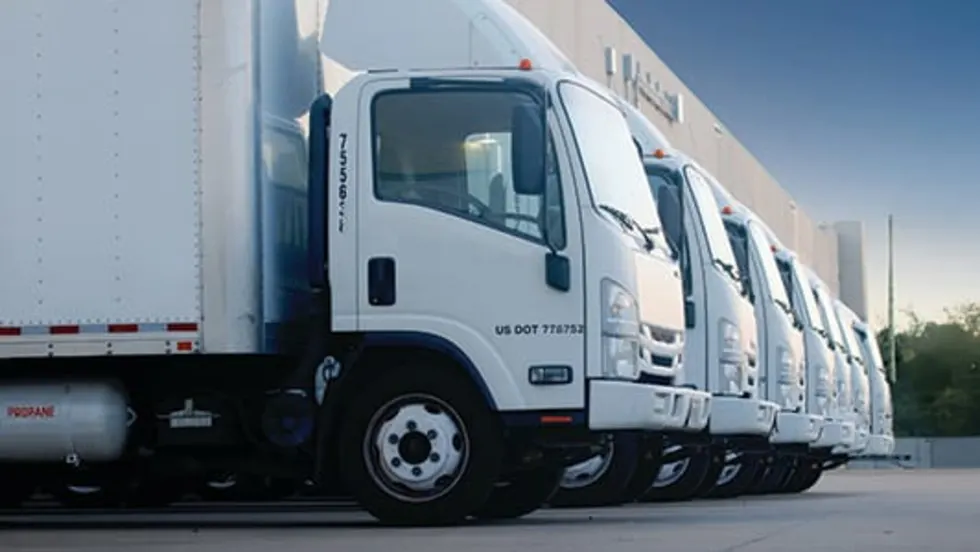
New Propane Autogas Program Offers Fleet Compensation
Qualified commercial fleets can receive $7,500 per eligible propane autogas vehicle and up to $10,000 for new refueling site prep. Learn how the program works and see whether your fleet qualifies.
Read More →
EV Charging Use Is Outpacing Infrastructure Growth
ChargePoint’s 2026 Charging Forward Report points to rising charger use, higher-powered charging, commercial vehicle electrification, and energy-management technology. Here’s what fleets should know.
Read More →
Merchants Fleet Reports 290M EV Miles as Fleets Navigate Changing Electrification Market
From millions in operating savings to hundreds of millions of EV miles, Merchants Fleet’s latest report reveals what’s working and what’s changing in fleet electrification.
Read More →
The EV Breakdown Nobody's Talking About: Why Most Electric Vehicle Roadside Calls Aren't Mechanical Failures
Here's why EV breakdowns are widely misunderstood.
Read More →
ChargePoint Now Available in Energy Pass
ChargePoint and additional planned charging network integrations were added to GM's Energy Pass.
Read More →

First Look: Slate Auto's Electric Fleet Pickup
Could an affordable, modular EV pickup make electrification more practical for fleets?
Read More →
Slate Debuts Colorful, Unique EV Models
A recent media and client event, studded with electric vehicles dressed up on platforms, planted a new position for the manufacturer in the wider EV market. Fleets will find cost-saving advantages.
Read More →
Slate Electric SUV, Pickup Switchable Model Aims For Light-Duty Fleets
Everything about this EV is counterintuitive and understated, making it stand out from the crowd.
Read More →
Inspiration Mobility Acquires Key Electrada Assets
Inspiration Mobility Group has acquired select assets of Electrada, adding the fleet electrification provider's team, technology, and charging infrastructure development capabilities to its energy management business.
Read More →