




Personal-Use Charge Increases to $123
Fleet managers are reevaluating personal-use policies, programs, and charges and working to educate their drivers on the importance of accurate reporting.


Photo via Drivingforceauto.com

Year-over-year, personal-use charges for company-provided vehicles continues to increase. In 2013, average charges were $123 vs. $121 in 2013, and $116 in 2012.
Overall, fuel costs continue to rise and fleet managers have continued to weigh the value of reimbursement vs. company-provided vehicles.
Automotive Fleet’s annual survey of personal-use policies and charges took place via an online questionnaire, completed by commercial fleet managers representing all industry segments and fleet sizes.
Not a One-Size-Fits-All Program
For the second year, the percentage of fleets that allow personal use of company-provided vehicles was broken out by field and non-field vehicles. While 82 percent of fleets with field vehicles allow personal use (down from 87 percent in 2013), only 31 percent of fleets with non-field vehicles allow personal use (down from 38 percent in 2013).
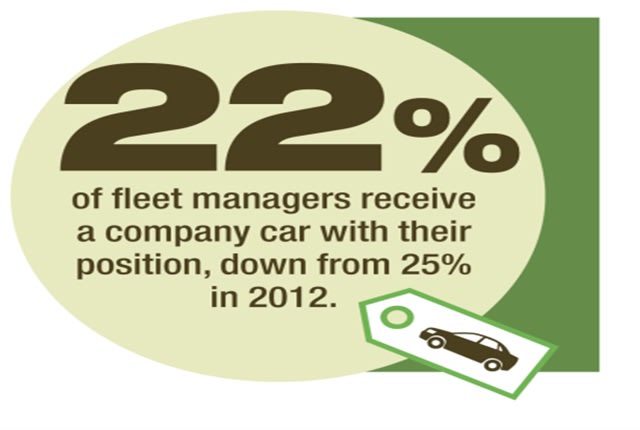
The difference in percentage is most likely due to the geographic territory that must be covered by field vehicles.
“We are an electrical contractor. A large percentage of our field staff travel out of town or state for their job,” noted Vicki Driessen, fleet manager for Faith Technologies.
Of the fleets that allow personal use of a company-provided vehicle, most fleets (65 percent) allow an employee’s spouse to utilize the vehicle, down from 73 percent in 2013; however, the percent of survey respondents that do not allow anyone, aside from the employee, personal use (34 percent) is up from the 25 percent reported in 2012.
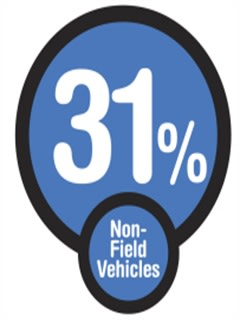
Additionally, the majority of fleets that allow personal use continue to require an MVR check on non-employees driving the company-provided vehicle (61 percent), which is down from the 67 percent in 2013.
Fleets that allow personal use more often allow it at all times, whenever necessary (78 percent), down from the 83 percent in 2013, but still up from the 71 percent in 2012.
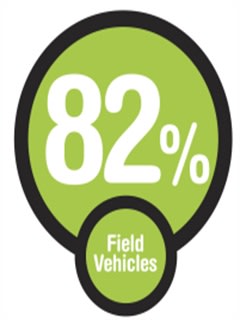
Additionally, the majority of fleets (77 percent) continue to utilize job function as the No. 1 determining factor in governing assignment of a company-provided vehicle (down slightly from 75 percent in 2013). This is followed by annual business miles driven (58 percent) and job title (49 percent). The percent of respondents that utilize the company-provided vehicle as a fringe benefit did increase over 2013 by 3 percentage points to 19 percent in 2014.
The majority of fleets continue to find the value in performing a “true up” or personal-use reconciliation on an annual basis (69 percent), which is mostly flat vs. 2013 (71 percent). Fewer fleets also reported that they never perform a personal-use reconciliation (14 percent in 2014 vs. 16 percent in 2013).
Varying Personal-Use Charges
At 86 percent, most survey respondents continue to use industry averages or competitive benchmarks to determine actual personal-use charges. This is followed by calculating the cost to the company (20 percent) and including a fuel benefit (16 percent).
However, of the fleets that allow personal use, only 68 percent charge employees directly (up slightly from 67 percent in 2013).
“We have been trying to convince management to opt into a personal-use charge without success so far,” said Nancy Murray, facilities, fleet, and travel manager for Agfa Corporation.
When reimbursing employees for business use of a personally owned vehicle, the majority of fleets 86 percent (vs. 87 percent in 2013) continue to utilize a per-mile rate.; however, some fleet managers are looking to change that practice with measurable success.
“A few years ago, we switched to per round trip charge, instead of per mile. This streamlined the process of getting personal-usage reports out to our drivers and receiving them back,” said Driessen of Faith Technologies. “We also used to send out the form twice per year and moved it to only once per year.”
When collecting personal-use charges, the majority of fleets continue to utilize payroll deduction (85 percent), up from the 83 percent reported in 2013.
Finally, the majority of surveyed fleets charge more than $100 per month for personal charges, with 38 percent charging between $100 and $149 and 25 percent charging $150 or more per month.
Personal-Use Program Challenges
This year, AF asked fleet managers to share their biggest challenge, or headache, regarding personal use. Hands down, the top response was mileage reporting.
“My biggest headache right now with personal use is drivers not filing mileage as required by company policy; hence, a lot of follow up,” said one fleet manager, who wished to remain anonymous.
Some fleet managers are looking to technology to help solve the problem. “We are looking at a pilot program to use vehicle telematics and location data to create mileage reporting. We are also looking at mileage tracking apps,” said the fleet manager for a Western U.S.-headquartered technology company.
Another fleet manager, who wished to remain anonymous, was also looking to telematics to report personal use versus associates reporting monthly and manually.
In addition to the inaccurate reporting, the timeliness of the mileage reporting is also a concern.
“Drivers do not report personal/business miles on time. They will not report the whole year and then try to reconstruct the entire year in October. They will put the same low personal-use mileage down for each day (for example, 3 miles) and everything else is business mileage,” noted Phil Schreiber, fleet manager North America for OTIS Service Center.
Sometimes, it’s not just the drivers not reporting their mileage. “Some departments have take-home vehicles that are not always reported,” said one fleet manager, who wished to remain anonymous.
An additional challenge encountered by fleet managers is that some drivers are simply not willing to pay for personal-use charges.
“We have found drivers who are not willing to pay for personal-use and prefer to park the vehicle at a local branch versus pay the personal-use charges. It’s a little bit of a headache, but for the most part, drivers are complying. My favorite response is ‘I’d like to drive a new vehicle and only pay $220 per month, beats having to make my monthly payment,’ ” said Janie Arreola, fleet administration manager for Dean Foods, Inc.
However, sometimes it just takes education, patience, and consistency to get drivers on board.
“Now that the program is few years old, there is a lot more acceptance. Drivers realize the company is not trying to get them, we are fulfilling the IRS regulations laws,” Schreiber said.
More Operations

Fleet Has a Talent Pipeline Problem. What Comes Next? | AF News Recap
Where will fleet’s next generation of leaders come from? This week, we’re looking at the industry’s talent pipeline, what certification can add to a fleet career, how to build an award-worthy track record, and the return of Automotive Fleet’s Personal Use Survey.
Read More →
Smith System Launches Driver Risk Management Program
Fleets have more driver data than ever, but identifying risky behavior doesn't necessarily correct it. Smith System's new Driver Risk Management program combines monitoring, training, and follow-up coaching to help fleets connect risk signals with driver intervention.
Read More →
Automotive Fleet Opens 2026 Personal Use Survey for Commercial Fleet Managers
Less than two weeks left! Commercial and corporate fleet managers are invited to share how their organizations handle company vehicle personal-use policies, charges, and driver eligibility.
Read More →
From AI Prompts to AI-Generated Safety Songs | AF News Recap
Can better prompts make AI more useful for fleet managers? This week, we’re breaking down smarter fleet analysis, an AI-assisted experiment that turned safety training into music, and what happened to fuel prices in August.
Read More →
How to Write Better AI Prompts for Fleet Analysis
Include these six elements in your fleet prompts to generate more relevant analysis and accurate answers.
Read More →
Fleet Meets: Eric Kilgore
This edition of the Fleet Meets series features one of the industry's best leaders driving multi-market and national operations.
Read More →
Why Reactive Fleet Management Is Becoming Too Expensive to Sustain
Research highlights a growing need for proactive management strategies to address rising costs in fleet operations effectively.
Read More →
What Your Fleet KPIs Aren’t Telling You
Tracking fleet metrics is only useful when the data leads to better decisions. This guide helps fleet leaders assess cost, utilization, and downtime more accurately, identify performance gaps, and prioritize the actions that can improve operational results.
Read More →
Hidden in Plain Sight: Fleet Compliance Risks
Fleet compliance isn't just about having policies — it's about consistently enforcing them. This practical guide reveals six hidden compliance risks common in public sector and shared fleet operations and outlines proven strategies to improve visibility, accountability, and audit readiness
Read More →
Turning Fleet Payment Data into Executive Insights
Does data alone drive results in operations?
Read More →