




10 Points for Selecting Specialty Truck Bodies
Truck body selection directly impacts employee productivity, crew safety, and overall cost of vehicle ownership. Here are 10 basic points to consider when selecting specialty bodies for a truck fleet.

At a Glance
When selecting a truck body, main points to consider include:
Vehicle application
Body type and dimensions
Matching the chassis with the body
Cargo requirements and access
Using available resources such as fleet management companies, dealers, shop managers, and OEMs
Truck body selection directly impacts employee productivity, crew safety, and overall cost of vehicle ownership. Here are 10 basic points to consider when selecting specialty bodies for a truck fleet.
When ordering cars, SUVs, or light-duty work trucks with minimal upfits, the selection process is relatively simple. There are a handful of options — passenger capacity, seat type and material, engine size, transmission type, power seats, and so forth — that, for the most part, are available directly from the original equipment manufacturer (OEM).
The process of selecting specialty bodies for trucks, however, is considerably more daunting, especially for those new to fleet management or at least to the truck side of fleet. The fleet manager is not only sifting through OEM chassis specs, but also the dozens of options available with aftermarket truck bodies. Is a service body or dry van body better? If a dry van body is selected, what length should it be? What material should it be built from? What size and spec chassis is needed to fit the body and the application? These questions are just scratching the surface.
Truck body selection directly impacts employee productivity, crew safety, and overall cost of vehicle ownership. So, how does a fleet manager stack the odds in his or her favor to select a truck body that best fits the application and budget?
Follow these 10 steps:
1 - Define the application
What exactly will the truck be used for? Will it haul loose gravel, dry goods, perishable products, pallets of sod, tools, parts, piping materials, compressors, construction debris, or a combination of items? How much will the maximum load weigh? Will it be a constant load or will it diminish with each delivery throughout the day? Will the truck pull a trailer? If so, what length? How much total weight, including trailer, is cargo? The answers to these questions will present a clear idea of what body spec and chassis capacity will be needed.
2 - Determine expected vehicle lifecycle
How long will the truck be kept in operation? “This is an important question to get a feel for what cost level is going to be appropriate for the body. Should you go for a body built for longevity that also costs more money or select a lower-priced body that is going to be on a shorter turn cycle?” said Ken Gillies, truck engineering manager with GE Capital Fleet Services.
3 - Consider marketing & graphics requirements
Vehicle graphics can be a promotional point for the company, so the marketing department may have a role in what kind of body the fleet manager can select. “What images go on the truck and how they look is critical,” Gillies said. “However, graphics is a frequent afterthought in the body selection process, even though it greatly impacts body configuration as well as materials used to build that particular truck body. In van body applications, graphics impact sidewall construction. The cleaner the surface, the better. Graphics impact door design because they work better on a swing door than a roll-up door. Overall, you’ve got to balance functionality with promotional considerations.”
4 - Choose a body type
How much space will cargo require? How will cargo be loaded and unloaded? Does cargo need extra protection from climate and theft? Are there specific temperature requirements for the cargo?
Some applications for common truck body types include:
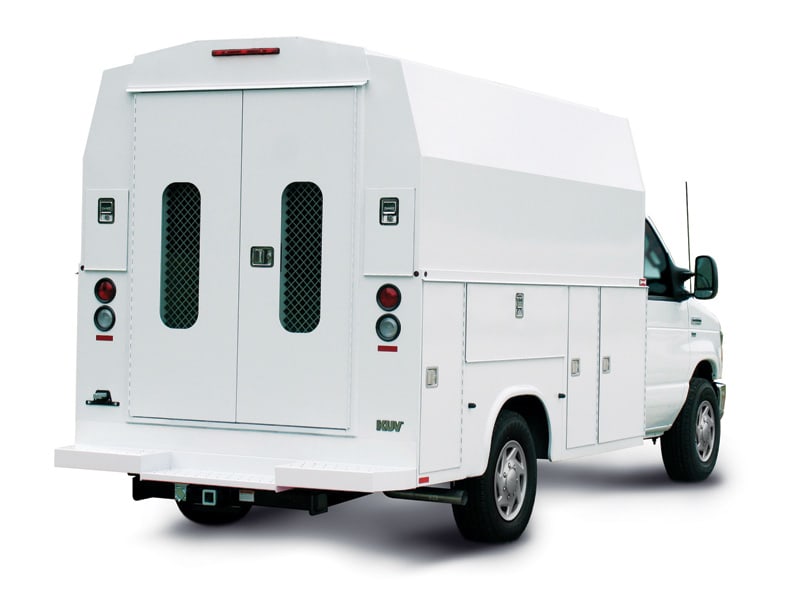
Service/utility body. Electrical, plumbing, mechanical, heating and air, mobile equipment service and general construction.
Flatbed. Landscape, heavy construction, pest control, plumbing, and mechanical distribution.
Dump bed. Heavy construction, landscape, and demolition.
Dry van bodies. Package, equipment and furniture delivery; landscape; and plumbing; heating and air.
Refrigerated body. Food and beverage delivery.
For example, if the truck’s application is landscape service/ground maintenance, none of the cargo this truck carries requires a refrigeration system or extra insulation on the body to maintain specific temperatures.
In this instance, there are two likely body type options to consider. The first is an open-air steel flatbed with a reinforced dovetail ramp (to drive mowers onto the platform), metal fixed sides, and open mesh compartments for shovels, blowers, etc. The second is an enclosed aluminum dry van body (with air vents for fuel containers), with shelving inside the box (to contain tools and equipment), and a reinforced dovetail ramp to load mowers.
Either body is capable of carrying the same cargo. However, the enclosed dry van body with ramp would offer extra protection from the elements in harsh climates (including areas along shorelines where salty sea air can cause premature corrosion of equipment) and theft. Yet, it usually costs more money than the open-air flatbed.
Is the added protection and security of the van body worth the additional cost? In some cases, yes. In others, no. The key is deciding which factors are most important to the fleet manager.
5 - Calculate required body dimensions
Refer back to the answers to the questions in Step 1. When hauling pallets of tile, for example, what length, width, and height does each pallet measure? How many pallets will the truck carry in a full load? How much total space — in terms of combined length, width, and height — would that number of pallets require? What else will be placed on the truck at full load? How much space does the fleet manager need to accommodate?
Based on these calculations, work with a body manufacturer and/or fleet management company to determine the precise dimensions needed for the truck body to safely carry this cargo.
Another aspect of body height to consider is clearance. Will the truck need to fit in parking garages and other areas with limited height clearance? If so, spec the truck and body height accordingly.
Contd.
[PAGEBREAK]
6 - Select chassis
Based on the information gathered in the first five steps — including payload and trailering requirements, body type, and body dimensions — a chassis can be selected. Here are six points to consider when matching the chassis with the body:
Gross vehicle weight rating (GVWR). This refers to the maximum amount of total weight (including weight of chassis, body, payload, and people), as determined by the manufacturer, that the truck can safely haul. For example, if the chassis weighs 9,000 lbs. and the combined weight of the body, equipment, and maximum payload is 6,500 lbs., total gross vehicle weight is approximately 15,500 lbs. Based on these numbers and to allow for a buffer, a fleet manager would most likely select a 19,500 GVWR chassis.
Gross combination weight rating (GCWR). This is the number from which trailering capacity is derived. It defines maximum allowable weight of truck, body, and payload, plus the weight of the trailer and its contents. Be sure chassis selection factors in not only body payload but also trailering requirements.
Power take-off (PTO). If a dump body has been selected, for example, will it require power take-off (PTO) capability with the transmission to drive the dump hoist or the equipment? If so, make sure the chassis specs include the PTO option.
Frame-rail clearance. “In some cases, we encounter customers using utility bodies who have to adjust their configuration around new diesel emissions systems that are now taking up more real estate on both sides of the frame rails,” Gillies said. “For example, a utility body may need a compartment downsized to allow more room for the emissions system. There are also different fuel tank configurations that could potentially interfere with the body mounting.”
Cab-to-axle (CA). Most body companies refer to chassis length in terms of cab-to-axle (CA), which is the distance from the back of the cab to the center of the rear axle. If the truck application requires a 12-foot flatbed, for example, the body company will recommend an 84-inch CA. Consult the fleet’s body manufacturer or fleet management company on the precise CA chassis to fit the vehicle’s body.
Wheel size. This impacts load height. For example, if the truck will be loaded and unloaded at dock height, and the chassis GVWR is more than 19,500 lbs., then select a chassis with 22.5-inch wheels.
7 - Decide which body material works best
What region or climate will the truck operate in? If it operates in highly corrosive environments with harsh winters or coastal regions with salty sea air, then consider alternative materials to conventional steel, such as aluminum, fiberglass and other composites. However, these materials will cost more than steel. Therefore, balance the advantages of alternative materials — in terms of corrosion resistance, body longevity, and, in many cases, lighter weight — with the additional cost to determine whether it’s worth the investment.
8 - Evaluate body flooring options
“Concentration of load impacts body floor material and construction,” Gillies said. “If you’re loading with a forklift, consider the concentrated load of not only the forklift, but also the pallet it is carrying into the body. Make sure the floor strength is appropriate for that application. The addition of a ‘forklift package’ (if available) or spec’ing additional crossmembers to the rear area of the floor will go a long way toward safely supporting that added weight.”
Also, keep slip resistance in mind with floor selection. If employees will be stepping onto or into the vehicle’s body, what precautions can be made to prevent slip-and-fall accidents?
9 - Identify cargo access needs
How will cargo loading and unloading be handled? Will it be from the rear of the truck, the side, or both? If a box truck is selected, what type and size doors will be needed? Should built-in stairs or stirrups be included to minimize employee fatigue from entering and exiting the truck body?
Or, if selecting a flatbed, what type and size sides does the application require? Can removable stake sides be used, or would it be more efficient for employees to use a swing-open rear gate with fixed posts?
Whatever the body, solicit input from the crew, who will actually be using the truck, to ensure cargo access specs will optimize employee efficiency and productivity.
10 - Factor in mounted equipment and other options
Does equipment — such as a liftgate, ladder rack, trailering equipment, crane, or compressor — need to be mounted to the truck body? The type of equipment included might impact the body spec.
The Bottom Line
The process of selecting truck bodies doesn’t have to be overwhelming. Stack the odds in your favor by following the 10 steps and leveraging expert resources available — including a fleet management company, shop manager, chassis OEM, and even dealer — to ensure you’re on the right track.
More Operations

Here's When You Should Make an Exception to Fleet Policy
Fleet policies are designed to create consistency, but not every driver or situation fits neatly within standard rules.
Read More →
AI-Native or AI-Acquired: What Should Fleet Managers Look for in an AI Platform?
Six questions can help fleet managers look beyond AI marketing claims to evaluate integration, data access, and real-world operational performance.
Read More →
A buyer's guide to fleet management software in 2027
Buying fleet management software in 2027 means looking beyond features and price. As fleet operations, technology and expectations evolve, this guide explores what today’s fleet professionals should consider when choosing a system that can deliver value now and adapt to what comes next.
Read More →

What Will Shape the Next Era of Fleet Management?
EVs, AI, and autonomous vehicles are reshaping fleet management. Discover what’s ahead—and how fleet leaders can prepare for the next era.
Read More →
How Fleets Can Recruit and Train Veterans for Technician Roles
Here's how the technician shortage has affected uptime for fleets, and what to do about it.
Read More →
Avis Budget Group Deploys Neology Toll Management Technology Across Major Brands
Neology’s neoFleet platform will manage toll transactions and toll-authority operations for vehicles across Avis, Budget, Payless, Budget Truck and Zipcar.
Read More →
Fleet Personal-Use Charges Edge Higher in 2026
Nearly eight in 10 surveyed fleets allow personal use of company vehicles, while just over half of respondents report charging employees for the privilege.
Read More →
The Future of Fleet + What’s Changing Right Now | AF News Recap
Could developments overseas offer a preview of what’s coming for U.S. fleets? This week, we’re looking at the future of AI, autonomy, and electrification, plus Ford Pro’s new certified pre-owned program, smarter vehicle offboarding, and a new way for fleets to manage toll expenses.
Read More →
How to Handle Vehicle Offboarding
What do fleet managers need to do when a driver leaves?
Read More →
Fleet Manager’s Ultimate Playbook: Navigating the New Standard in OEM Connectivity
Rising operating costs, driver safety concerns, and unplanned downtime are putting unprecedented pressure on modern fleets. Discover how fleet managers use embedded OEM connectivity and real-time vehicle data to cut TCO, prevent downtime, and protect drivers without aftermarket telematics hardware.
Read More →