




Video Safety Tip: Urban Driving
Here's advice, provided by State Farm and the San Francisco Municipal Transportation Agency, on how to drive safely in central business districts in major cities.

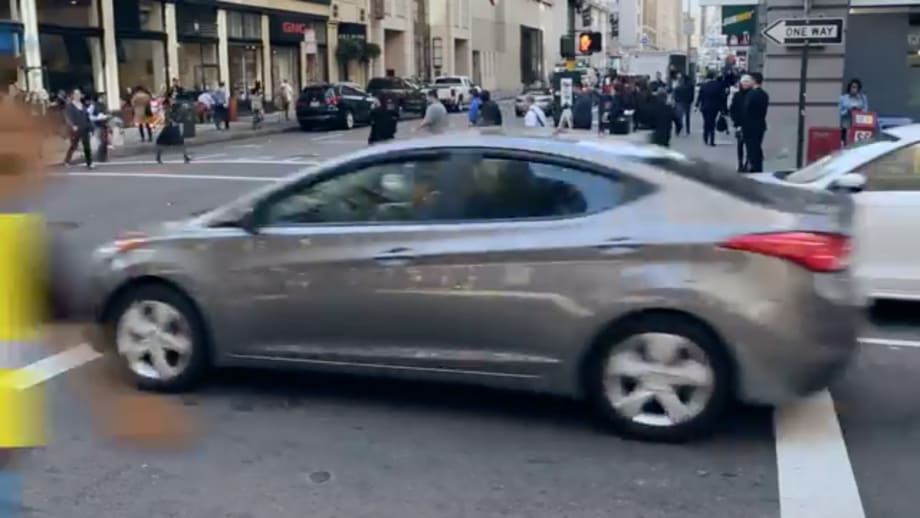
Photo: AAA
Some drivers become more apprehensive when they’re driving in a major city’s central business district. There are more vehicles, pedestrians, bicyclists, blaring horns, responding emergency vehicles, one-way streets, bus stops — all of which can combine to make driving more challenging.
Click on the photo or link above to watch a video that offers city driving tips from Vision Zero San Francisco and the San Francisco Municipal Transportation Agency.
Additionally, State Farm offers this advice:
Avoid aggressive driving and weaving from lane to lane.
Keep a safe distance of at least three seconds between you and the vehicle ahead of you. This will help avoid frequent braking and rear-end collisions.
Watch the traffic ahead closely. When cars in front brake, take your foot off the accelerator to slow down gradually before you brake. Be cautious not to brake abruptly.
Stay focused. Keep your mind on driving by avoiding distractions such as eating or using your cell phone.
Use your blinkers when changing lanes or merging. Most state laws require activating blinkers at least 100 feet before merging or turning, but some states require at least 200 feet.
Use your mirrors to monitor the areas around your car. Perform head checks to check your blind spots before changing lanes or merging.
Use the length of the acceleration lane to merge safely into traffic.
Be responsible with technology, and plan ahead. Before you start your trip, check traffic apps on your phone or listen to radio reports to avoid extra-congested areas. If you're worried about encountering heavy traffic during your commute, take time before you leave to map out an alternate route on your GPS.
More Safety
Managing Road Risk at Scale: Why Fleet Safety Needs a Data-Driven Framework
Insights from the FIA Road and Driver Safety Indexes reveal how to manage road risk on a larger scale.
Read More →
Stellantis Recalls 1.3 Million Jeep Vehicles Worldwide Over Fire Risk
Stellantis is recalling more than 1.3 million Jeep Wrangler and Gladiator models worldwide over a fire risk linked to power steering pump wiring.
Read More →
Coaching Is Not Training, Even When AI Is Doing It
AI-powered safety platforms can detect risky behaviors and deliver immediate feedback. But effective driver development still requires a foundation of training followed by coaching that reinforces those skills.
Read More →
How Emotions Behind the Wheel Can Affect Fleet Safety
During National Safety Month, fleets are encouraged to look beyond distracted driving and recognize how stress, fatigue, and emotional well-being influence driver performance and crash risk.
Read More →
Nominations Open for 2026 Fleet Safety Award
Nominations have officially opened for the 2026 Fleet Safety Award Winner.
Read More →
Turning Connected Vehicle Data Into Decisions That Matter
Fleet leaders have more data than ever, but turning that data into clear, actionable decisions remains a challenge. This white paper shows how leading organizations are using connected vehicle data to improve safety, reduce costs, and optimize fleet performance. Learn how to turn insight into action across your fleet.
Read More →
Cameras, Safety and Insurance: From Reactive Claims to Real-time Prevention
Commercial auto remains one of the most challenging and costly lines of coverage for fleet operators and insurers alike. Learn more about how to effectively address these issues from Onur Aksan, Enterprise Business Development Executive, Geotab.
Read More →
NAFA Fleet Safety Symposium to Collocate With 2026 Fleet Forward Conference
The daylong certificate program will precede the Fleet Forward Conference at the Gaylord National Harbor in Maryland.
Read More →
The Distractions You Can’t Turn Off: What Drivers Face Outside the Vehicle
Fleet drivers face constant visual, cognitive, and environmental interruptions the moment they hit the road. From roadside chaos to mental fatigue and digital overload, today’s biggest driving risks often come from outside the vehicle itself.
Read More →
FLASH Weather AI Launches First Deep-Learning Hail Prediction Model With High-Resolution Forecasting
FLASH Weather AI has launched a first-of-its-kind hail prediction model capable of forecasting hail size and arrival time at 1-kilometer resolution up to 55 minutes ahead, giving fleets and insurers critical time to prepare for severe storms.
Read More →