




Watch the Hyundai Santa Fe Earn Top Safety Honor
The Insurance Institute for Highway Safety names the mid-size SUV a Top Safety Pick+ award winner.

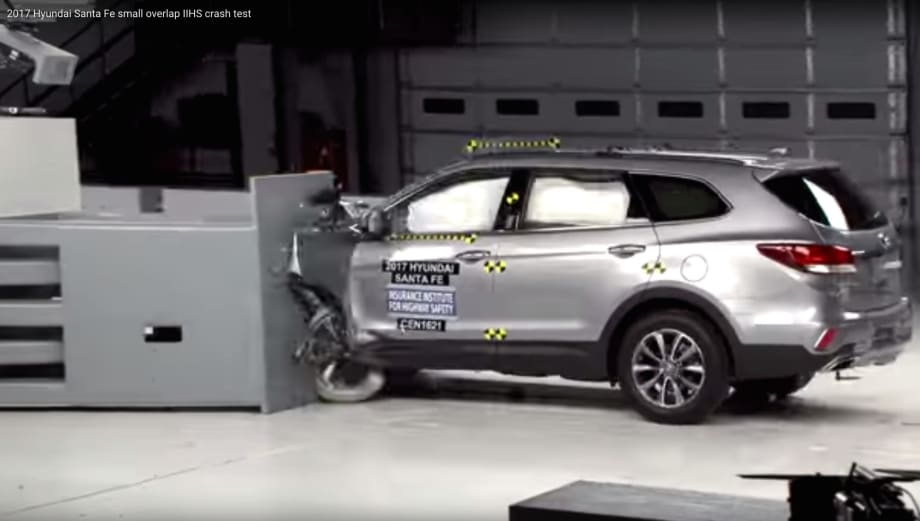
The three-row Santa Fe SUV, a distinct model from the two-row Santa Fe Sport, previously earned a “marginal” rating in the institute’s small overlap test. But the 2017 model drew a rating of “good” — the highest possible score — in that crash test.
Photo: IIHS
The 2017 model-year Hyundai Santa Fe, which includes improvements designed to boost protection in a small overlap front crash, has captured the Top Safety Pick+ award from the Insurance Institute for Highway Safety.
The three-row Santa Fe SUV, a distinct model from the two-row Santa Fe Sport, previously earned a “marginal” rating in the institute’s small overlap test. But the 2017 model drew a rating of “good” — the highest possible score — in that crash test.
Introduced in 2012, the small overlap front test replicates what happens when the front, driver-side corner of a vehicle collides with another vehicle or an object such as a tree or utility pole.
The earlier version of the Santa Fe suffered extensive structural damage to the driver’s space during this test, IIHS said, with intrusion measuring as much as 10 inches at the lower door hinge pillar. The dummy’s head barely contacted the frontal air bag before sliding off the left side, as the steering column moved 5 inches to the right.
Hyundai reinforced the occupant compartment beginning with the 2017 model year. After production began, the driver safety belt was modified to further improve small overlap protection.
As a result, the vehicle’s performance in the small overlap crash test improved markedly. Maximum intrusion was just 4 inches at the lower door hinge pillar, and the safety belt and air bags worked well to control the dummy’s movement, IIHS said.
The “good” rating applies to 2017 Santa Fe SUVs built after March, when the safety belt was changed.
The Santa Fe also attracted ratings of “good” in the institute’s moderate overlap front, side, roof strength, and head restraint tests.
The new model’s optional front crash prevention system drew the highest rating of “superior.” When equipped with the system, the Santa Fe avoided collisions in 12 mph and 25 mph track tests, according to IIHS. The system also includes a forward collision warning component that meets criteria from the National Highway Traffic Safety Administration.
The front crash prevention system is part of a technology package that also includes curve-adaptive, high-intensity discharge headlights that earned a “good” rating in IIHS headlight evaluations.
According to IIHS, the low beams provide good or fair visibility on most approaches and don’t create excessive glare for oncoming drivers. Additionally, the high beams provide mostly good visibility.
The package also includes high beam assist, a feature that automatically switches between high beams and low beams, depending on the presence of other vehicles.
Without the technology package, the Santa Fe comes with halogen headlights that drew a “poor” rating from IIHS.
Currently, to qualify for the Top Safety Pick+ award, a vehicle must have “good” ratings in the five crashworthiness tests and an “advanced” or “superior” rating for front crash prevention. For 2017, a “good” or “acceptable” headlight system also will be required.
More Safety

What’s Next for Fleet? Safety, AI & Industry Recognition | AF News Recap
Could your company's culture be encouraging distracted driving? This week, we're exploring how workplace expectations affect driver safety, what AI, EVs, and autonomous vehicles could mean for the future of fleet management, and how fleet professionals can strengthen their award nominations.
Read More →
Does Your Fleet's Culture Encourage Distracted Driving?
What happens when the people responsible for enforcing safety rules are the ones setting the wrong example? The answer may reveal why some of the biggest risks to fleet drivers have little to do with what's written in the employee handbook.
Read More →
Fleet Manager’s Ultimate Playbook: Navigating the New Standard in OEM Connectivity
Rising operating costs, driver safety concerns, and unplanned downtime are putting unprecedented pressure on modern fleets. Discover how fleet managers use embedded OEM connectivity and real-time vehicle data to cut TCO, prevent downtime, and protect drivers without aftermarket telematics hardware.
Read More →
From Driver Well-Being to EV Charging | AF News Recap
Mental health belongs in the fleet safety conversation. This week, we’re looking at five ways fleets can support employee well-being before a crisis, plus Holman’s expansion in Mexico, new one-day Fleet Forward passes, and why EV charging demand is outpacing infrastructure growth.
Read More →
Nexar-Nauto Merger Aims to Give Fleets Better Safety Intelligence Through Larger Driving Dataset
Stefan Heck tells Automotive Fleet that combining more than 10 billion miles of driving history with Nexar's AI models will give fleets deeper insights into driver risk and roadway conditions than either company could provide independently.
Read More →
Don't Wait for a Crisis: 5 Ways to Build Mental Health Into Your Fleet Safety Program
For Suicide Prevention Month, fleet and safety leaders have an opportunity to put mental health where it belongs: at the center of workplace safety.
Read More →
How Camera Data Can Strengthen a Fleet’s Insurance Renewal
Insights from a commercial insurance carrier and a broker show how fleets can turn video telematic data, driver coaching, and improved claims results into a stronger case at insurance renewal.
Read More →
The Safest Fleets Aren’t the Ones with the Most Technology
You’ve made the telematics investment. Here’s how to capture the other half of its value and build the safest fleet on the road.
Read More →
Hidden in Plain Sight: Fleet Compliance Risks
Fleet compliance isn't just about having policies — it's about consistently enforcing them. This practical guide reveals six hidden compliance risks common in public sector and shared fleet operations and outlines proven strategies to improve visibility, accountability, and audit readiness
Read More →
NETS Sets 2026 Fleet Safety Benchmark Conference for Indianapolis
The Sept. 15–17 program will feature fleet benchmarking data, case studies, emerging technologies, and implementation strategies while running alongside the NSC Safety Congress & Expo.
Read More →