





Miss This? Maintenance Costs Edge Up in Q1 2025, Some Services Decline
Less than 50% of American Drivers Know How to Change A Tire
Routine maintenance and upkeep are crucial to the longevity of your vehicle.
August 6, 2025
FinanceBuzz surveyed 1,000 American drivers to test their knowledge.
Photo: Automotive Fleet
3 min to read
A recent survey conducted by FinanceBuzz is shining a light on what American drivers know about caring for their vehicles.
The team at FinanceBuzz surveyed 1,000 U.S. adults on basic automotive knowledge to find out what they do and do not know.
Routine Maintenance Tasks
Cars are essential to the American daily routine, and so is their maintenance. While most Americans have their favorite mechanic shops to help with the routine upkeep, like oil and filter changes, knowing how to do some of these tasks yourself can save a lot of money in the long run.
Most respondents would not be able to change a spare tire in an emergency, with 48% of drivers saying they do not know how.
Oil changes, while the most common of car maintenance tasks, are the most procrastinated on. Doing it yourself could save $75-$100 per change; however, only 36% of drivers said they can perform their own oil change.
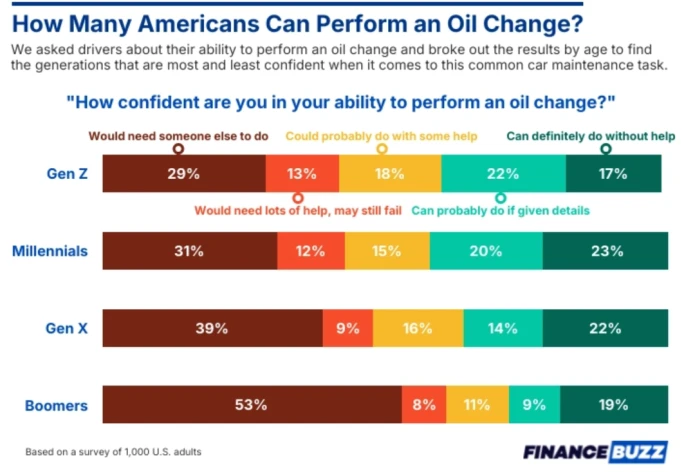
While there is a generational divide, most people are not performing their own vehicle maintenance.
Graph: FinanceBuzz
Changing spark plugs is the task with the lowest confidence level when it comes to doing it yourself, with 73% of respondents saying they would need someone else to do the job.
Generation Gap
As with many things, experience makes a big difference. Age impacts a driver’s knowledge of cars, driving, and maintenance.
The youngest generation, Gen Z, is the least knowledgeable and has the least confidence in their ability to perform an oil change.
Millennials are most confident in their abilities to perform their own oil changes, with some adding that they would need to look up a few details before doing so.
Older generations, like Boomers and Gen X, have more car experience because they have been driving for longer; however, that did not result in a higher rate of confidence or ability to do their oil change.
Drivers Just Don’t Understand
While maintenance and upkeep are central to being a responsible car owner, so is knowing your car's warning signs and keeping an updated car insurance policy.
All vehicles have safety warning lights built into the vehicle’s dashboard to alert drivers when something is needed. But how effective are these lights if drivers don’t know what they mean?
Just 75% of drivers knew the check engine and oil pressure symbols, and even fewer know the difference between the tire pressure and brake indicator.
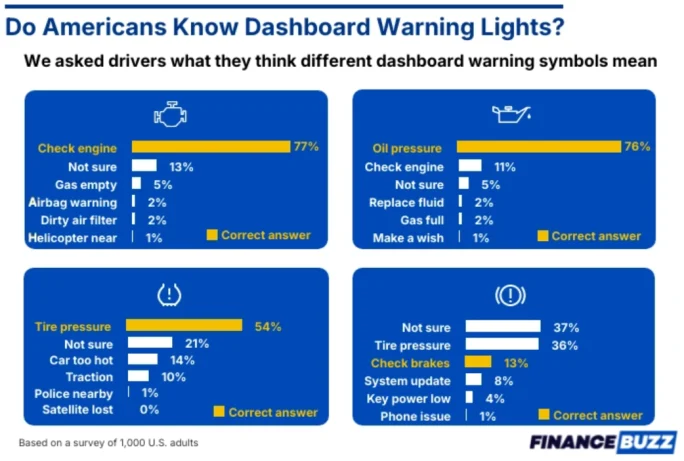
While most Americans can identify the check engine light, they cannot readily identify other dashboard warning symbols.
Graph: FinanceBuzz
While 70% of drivers say they are confident they know how much their monthly auto insurance premium costs, they are uncertain of their coverage limits. Only 48% are confident in their knowledge of insurance coverage limits.
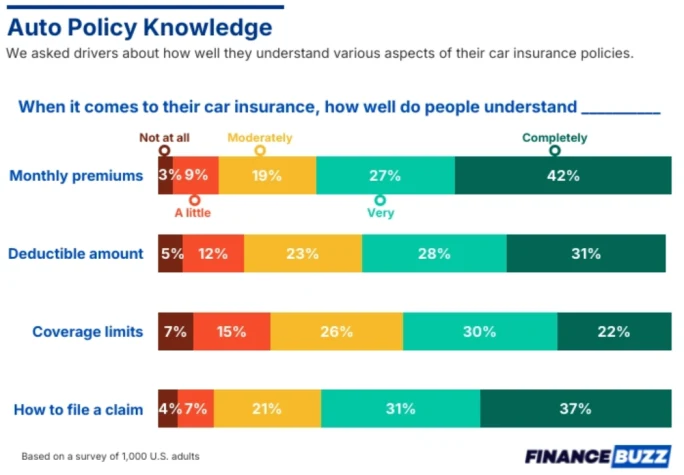
Most Americans are not familiar with the details of their insurance coverage.
Graph: FinanceBuzz
FinanceBuzz offers some important reminders when picking an insurance provider:
Pick the right provider. Find highly rated insurers that offer a potent mix of coverage, pricing, and customer support.
Get clarity on your coverage plan. Familiarize yourself with your coverage plan and any incentives your provider may offer for safe driving or courses; some could save you hundreds yearly.
Manage auto repairs with smart financing. Explore payment options for maintenance fees. Some shops offer their own financing for big-ticket jobs.
Taking the time to learn and understand the warning symbols for your vehicle’s make and model and your insurance coverage promotes safety when driving and in an emergency.
Subscribe to Our Newsletter
More Safety

Sponsored•October 1, 2026
Fleet Manager’s Ultimate Playbook: Navigating the New Standard in OEM Connectivity
Rising operating costs, driver safety concerns, and unplanned downtime are putting unprecedented pressure on modern fleets. Discover how fleet managers use embedded OEM connectivity and real-time vehicle data to cut TCO, prevent downtime, and protect drivers without aftermarket telematics hardware.
Read More →
From Driver Well-Being to EV Charging | AF News Recap
Mental health belongs in the fleet safety conversation. This week, we’re looking at five ways fleets can support employee well-being before a crisis, plus Holman’s expansion in Mexico, new one-day Fleet Forward passes, and why EV charging demand is outpacing infrastructure growth.
Read More →
Nexar-Nauto Merger Aims to Give Fleets Better Safety Intelligence Through Larger Driving Dataset
Stefan Heck tells Automotive Fleet that combining more than 10 billion miles of driving history with Nexar's AI models will give fleets deeper insights into driver risk and roadway conditions than either company could provide independently.
Read More →
Don't Wait for a Crisis: 5 Ways to Build Mental Health Into Your Fleet Safety Program
For Suicide Prevention Month, fleet and safety leaders have an opportunity to put mental health where it belongs: at the center of workplace safety.
Read More →
How Camera Data Can Strengthen a Fleet’s Insurance Renewal
Insights from a commercial insurance carrier and a broker show how fleets can turn video telematic data, driver coaching, and improved claims results into a stronger case at insurance renewal.
Read More →
The Safest Fleets Aren’t the Ones with the Most Technology
You’ve made the telematics investment. Here’s how to capture the other half of its value and build the safest fleet on the road.
Read More →
Sponsored•August 7, 2026
Hidden in Plain Sight: Fleet Compliance Risks
Fleet compliance isn't just about having policies — it's about consistently enforcing them. This practical guide reveals six hidden compliance risks common in public sector and shared fleet operations and outlines proven strategies to improve visibility, accountability, and audit readiness
Read More →
NETS Sets 2026 Fleet Safety Benchmark Conference for Indianapolis
The Sept. 15–17 program will feature fleet benchmarking data, case studies, emerging technologies, and implementation strategies while running alongside the NSC Safety Congress & Expo.
Read More →
Off-the-Job Crashes Account for 43% of Employers’ $61.7 Billion Crash Burden
NETS quantifies costs dispersed across fleet, risk, HR, and other departments while providing new per-crash benchmarks for employers.
Read More →
Ram Recalls More Than 1.27 Million 1500 Pickups for Seat Belt Anchor Issue
The recall affects certain 2019-2026 Ram 1500 pickups that may have improperly attached second-row seat belt buckle anchors.
Read More →