





Did You Miss This News? Report: Distracted Driving Falls for First Time Since 2020
Safety First: Mastering Work Zone Awareness
Some basics on staying safe in work zones to protect yourself and others. Plus, a look at what’s in store for this year’s National Work Zone Awareness Week.
April 16, 2024
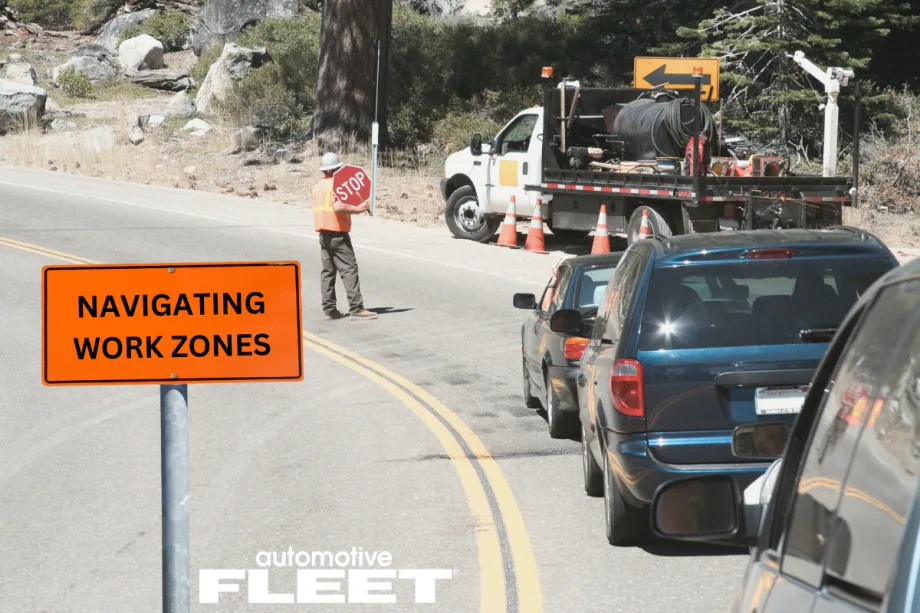
Road work may mean a lane is closed or the position of the lanes has shifted. Pay attention to these changes and be prepared to merge as needed.
Photo: Automotive Fleet
3 min to read
Warmer temperatures make spring and summer the perfect time for road construction projects. Fleet drivers may find these work zones frustrating, but keep in mind that they demand more focus and attention for safety’s sake.
Many vehicle crashes occur in construction zones, which is why the U.S. Federal Highway Administration hosts National Work Zone Awareness Week, which is set for April 15-19 this year.
Following a few easy tips can protect roadside workers, while also reducing your own risk, making the task of driving through work zones simpler and safer.
How to Navigate Work Zones
Stay alert for road work zones. They’re typically indicated by special signs, barrels, or cones. You also may see workers in orange or other colored vests. If a sign tells you a road work zone is ahead, be prepared to adjust your driving.
Reduce your speed to the posted limit in the work zone. You’ll normally see signs ahead of the work area alerting you that a reduced speed limit is coming up. These limits are designed to keep drivers and road workers safe, so always obey them. And remember that speeding in a work zone usually carries higher fines than speeding in other areas.
Keep an eye out for new traffic patterns. Road work may mean a lane is closed or the position of the lanes has shifted. Pay attention to these changes and be prepared to merge as needed.
Give workers ample room. If you can avoid driving in the lane adjacent to the road work, it’s best to do so, but if you must drive in that lane stay centered and avoid drifting toward the right line. These actions help to give road crews and their vehicles more space to work and add distance between passing traffic and workers standing on the roadside.
Give other motorists more space, too. If you’re tailgating the vehicle ahead, you won’t have the time or space to avoid a rear-end collision if the driver stops or slows abruptly.
Stay attentive to the driving task. No matter what the environment, driving always demands your complete focus. But in work zones it’s even more important to avoid distraction. Stay off the phone, don’t eat, and don’t attend to anything other than driving while traveling through a work zone.
Check your route before you depart. When you know what to expect, you have the option to adjust your route to avoid road construction or allow more travel time in case road work ties up traffic. Check local sources like a state, county, or province transportation web site for details on current road work activity before you depart.
Road work projects help ensure the highways and other roads we travel are up to par. But highway work zones make for a challenging driving environment. While your immediate concern may be slowed traffic and delays, the bigger issue is the increased risk in work zones and the need for greater focus on driving.
National Work Zone Awareness Week (NWZAW) has effectively raised awareness for work zone safety nationwide thanks to the active involvement of organizations, companies, and individual state-run programs and education.
Every year, hundreds of companies engage with the American Traffic Safety Services Association on social media through the #NWZAW hashtag, contributing to its impactful reach.
NWZAW highlights the deadly dangers of inattention at highway work areas. The 2024 weeklong commemoration includes, according to the U.S. Department of Transportation Federal Highway Administration:
Work Zone Safety Training Day: April 15
National kickoff event: April 16
Go Orange Day: April 17
Social media storm: April 18
Moment of silence: April 19*
*The moment of silence started in 2022 to remember the people whose lives have been lost in a work zone incident.
This year’s theme is: “Work Zones are temporary. Actions behind the wheel can last forever.”
This article was authored and edited according to Automotive Fleet's editorial standards and style. Opinions expressed may not reflect that of Automotive Fleet.
Subscribe to Our Newsletter
More Safety

Sponsored•October 1, 2026
Fleet Manager’s Ultimate Playbook: Navigating the New Standard in OEM Connectivity
Rising operating costs, driver safety concerns, and unplanned downtime are putting unprecedented pressure on modern fleets. Discover how fleet managers use embedded OEM connectivity and real-time vehicle data to cut TCO, prevent downtime, and protect drivers without aftermarket telematics hardware.
Read More →
From Driver Well-Being to EV Charging | AF News Recap
Mental health belongs in the fleet safety conversation. This week, we’re looking at five ways fleets can support employee well-being before a crisis, plus Holman’s expansion in Mexico, new one-day Fleet Forward passes, and why EV charging demand is outpacing infrastructure growth.
Read More →
Nexar-Nauto Merger Aims to Give Fleets Better Safety Intelligence Through Larger Driving Dataset
Stefan Heck tells Automotive Fleet that combining more than 10 billion miles of driving history with Nexar's AI models will give fleets deeper insights into driver risk and roadway conditions than either company could provide independently.
Read More →
Don't Wait for a Crisis: 5 Ways to Build Mental Health Into Your Fleet Safety Program
For Suicide Prevention Month, fleet and safety leaders have an opportunity to put mental health where it belongs: at the center of workplace safety.
Read More →
How Camera Data Can Strengthen a Fleet’s Insurance Renewal
Insights from a commercial insurance carrier and a broker show how fleets can turn video telematic data, driver coaching, and improved claims results into a stronger case at insurance renewal.
Read More →
The Safest Fleets Aren’t the Ones with the Most Technology
You’ve made the telematics investment. Here’s how to capture the other half of its value and build the safest fleet on the road.
Read More →
Sponsored•August 7, 2026
Hidden in Plain Sight: Fleet Compliance Risks
Fleet compliance isn't just about having policies — it's about consistently enforcing them. This practical guide reveals six hidden compliance risks common in public sector and shared fleet operations and outlines proven strategies to improve visibility, accountability, and audit readiness
Read More →
NETS Sets 2026 Fleet Safety Benchmark Conference for Indianapolis
The Sept. 15–17 program will feature fleet benchmarking data, case studies, emerging technologies, and implementation strategies while running alongside the NSC Safety Congress & Expo.
Read More →
Off-the-Job Crashes Account for 43% of Employers’ $61.7 Billion Crash Burden
NETS quantifies costs dispersed across fleet, risk, HR, and other departments while providing new per-crash benchmarks for employers.
Read More →
Ram Recalls More Than 1.27 Million 1500 Pickups for Seat Belt Anchor Issue
The recall affects certain 2019-2026 Ram 1500 pickups that may have improperly attached second-row seat belt buckle anchors.
Read More →