





See Also: Over Half of Mid-Size SUVs Capture Good Rating in Side-Impact Test
2022 Toyota Tacoma Struggles in Passenger-Side Crash Test
While it garnered good ratings in five other crashworthiness evaluations, the 2022 Toyota Tacoma did not meet the safety standards of IIHS engineers during the passenger-side small overlap front crash test.
June 10, 2022
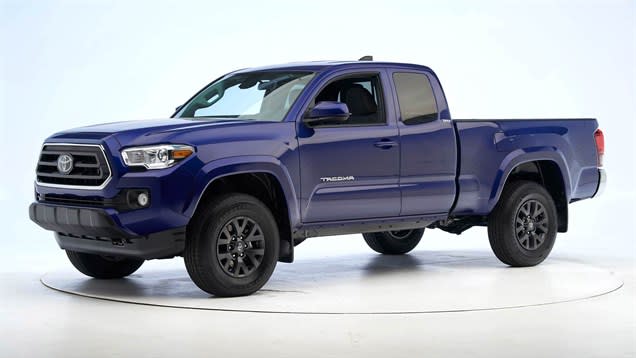
The 2022 Toyota Tacoma may have faltered in its passenger-side, the vehicle garnered good ratings in five other evaluations.
Photo: IIHS
2 min to read
The Insurance Institute for Highway Safety (IIHS) has given the 2022 Toyota Tacoma extended cab pickup just a marginal rating in one of its key crashworthiness evaluations — the passenger-side small overlap front crash test.
The reason the small pickup did not score better was due to heightened injury risks to the front seat passenger, notes IIHS.
Also noteworthy, the marginal rating applies to vehicles built after October 2021, when Toyota modified the rear leaf springs — arc-shaped steel pieces that stabilize the axle. Vehicles built prior to that date are rated poor.
In an earlier evaluation of a vehicle built before the changes, one of the rear leaf springs punctured the fuel tank, resulting in a fire risk and an automatic downgrade. While the automaker’s modifications corrected the fuel-leak issue, other problems persisted in the more recent test.
Specifically, the Tacoma’s doorframe and dashboard intruded into the occupant survival space during the crash, contributing to heightened injury risks to the front seat passenger. Based on the crash dummy, IIHS engineers determined a high risk of injury to the occupant’s right leg and a moderate risk of injury to the left leg. Though the frontal and side curtain airbags performed reasonably well, the dummy’s head also struck the grab handle on the A-pillar on the right side of the windshield.
Although the Tacoma struggled through the passenger-side small overlap front crash test, it garnered good ratings in five other evaluations. These included the driver-side small overlap, moderate overlap front, original side, roof strength, and head restraint tests.
The IIHS also sets rigorous standards for front crash prevention and headlights. In both cases, the Tacoma performed relatively well.
The pickup’s standard front crash prevention system captured a superior rating in the vehicle-to-vehicle evaluation but was not tested for pedestrian detection. The optional LED reflector headlights available on higher trims scored a good rating, but the base halogens are rated marginal.
More Safety

What’s Next for Fleet? Safety, AI & Industry Recognition | AF News Recap
Could your company's culture be encouraging distracted driving? This week, we're exploring how workplace expectations affect driver safety, what AI, EVs, and autonomous vehicles could mean for the future of fleet management, and how fleet professionals can strengthen their award nominations.
Read More →
Does Your Fleet's Culture Encourage Distracted Driving?
What happens when the people responsible for enforcing safety rules are the ones setting the wrong example? The answer may reveal why some of the biggest risks to fleet drivers have little to do with what's written in the employee handbook.
Read More →
Sponsored•October 1, 2026
Fleet Manager’s Ultimate Playbook: Navigating the New Standard in OEM Connectivity
Rising operating costs, driver safety concerns, and unplanned downtime are putting unprecedented pressure on modern fleets. Discover how fleet managers use embedded OEM connectivity and real-time vehicle data to cut TCO, prevent downtime, and protect drivers without aftermarket telematics hardware.
Read More →
From Driver Well-Being to EV Charging | AF News Recap
Mental health belongs in the fleet safety conversation. This week, we’re looking at five ways fleets can support employee well-being before a crisis, plus Holman’s expansion in Mexico, new one-day Fleet Forward passes, and why EV charging demand is outpacing infrastructure growth.
Read More →
Nexar-Nauto Merger Aims to Give Fleets Better Safety Intelligence Through Larger Driving Dataset
Stefan Heck tells Automotive Fleet that combining more than 10 billion miles of driving history with Nexar's AI models will give fleets deeper insights into driver risk and roadway conditions than either company could provide independently.
Read More →
Don't Wait for a Crisis: 5 Ways to Build Mental Health Into Your Fleet Safety Program
For Suicide Prevention Month, fleet and safety leaders have an opportunity to put mental health where it belongs: at the center of workplace safety.
Read More →
How Camera Data Can Strengthen a Fleet’s Insurance Renewal
Insights from a commercial insurance carrier and a broker show how fleets can turn video telematic data, driver coaching, and improved claims results into a stronger case at insurance renewal.
Read More →
The Safest Fleets Aren’t the Ones with the Most Technology
You’ve made the telematics investment. Here’s how to capture the other half of its value and build the safest fleet on the road.
Read More →
Sponsored•August 7, 2026
Hidden in Plain Sight: Fleet Compliance Risks
Fleet compliance isn't just about having policies — it's about consistently enforcing them. This practical guide reveals six hidden compliance risks common in public sector and shared fleet operations and outlines proven strategies to improve visibility, accountability, and audit readiness
Read More →
NETS Sets 2026 Fleet Safety Benchmark Conference for Indianapolis
The Sept. 15–17 program will feature fleet benchmarking data, case studies, emerging technologies, and implementation strategies while running alongside the NSC Safety Congress & Expo.
Read More →