




WEX Says Fuel Prices Falling, U.S. EIA Predict Lower Prices Later This Year
Both retail and wholesale gasoline prices are dropping, according the monthly WEX Index. Diesel is also expected to decline due to weakening demand and the spring thaw.
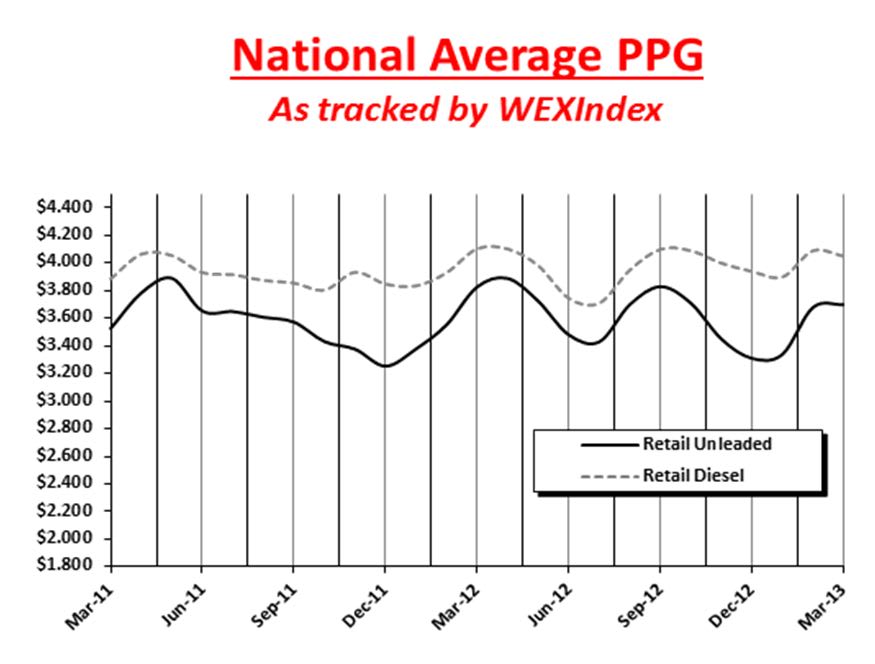
WEXIndex Retail Fuel Price Index is a monthly publication produced by WEX Inc. with market insights provided by OPIS Energy Group.
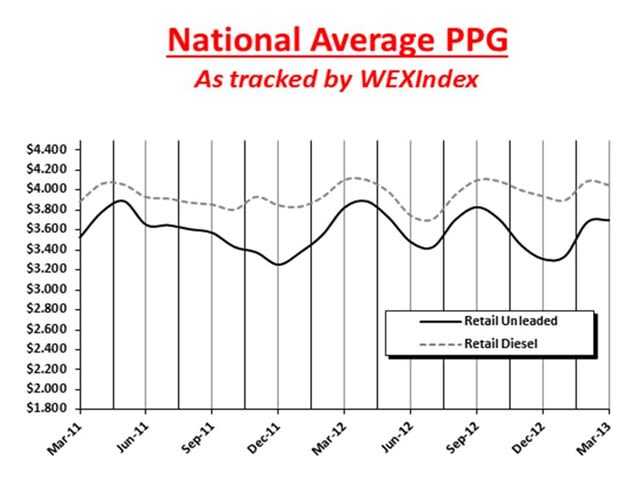
WEXIndex Retail Fuel Price Index is a monthly publication produced by WEX Inc. with market insights provided by OPIS Energy Group.
The national average for retail gasoline has fallen 10 cents per gallon in the past month to $3.64 per gallon, according to the monthly report from WEX Inc.
This drop means the national average is down nearly 30 cents per gallon compared to last year, and WEX said that analysts forecast more drops in the weeks to come.
WEX Monthly Average
Price Per Gallon
– March 2013
CITYUNLEADEDDIESEL Atlanta, GA $3.60 $4.02 Boston, MA $3.74 $4.16 Chicago, IL $3.96 $4.13 Dallas, TX $3.62 $3.97 Denver, CO $3.53 $3.94 Detroit, MI $3.79 $4.15 Houston, TX $3.56 $3.93 Los Angeles, CA $4.23 $4.31 Memphis, TN $3.50 $3.93 Miami, FL $3.84 $4.16 Minneapolis, MN $3.61 $4.01 New Orleans, LA $3.53 $3.89 Philadelphia, PA $3.66 $4.14 Phoenix, AZ $3.79 $4.00 Portland, OR $3.80 $4.04 San Francisco, CA $4.21 $4.45 Seattle, WA $3.90 $4.23 St. Louis, MO $3.58 $3.80 Washington, DC $3.99 $4.19 National Average$3.70$4.05
Wholesale prices are also seeing tremendous declines. U.S. crude and refined product prices are under assault this week, according to WEX, and a mixed report from the Energy Information Administration (EIA) seems to confirm suspicions that a slowdown has gripped the country in recent weeks.
Gasoline demand last week, as measured by EIA, actually rose by 124,000 b/d (barrels per day) but that reflects a poor level for a week bracketing the peak Easter spring break period.
There is a hint that demand is particularly poor across the upper tier of U.S. states in the Midwest and Northeast. The four-week average for gasoline is now 104,000 b/d behind last year, after a relatively robust February. American consumers may be beneficiaries of motor fuel
costs that are 30 cents per gallon below a year ago, but EIA stats have yet to demonstrate any measurable lift from cheaper prices.
Every state has an average below last year with Indiana showing the largest year-over-year change with prices down 41 cents per gallon. North Dakota has the smallest difference from last year with the average price off by just 12.5 cents per gallon.
Meanwhile, diesel prices nationally are hovering at $4.00 per gallon. However, demand for distillate (the product used to make diesel) dropped by a hefty 341,000 b/d on the week. The four-week average shows a gain of nearly 200,000 b/d to last year, but virtually all of that difference can be attributed to cold weather. The supposition is that there is a slump in diesel for domestic transportation usage.
Experts believe that diesel prices could see large declines, due to the spring thaw and weak demand.
The U.S. Energy Information Administration also released its latest Short-Term Energy and Summer Fuels Outlook on April 9, which predicts that regular gasoline retail prices will average $3.63 per gallon during the summer driving season. EIA also predicts that in the May 2013, the average price for a gallon of regular gasoline at retail will fall to $3.57.
For oil prices, the EIA said the Brent crude oil spot price will average $108 per barrel in 2013, which is down from $112 per barrel in 2012. The price of Brent crude did spike in February of this year to $119 per barrel but has since fallen. Looking ahead, EIA predicts that West Texas Intermediate will be roughly $14 per barrel less expensive than Brent crude, and that this price will fall further as planned new pipeline capacity could reduce the cost of moving oil from the middle of the continent to Gulf Coast refineries.
Updated 4/9/2013 with EIA Short Term Energy Outlook information.
More Fuel

Turning Fleet Payment Data into Executive Insights
Ramel Lindsay of U.S. Bank Voyager discusses how fleets can transform payment and transaction data into actionable intelligence to reduce costs, improve oversight, and support executive decision-making.
Read More →
Why the IRS Raised Its Mileage Rate in the Middle of 2026
Fuel-price volatility drove the rare increase to 76 cents per mile, the fifth midyear adjustment since 2000.
Read More →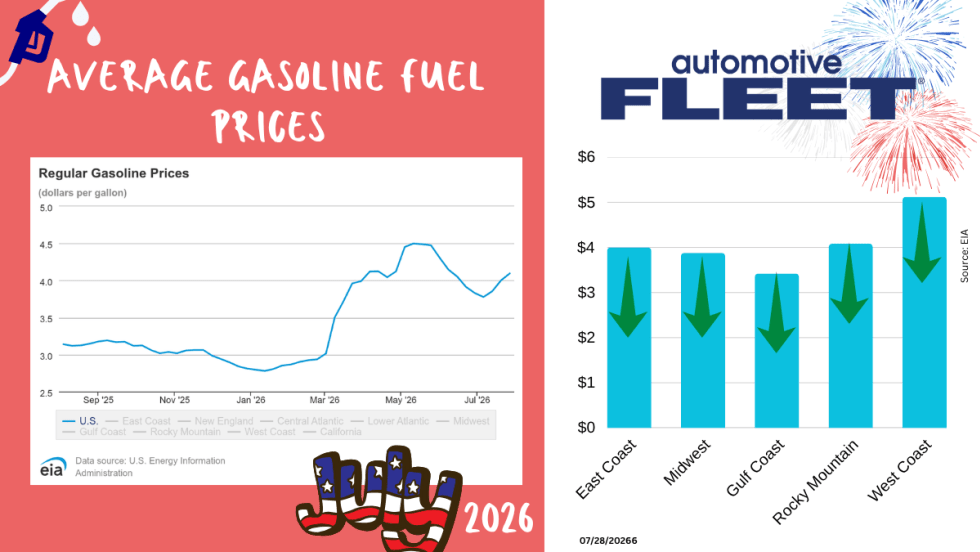
July Fuel Update: Prices Keep Rising in Light of More Conflict
Gas prices continue to rise as more and more conflicts do, too.
Read More →
Bob Adamsky on Fuel Volatility: "Don't Panic, Have a Plan."
When it comes to up and down fuel prices, Adamsky has a message for fleets: “Don’t panic.”
Read More →
How Fleets Can Gain Control of Non-Fuel Spend
Fuel often gets the spotlight, but non-fuel expenses can have a major impact on fleet costs. Ramel Lindsay of U.S. Bank Voyager discusses how fleets can gain better visibility and control over these often-overlooked expenditures.
Read More →
Fuel is Just the Start: How Middle East Tensions are Driving Up Fleet Maintenance Costs
The Middle East conflict is doing more than pushing up fuel prices. It’s also raising the cost of key maintenance products your fleet depends on, from motor oil to tires to windshield wipers. Here’s what you need to know about this budget-busting situation.
Read More →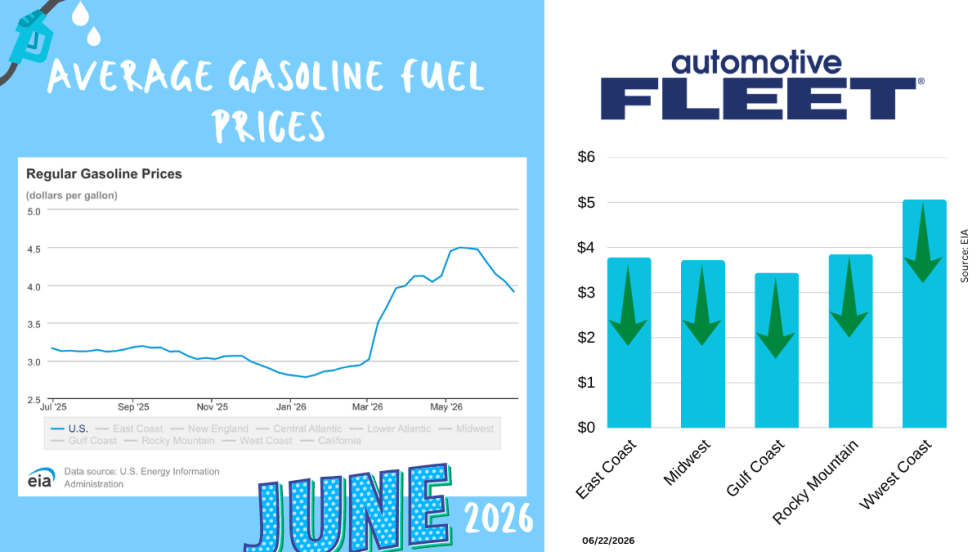
June Fuel Update: Prices Fall Below $4
Drivers are finally getting some relief at the pump. The national average gas price has dropped below $4 a gallon for the first time in months, with prices falling in 47 states as oil markets react to developments in U.S.-Iran negotiations.
Read More →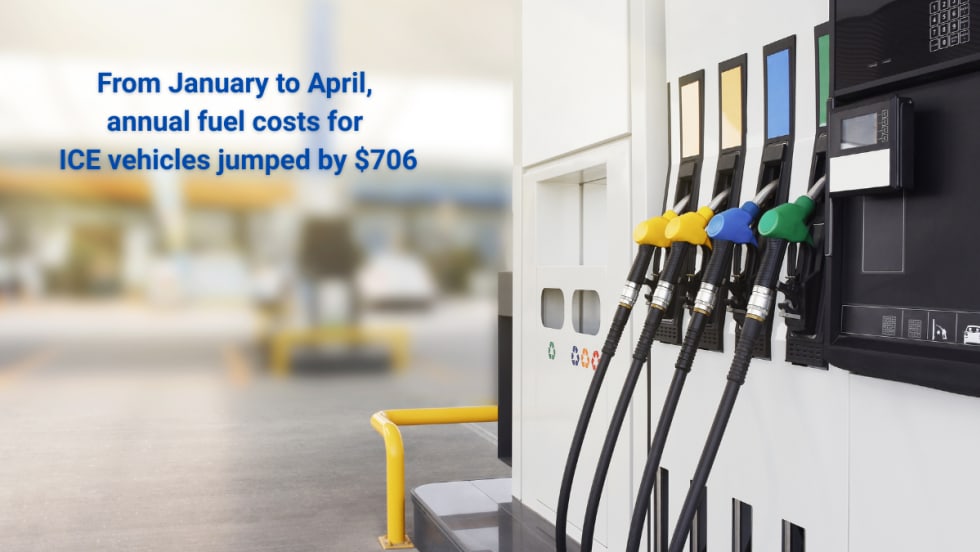
Study: How 2026's Gas Price Hikes Affect Different Vehicle Types
New data from iSeeCars reveals how rising fuel costs have affected different vehicle segments as gasoline prices climbed nearly 46% over the past four months.
Read More →
Are You Tracking Your Fleet's True Total Cost of Ownership?
Bobit Business Media surveyed 190 fleet professionals and found that while most fleets are tracking costs, fragmented systems and data gaps are keeping true TCO visibility out of reach. With rising pressure to control spend in an increasingly volatile environment, the gap between what fleets think they know and what the data actually shows is wider than you might expect. See how your peers are managing costs today and where the industry still has room to improve.
Read More →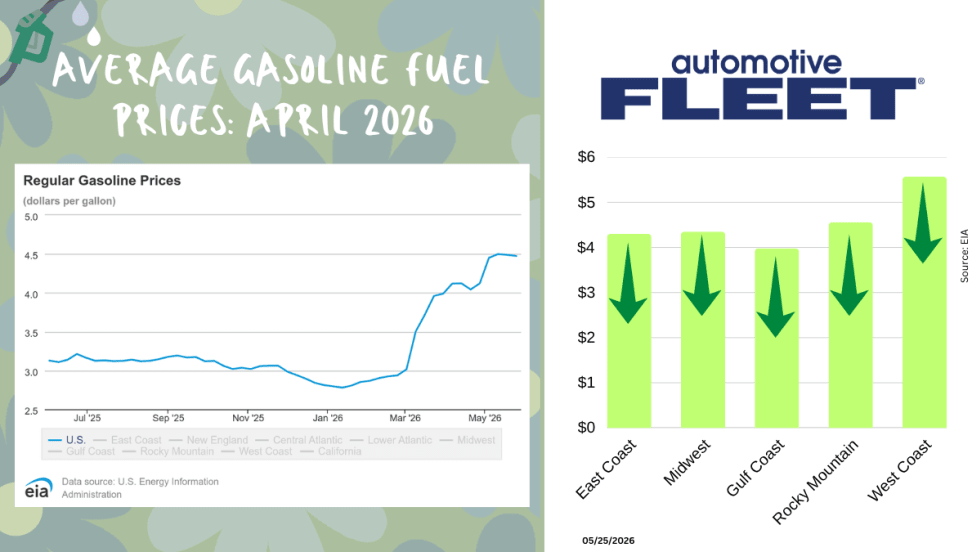
May Fuel Update: All Regions Experience Declines
Gas prices are finally easing in much of the country, but experts warn global tensions could quickly reverse the trend as the national average remains well above last month’s levels.
Read More →