




Waste Management Unveils New RNG Facility
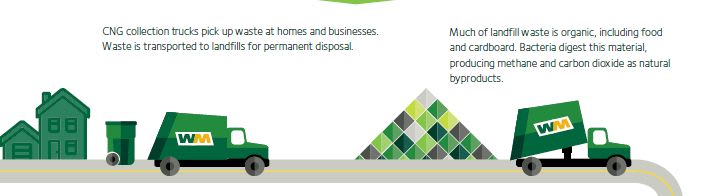
Waste Management unveiled the latest technology at its Outer Loop Recycling and Disposal Facility in Kentucky, turning waste from the landfill into usable, renewable natural gas (RNG).

Like wind, solar, and other biofuels, landfill gas is a renewable source of fuel and energy endorsed by the Environmental Protection Agency as an alternative to fossil fuels.
Image courtesy of Waste Management
Waste Management unveiled the latest technology at its Outer Loop Recycling and Disposal Facility in Kentucky, turning waste from the landfill into usable, renewable natural gas (RNG). This innovative facility captures methane produced by the landfill and converts it to pipeline quality natural gas.
The facility processes up to 5,000 standard cubic feet per minute (SCFM) of incoming landfill gas. This equates to about 2,500 mmbtu per day of RNG, or 18,000 diesel gallon equivalents (DGE) per day, enough to fuel about 800 of the company’s compressed natural gas (CNG) collection trucks.
The Outer Loop RNG facility serves as a model for a planned rollout of additional facilities in the coming years. Waste Management also operates renewable natural gas facilities in Illinois (Milam Landfill) and Ohio (American Landfill).
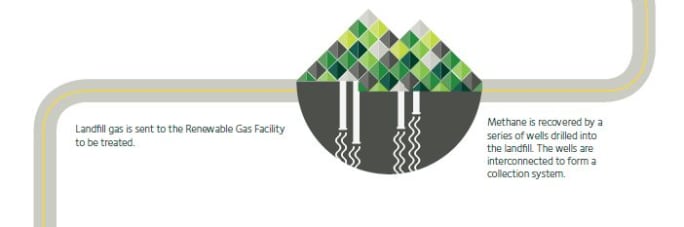
16 million diesel equivalent gallons of renewable natural gas are produced by harnessing the methane at the company’s landfills with RNG facilities.
Image courtesy of Waste Management
RNG, or biomethane, is a pipeline-quality gas that is fully interchangeable with conventional natural gas and thus can be used in natural gas vehicles. RNG is essentially biogas, the gaseous product of the decomposition of organic matter, that has been processed to purity standards. Like conventional natural gas, RNG can be used as a transportation fuel in the form of compressed natural gas (CNG) or liquefied natural gas (LNG).
16 million diesel equivalent gallons of renewable natural gas are produced by harnessing the methane at the company’s landfills with RNG facilities. Waste Management uses this RNG to fuel a portion of its collection fleet, lowering fuel costs and reducing greenhouse gas emissions more than 80% compared to those powered by diesel.
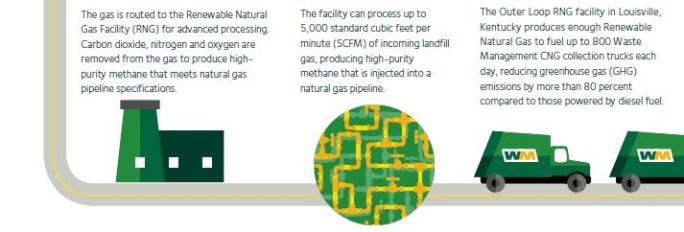
RNG, or biomethane, is a pipeline-quality gas that is fully interchangeable with conventional natural gas and thus can be used in natural gas vehicles.
Image courtesy of Waste Management
Waste Management’s 110 compressed natural gas stations deliver 60 million diesel equivalent gallons of natural gas each year. The company’s fleet of 6,700 natural gas trucks represents 30% of the company’s overall collection fleet. The company continues its commitment to converting its fleet from diesel to natural gas with 80% of new truck purchases powered by natural gas.
Like wind, solar, and other biofuels, landfill gas is a renewable source of fuel and energy endorsed by the Environmental Protection Agency as an alternative to fossil fuels. Waste Management is a leader in this important renewable resource, including the company’s landfill-gas-to-energy facilities, with 130 projects at our landfills around the country and the equivalent of more than 650 megawatts of capacity — enough to power 490,000 homes.
RELATED: Renewable Dairy Fuels Adding RNG Plant
Originally posted on Work Truck Online
More Green Fleet

Merchants Fleet Reports 290M EV Miles as Fleets Navigate Changing Electrification Market
From millions in operating savings to hundreds of millions of EV miles, Merchants Fleet’s latest report reveals what’s working and what’s changing in fleet electrification.
Read More →
The EV Breakdown Nobody's Talking About: Why Most Electric Vehicle Roadside Calls Aren't Mechanical Failures
Here's why EV breakdowns are widely misunderstood.
Read More →
ChargePoint Now Available in Energy Pass
ChargePoint and additional planned charging network integrations were added to GM's Energy Pass.
Read More →

First Look: Slate Auto's Electric Fleet Pickup
Could an affordable, modular EV pickup make electrification more practical for fleets?
Read More →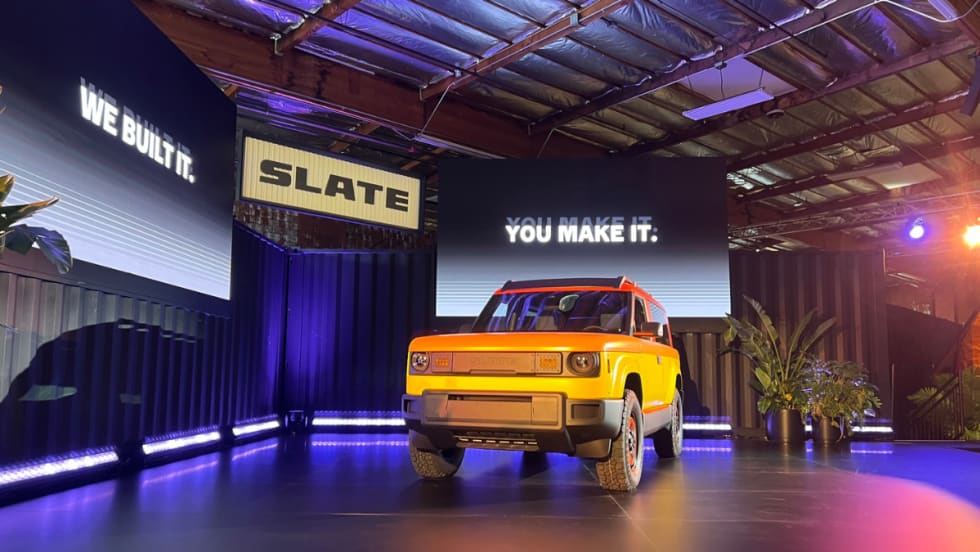
Slate Debuts Colorful, Unique EV Models
A recent media and client event, studded with electric vehicles dressed up on platforms, planted a new position for the manufacturer in the wider EV market. Fleets will find cost-saving advantages.
Read More →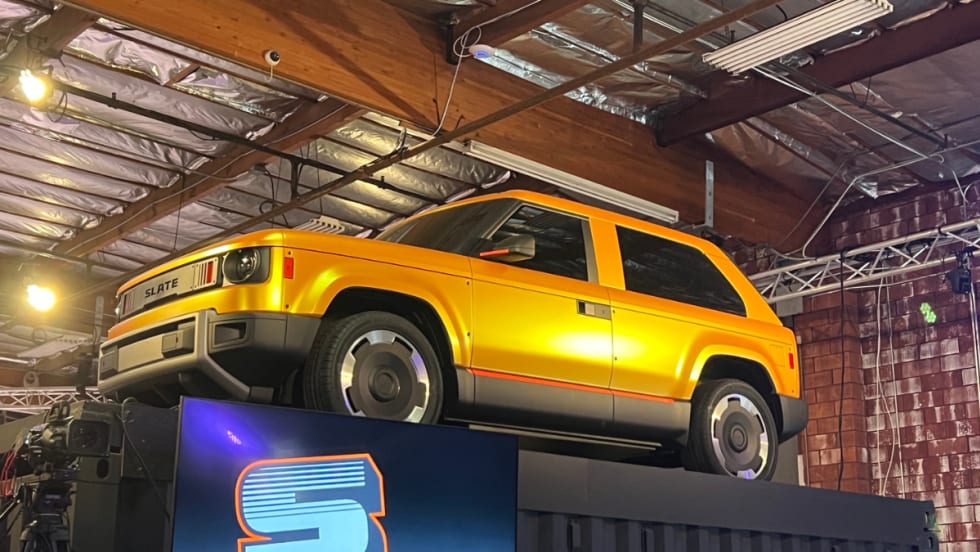
Slate Electric SUV, Pickup Switchable Model Aims For Light-Duty Fleets
Everything about this EV is counterintuitive and understated, making it stand out from the crowd.
Read More →
Inspiration Mobility Acquires Key Electrada Assets
Inspiration Mobility Group has acquired select assets of Electrada, adding the fleet electrification provider's team, technology, and charging infrastructure development capabilities to its energy management business.
Read More →
Turning Connected Vehicle Data Into Decisions That Matter
Fleet leaders have more data than ever, but turning that data into clear, actionable decisions remains a challenge. This white paper shows how leading organizations are using connected vehicle data to improve safety, reduce costs, and optimize fleet performance. Learn how to turn insight into action across your fleet.
Read More →
Are You Tracking Your Fleet's True Total Cost of Ownership?
Bobit Business Media surveyed 190 fleet professionals and found that while most fleets are tracking costs, fragmented systems and data gaps are keeping true TCO visibility out of reach. With rising pressure to control spend in an increasingly volatile environment, the gap between what fleets think they know and what the data actually shows is wider than you might expect. See how your peers are managing costs today and where the industry still has room to improve.
Read More →