




VW Developing Automated EV Parking and Charging
Volkswagen said it aspires to hold the leading position in the field of automated parking.
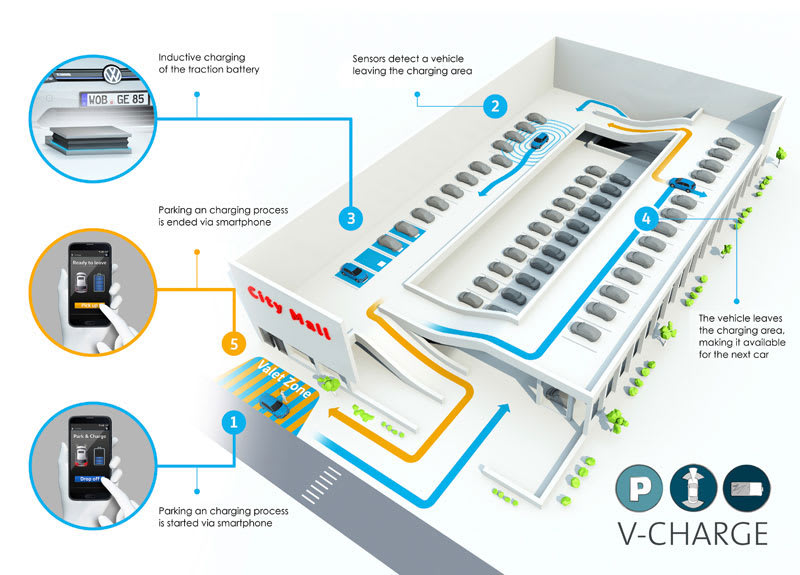
Illustration: Volkswagen
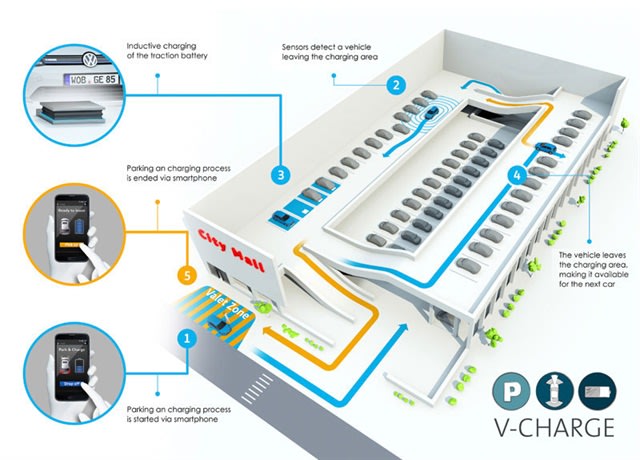
Illustration: Volkswagen
Volkswagen said it wants to take a leading position in the field of automated parking. A look into the near future of automated parking is given by ‘V-Charge’, an EU research project, in which six national and international partners are jointly developing new technologies. Its focus is on automating the search for a parking space and on the charging of electric vehicles.
The vehicle automatically looks for an empty parking space, but that it finds an empty space with charging infrastructure and inductively charges its battery, according to the automaker. Once the charging process is finished, it automatically frees up the charging bay for another electric vehicle and looks for a conventional parking space. ‘V-Charge’ stands for Valet Charge and is pointing the way to the future of automated parking.
Taking the lead in the international research consortium is the Swiss Federal Institute of Technology (ETH) in Zurich. It is responsible for visual localization, movement planning and vehicle control (Autonomous Systems Lab division), camera calibration, 3D reconstruction from images and obstacle detection (Computer Vision and Geometry Lab division). Braunschweig Technical University works on the issues of car park management and the vehicle’s communication with the technical surroundings (vehicle-to-infrastructure ‘V2I’), Robert Bosch GmbH contributes its expertise in the field of sensor technology, Parma University looks after object recognition and Oxford University handles the development of detailed navigation maps of the parking area (semantic mapping concepts). As the sixth partner in the consortium, Volkswagen is providing the platform equipment, safety and control modules, as well as systems for static monitoring of surroundings, object recognition and automated parking.
The technical prerequisites largely already exist, according to the automaker. During the introductory stage, for instance, it was possible to utilize sensor and camera technologies that are already being used in today’s production vehicles. A dense network of sensory devices enables autonomous operation of the V-Charge test vehicle, which is based on a Volkswagen e-Golf. Four wide-angle cameras and two 3D cameras, 12 ultrasound sensors, digital maps and the so-called "Car2X" technology for the vehicle’s communication with the infrastructure ensure that the vehicle’s surroundings are reliably detected and recognized. Pedestrians, vehicles, and obstacles get identified, parking spaces recognized and measured, and then this stream of data is put together in real time to form an overall picture – the task that the technical “sensory organs” have to fulfill is complex and extremely varied.
As continual tests run as part of the research project show, V-Charge is already functional today. GPS-independent indoor localization, centimeter-exact parking space measurement and 360-degree recognition of surroundings all function reliably, as do the system’s reactions to pedestrians and vehicles and the way in which it takes account of traffic moving in line with or across the vehicle’s path, according to the automaker.
More Global Fleet

Holman Takes Full Ownership of ARIZA in Mexico
Holman is bringing its Mexican fleet management operation fully under its own brand after more than 30 years as a joint venture. The change gives multinational fleet customers a single Holman operation across the U.S., Canada, and Mexico.
Read More →
Proven Ways to Reduce Work Truck Downtime
The age-old problem of downtime will always be a reality, but with new strategies at hand, fleets have more ways to keep trucks on the road longer.
Read More →
The Top 300 Commercial Fleets
The Top 300 Commercial Fleets: See the List
Read More →


Cameras, Safety and Insurance: From Reactive Claims to Real-Time Prevention (Part 2 of 2)
Part Two: Commercial auto remains one of the most challenging and costly lines of coverage for fleet operators and insurers alike. Continue learning more about how to effectively address these issues from Onur Aksan, Enterprise Business Development Executive, Geotab
Read More →
Cameras, Safety and Insurance: From Reactive Claims to Real-time Prevention
Commercial auto remains one of the most challenging and costly lines of coverage for fleet operators and insurers alike. Learn more about how to effectively address these issues from Onur Aksan, Enterprise Business Development Executive, Geotab.
Read More →
Fleet Costs Are Rising: Here’s How Leaders Are Responding
Fleet leaders are under pressure to reduce costs, adapt to economic uncertainty, and make smarter decisions. See how peers across North America are responding with real data, proven strategies, and forward-looking insights. Download the 2026 Market Pulse Report to benchmark your strategy and uncover where you can gain an edge.
Read More →
Enterprise Fleet Management Surpasses 900,000 Vehicles in U.S. & Canada
Enterprise Mobility connects with mobility solutions around the globe
Read More →
Automotive Fleet's Guide to Fleet Electrification
Unlock the secrets to a successful transition to electric fleets with Automotive Fleet's comprehensive Fleet Electrification Guide!
Read More →
Sumitomo Rubber Industries to Acquire Viaduct
Viaduct will join Sumitomo as an independent subsidiary. Partnership strengthens global reach and accelerates AI-driven innovation for fleets and manufacturing.
Read More →