




Volvo S60 Features Pedestrian Detection with Full Auto Brake & Unique Technology
GOTEBORG, SWEDEN - The all-new Volvo S60 is packed with high-tech solutions that actively help the driver avoid accidents. The Pedestrian Detection with full auto brake is a world first.
GOTEBORG, SWEDEN - The all-new Volvo S60 is packed with high-tech solutions that actively help the driver avoid accidents. The Pedestrian Detection with full auto brake is a world first. To Volvo Cars' knowledge there is no other car manufacturer that offers a feature that can avoid a collision with a pedestrian.
This radar- and camera-based system can detect pedestrians in front of the car, warn if anyone walks out into its path - and then automatically activate the car's full braking power if the driver fails to respond in time.
Pedestrian accidents occur every day in our increasingly intensive traffic environments. In Europe, 14 percent of all traffic fatalities are pedestrians. The corresponding figure for the USA is 11 percent and in China the proportion rises to a worrying 26 percent.
Pedestrian Detection with full auto brake consists of a newly developed radar unit integrated into the car's grille, a camera fitted in front of the interior rear-view mirror, and a central control unit. The radar's task is to detect any object in front of the car and to determine the distance to it. The camera determines what type of object it is.
The function is programmed to also respond to vehicles in front that are at a standstill or that are moving in the same direction as the car fitted with the system.
Thanks to the newly developed dual-mode radar's much wider field of vision, pedestrians about to step into the roadway can also be detected early on. The camera has higher resolution than the previous-generation unit. This makes it possible to detect the pedestrian's pattern of movement.
In an emergency situation the driver first receives an audible warning combined with a flashing light in the windscreen's head-up display. In order to generate an immediate, intuitive reaction this warning resembles a brake light. At the same time, the car's brakes are pre-charged. If the driver does not react to the warning and an accident is imminent, full braking power is automatically applied.
This technology has the same limitations as the human eye, and just like us it "sees" less well in the dark and in poor weather.
Volvo Cars has worked for five years on the development of Pedestrian Detection with full auto brake. Test cars have been in operation all over the world to cover all possible variations of traffic behavior, road condition and climate.
Half of all pedestrian accidents occur at speeds below 25 km/h.
Pedestrian Detection with Full Auto Brake can avoid a collision with a pedestrian at speeds up to 35 km/h if the driver does not react in time. At higher speeds, the focus is on reducing the car's speed as much as possible prior to the impact. The speed reduction is up to 35 km/h.
Statistics reveal that the car's speed has considerable importance for the outcome of the accident. A lower speed of impact means that the risk of serious injury is significantly reduced. For instance, if speed is cut from 50 km/h to 25 km/h, Pedestrian Detection with full auto brake is expected to reduce the fatality risk with as much as 20 percent and in some certain cases with up to 85 percent.
"The proportion of pedestrian fatalities is high today and our technology will play a major role in reducing it," says Thomas Broberg.
Up to 90 percent of all road accidents are caused by distraction. Half of all drivers hitting another vehicle from behind do not brake at all prior to the collision.
Pedestrian Detection is a further development of the Collision Warning with Auto Brake technology already introduced by Volvo Cars. Therefore, the new S60 will also detect, alert and automatically brake if the car risks hitting another vehicle from behind.
The aim of the initial warning is to alert the driver so that he or she can brake or avoid the danger. If the driver does not react to the warning, the car automatically brakes with full force moments before the collision is unavoidable. With automatic braking, the collision can be avoided if the speed difference between the two vehicles is up to 35km/h.
The all-new Volvo S60 can naturally also be equipped with a range of additional solutions that help the driver to drive more safely, such as:
Driver Alert Control (DAC). A unique technology to alert tired and distracted drivers. This function monitors the car's progress between the lane markers and warns the driver if his or her driving pattern changes in a random or uncontrolled way.
Blind Spot Information System (BLIS) helps detect vehicles in the offset rear blind spot on both sides of the car. A warning lamp beside the relevant door mirror comes on to alert the driver to the danger.
Active Bi-Xenon Lights are articulated headlights that follow the curve of the road. For best possibility illumination when driving in the dark on twisting roads.
Lane Departure Warning (LDW) alerts the driver if the car runs across the lane markers without the turn indicator being used.
More Safety

Nexar-Nauto Merger Aims to Give Fleets Better Safety Intelligence Through Larger Driving Dataset
Stefan Heck tells Automotive Fleet that combining more than 10 billion miles of driving history with Nexar's AI models will give fleets deeper insights into driver risk and roadway conditions than either company could provide independently.
Read More →
Don't Wait for a Crisis: 5 Ways to Build Mental Health Into Your Fleet Safety Program
For Suicide Prevention Month, fleet and safety leaders have an opportunity to put mental health where it belongs: at the center of workplace safety.
Read More →
How Camera Data Can Strengthen a Fleet’s Insurance Renewal
Insights from a commercial insurance carrier and a broker show how fleets can turn video telematic data, driver coaching, and improved claims results into a stronger case at insurance renewal.
Read More →
The Safest Fleets Aren’t the Ones with the Most Technology
You’ve made the telematics investment. Here’s how to capture the other half of its value and build the safest fleet on the road.
Read More →
Hidden in Plain Sight: Fleet Compliance Risks
Fleet compliance isn't just about having policies — it's about consistently enforcing them. This practical guide reveals six hidden compliance risks common in public sector and shared fleet operations and outlines proven strategies to improve visibility, accountability, and audit readiness
Read More →
NETS Sets 2026 Fleet Safety Benchmark Conference for Indianapolis
The Sept. 15–17 program will feature fleet benchmarking data, case studies, emerging technologies, and implementation strategies while running alongside the NSC Safety Congress & Expo.
Read More →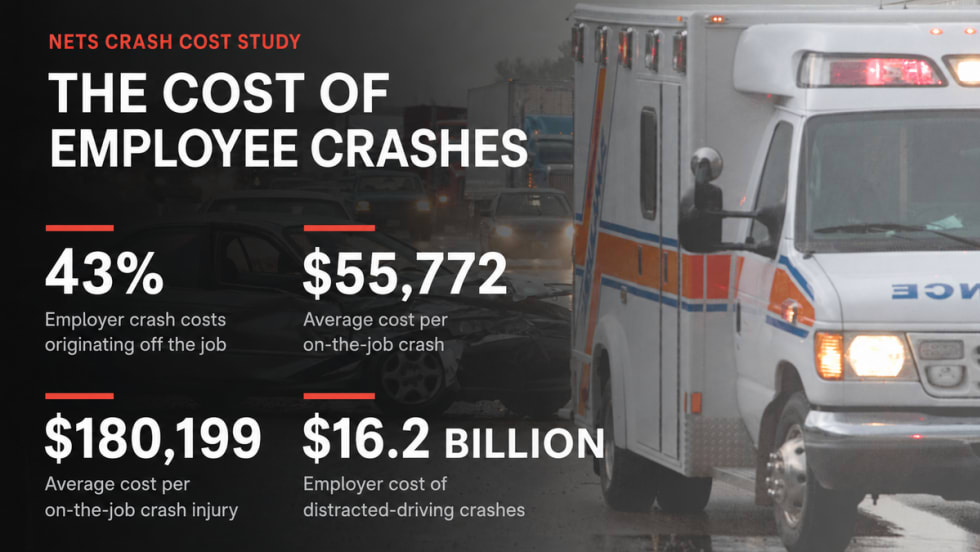
Off-the-Job Crashes Account for 43% of Employers’ $61.7 Billion Crash Burden
NETS quantifies costs dispersed across fleet, risk, HR, and other departments while providing new per-crash benchmarks for employers.
Read More →
Ram Recalls More Than 1.27 Million 1500 Pickups for Seat Belt Anchor Issue
The recall affects certain 2019-2026 Ram 1500 pickups that may have improperly attached second-row seat belt buckle anchors.
Read More →
How Better Visibility Cut Speeding Violations by 48%
Fleet leaders don't need more data, they need clearer visibility into what the data is saying. This case study explores how one utility replaced speeding-event counts with a single metric — miles driven in violation — to strengthen safety and significantly reduce speeding violations.
Read More →
Operation Safe Driver Week: Why the Industry's Oldest Safety Campaign Still Matters to Fleets
A look at how a 2007 enforcement initiative became one of the most consequential weeks on the fleet safety calendar, and what it means for your drivers in 2026.
Read More →