




Volvo Making Strides in Development of Autonomous Driving Technology
GOTHENBURG, SWEDEN – Volvo Car Corp. has demonstrated a new autonomous driving system that helps thwart traffic jams. The automaker said the system, in which a car automatically follows the vehicle in front in slow-moving queues up to 31 miles per hour, will be ready for production in 2014.
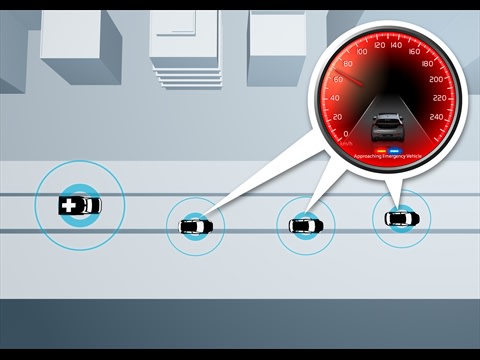
Car 2 Car technology can help alert drivers to an approaching emergency vehicle. Image by Volvo.
GOTHENBURG, SWEDEN – Volvo Car Corp. has demonstrated a new autonomous driving system that helps thwart traffic jams. The automaker said the system, in which a car automatically follows the vehicle in front in slow-moving queues up to 31 miles per hour, will be ready for production in 2014.
"This technology makes driving more relaxed in the kind of monotonous queuing that is a less attractive part of daily driving in urban areas. It offers you a safe, effortless drive in slow traffic," explained Peter Mertens, senior vice president of research and development at Volvo Car Corp.
The traffic jam assistance function has evolved from the current adaptive cruise control and lane keeping aid technology, which was introduced in the Volvo V40 earlier in 2012.
The driver activates the traffic jam assistance function by pushing a button. When active, the engine, brakes and steering respond automatically. The adaptive cruise control enables safe, comfortable driving by automatically maintaining a set gap to the vehicle in front, at the same time as the steering is also controlled.
"The car follows the vehicle in front in the same lane," Mertens said. "However, it is always the driver who is in charge. He or she can take back control of the car at any time."
Autonomous driving -- with steering, acceleration and/or braking automatically controlled by a vehicle that requires very little human interaction -- is a major focus area in Volvo development work.
"Our aim is to gain leadership in the field of autonomous driving by moving beyond concepts and pioneering technologies that will reach actual customers,” Mertens said. “Making these features reliable and easy to use is crucial to boosting customer confidence in self-driving cars."
The low-speed traffic jam assistance system is the second technology for autonomous driving recently presented by Volvo Car Corp. A few weeks ago, the company demonstrated the SARTRE project (Safe Road Trains for the Environment), which focuses on platooning in highway and motorway traffic at speeds of up to 56 mph.
[PAGEBREAK]
The traffic jam assistance technology will be part of Volvo's new Scalable Product Architecture (SPA), which will be introduced in 2014.
"SPA is a stand-alone Volvo project that will enable us to take the company's technological future into our own hands. Most of our volume will be based on this new architecture,” Mertens said. “It will give us a high degree of commonality and the right scale of economy to be competitive in the future."
Development of technology that allows vehicles to communicate with each other and with the traffic environment opens up a range of possibilities. Vital information can be shared and exchanged, creating a safer and more comfortable drive, Volvo said. That’s why the automaker joined the CAR 2 CAR Communication Consortium together with other European automakers and suppliers. The aim is to have a common platform for CAR 2 CAR communication ready within five years.
"In the future we will have advanced exchange of vital information between vehicles such as their position, speed and direction," said Erik Israelsson, project leader of cooperative ITS (Intelligent Transport Systems) at Volvo Car Corp.
Volvo recently signed a memorandum of understanding with the members of the CAR 2 CAR Communication Consortium regarding the implementation of standardized technology for communication between cars from 2016 and onwards.
The aim is for inter-car communication to function between all cars, regardless of make. Communication takes place via a wireless network (similar to WLAN) and utilizes existing systems such as the GPS navigation system. CAR 2 CAR has been granted a separate frequency so that cars within a given radius are automatically linked together and can exchange information about parameters such as their position, speed and direction. The installation of transmitters in the road infrastructure, such as road signs and traffic lights, further extends the communication network.
[PAGEBREAK]
"There is considerable potential in this area as well as opportunities for many benefits in many spheres over and above road safety, such as a more uniform flow of traffic and additional comfort for road users," Israelsson said.
A few examples of application areas for the new technology:
Green Light Optimum Speed Advisory
Via a transmitter in the traffic light, information is provided regarding the optimum speed for a car to maintain in order to pass through a succession of green lights, thus avoiding unnecessary braking for red. At red lights, the driver can also receive information about how long it will be before the light turns green.
Emergency Vehicle Warning
Alerts the driver to the presence of nearby emergency vehicles, allowing him or her to create free passage well in advance and without being taken by surprise. This can be of benefit in the evening and at night in urban areas where emergency vehicles use their sirens more sparingly out of consideration for nearby residents, and also if loud music is playing in the car.
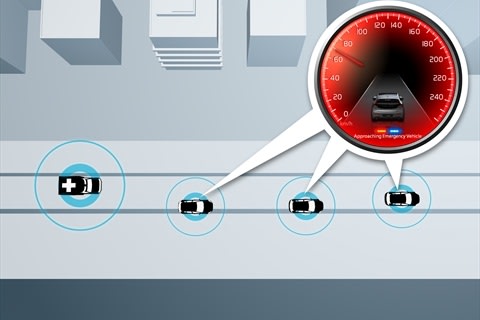
Car 2 Car technology can help alert drivers to an approaching emergency vehicle. Image by Volvo.
Road Works Warning
Alerts the driver to road works. Construction vehicles and heavy equipment can transmit information to vehicles well in advance of the site. Drivers can thus receive information about changed speed limits and altered routes near the work site. The system can also keep the driver informed about the remaining distance before the end of the long road-work zone.
Slow Vehicle Warning
Slow or broken-down vehicles in the roadway transmit a warning to other road users. Receiving information well in advance can cut the risk of unpleasant surprises in traffic and thus reduce accidents.
Traffic Jam Ahead Warning
Alerts the driver to traffic stops or tailbacks. Since vehicles to the rear are alerted that there is a stop further ahead, there is less risk of accidents.
Weather Information
Issues a warning about local bad weather such as heavy rain, snowfall or icy roads.
In-Vehicle Signage
CAR 2 CAR provides information about regular or temporary speed limits. This information is provided by communication units along the road that can pass on information about parameters such as road signs and their location on the route.
Emergency Electronic Brake Light
Vehicles that break down on the road create dangerous situations for drivers and passengers in the stricken vehicle, as well as for other road users. CAR 2 CAR warns if a vehicle suddenly slows down.
Motorcycle Approaching Indication
Motorcyclists are among the most vulnerable road users. In order to improve safety, CAR 2 CAR informs other road users when there is a motorcycle nearby.
Red Light Violation Warning
Traffic lights that communicate with cars make it possible to alert a driver who has not noticed a red light. For instance, the traffic lights can activate a prominent sound and light signal in the car. This technology also makes it possible to warn a driver going through a green light if another vehicle is about to cross his or her path by mistake.
"When the system is fitted into future cars it will be of considerable benefit to drivers and next-generation infrastructure, and will help improve traffic safety," Israelsson said.
More Safety

What’s Next for Fleet? Safety, AI & Industry Recognition | AF News Recap
Could your company's culture be encouraging distracted driving? This week, we're exploring how workplace expectations affect driver safety, what AI, EVs, and autonomous vehicles could mean for the future of fleet management, and how fleet professionals can strengthen their award nominations.
Read More →
Does Your Fleet's Culture Encourage Distracted Driving?
What happens when the people responsible for enforcing safety rules are the ones setting the wrong example? The answer may reveal why some of the biggest risks to fleet drivers have little to do with what's written in the employee handbook.
Read More →
Fleet Manager’s Ultimate Playbook: Navigating the New Standard in OEM Connectivity
Rising operating costs, driver safety concerns, and unplanned downtime are putting unprecedented pressure on modern fleets. Discover how fleet managers use embedded OEM connectivity and real-time vehicle data to cut TCO, prevent downtime, and protect drivers without aftermarket telematics hardware.
Read More →
From Driver Well-Being to EV Charging | AF News Recap
Mental health belongs in the fleet safety conversation. This week, we’re looking at five ways fleets can support employee well-being before a crisis, plus Holman’s expansion in Mexico, new one-day Fleet Forward passes, and why EV charging demand is outpacing infrastructure growth.
Read More →
Nexar-Nauto Merger Aims to Give Fleets Better Safety Intelligence Through Larger Driving Dataset
Stefan Heck tells Automotive Fleet that combining more than 10 billion miles of driving history with Nexar's AI models will give fleets deeper insights into driver risk and roadway conditions than either company could provide independently.
Read More →
Don't Wait for a Crisis: 5 Ways to Build Mental Health Into Your Fleet Safety Program
For Suicide Prevention Month, fleet and safety leaders have an opportunity to put mental health where it belongs: at the center of workplace safety.
Read More →
How Camera Data Can Strengthen a Fleet’s Insurance Renewal
Insights from a commercial insurance carrier and a broker show how fleets can turn video telematic data, driver coaching, and improved claims results into a stronger case at insurance renewal.
Read More →
The Safest Fleets Aren’t the Ones with the Most Technology
You’ve made the telematics investment. Here’s how to capture the other half of its value and build the safest fleet on the road.
Read More →
Hidden in Plain Sight: Fleet Compliance Risks
Fleet compliance isn't just about having policies — it's about consistently enforcing them. This practical guide reveals six hidden compliance risks common in public sector and shared fleet operations and outlines proven strategies to improve visibility, accountability, and audit readiness
Read More →
NETS Sets 2026 Fleet Safety Benchmark Conference for Indianapolis
The Sept. 15–17 program will feature fleet benchmarking data, case studies, emerging technologies, and implementation strategies while running alongside the NSC Safety Congress & Expo.
Read More →