




Volvo Develops Range Extenders for EVs
GÖTEBORG, SWEDEN -- Volvo Car Corp. said it is producing test cars with range extenders -- electric cars that are fitted with a combustion engine to increase their effective range.
GÖTEBORG, SWEDEN -- Volvo Car Corp. said it is producing test cars with range extenders -- electric cars that are fitted with a combustion engine to increase their effective range.
The projects, supported by the Swedish Energy Agency and the EU, include three potential technology combinations. Tests of the various concepts will get under way in the first quarter of 2012.
"This is an exciting expansion of our increasing focus on electrification,” said Derek Crabb, vice president of powertrain engineering at Volvo Car Corp. “Battery cost and size mean that all-electric cars still have a relatively limited operating range. With the range extender, the electric car has its effective range increased by a thousand kilometers -- yet with carbon dioxide emissions below or way below 50 g/km."
The company's technological developments in this area currently encompass three different technology combinations, with three-cylinder gasoline engines being installed to complement electric drive to the front wheels. All three concepts feature brake energy regeneration. The engines can run on both gasoline and ethanol (E85).
Two of the solutions are based on the Volvo C30 Electric. In both cases, the standard battery pack has been somewhat reduced in size to make room for the combustion engine and its fuel tank.
Here are the three concepts:
Technical concept I: Volvo C30 with series-connected range extender -- This is based on a C30 Electric with a three-cylinder combustion engine producing 60 horsepower (45 kW) installed under the rear load compartment floor. The car also has a 40-liter fuel tank.
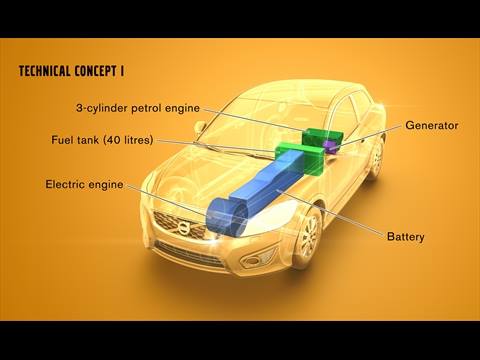
Concept I
The combustion engine is connected to a 40 kW generator. The power it generates is used primarily to drive the car's 111 horsepower (82 kW) electric motor, but the driver can also choose to let the generator charge the battery, thus increasing the car's operating range on electricity.
The range extender increases the electric car's range by up to 1,000 km -- on top of the 110 km range provided by the car's battery pack.
Technical concept II: Volvo C30 with parallel-connected range extender -- Here the car gets a more powerful three-cylinder combustion engine at the rear and a 40-liter fuel tank. The difference between this and the first solution is the parallel connection, whereby the turbocharged 190 horsepower engine primarily drives the rear wheels via a six-speed automatic transmission. This gives a better fuel efficiency rating when driving with the combustion engine cruising on the highway. Via a 40kW generator the battery can also be charged to give the car increased range on electricity alone.

Concept II
Here too the electric motor is a 111 hp (82 kW) unit. The two power sources give the car more than 300 hp in total, and acceleration from 0-100 km/h of less than six seconds.
The range extender increases the electric car's range by more than 1,000 km -- in addition to the range of up to 75 km provided by the car's battery pack.
Technical concept III: Volvo V60 with parallel-connected range extender -- This is a solution whereby the entire drive package is installed under the bonnet at the front. The 111 hp (80 kW) electric motor is supplemented with a three-cylinder gasoline turbo engine producing 190 hp (140 kW), a two-stage automatic transmission and a 40 kW generator. Power from the combustion engine drives the front wheels via the gearbox and recharges the battery pack whenever needed.
Up to 50 km/h, the car is always powered solely by electricity. The combustion engine is activated at higher speeds. What’s more, it charges the battery pack when its charge drops below a predetermined level.
The battery pack is located under the rear load floor and it gives the driver a range of 50 km on electricity alone. The car also has a 45-liter tank for gasoline or E85.
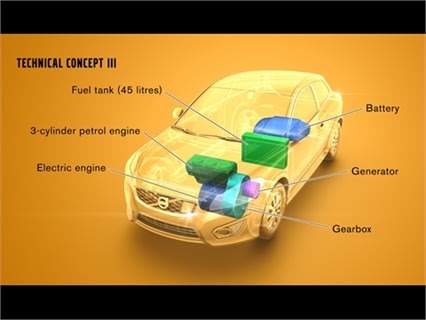
Concept III
With this technology, the range extender increases the car's total range by more than 1,000 kilometers.
The series-hybrid range extender in the C30 is part of an EU project in which the Volvo Car Corp. is the only car manufacturer among eight partners. The company's two parallel-hybrid range extender solutions are being developed with a grant of SEK 10.8 million (EUR 1.2 million) from the Swedish Energy Agency.
"These three projects allow us to evaluate the range extender's various possibilities. As with the C30 Electric and V60 Plug-in Hybrid, the goal is to make the cars exceptionally CO2-lean without compromising on customer requirements such as comfort, driving pleasure and practicality," Crabb said.
More Green Fleet

The EV Breakdown Nobody's Talking About: Why Most Electric Vehicle Roadside Calls Aren't Mechanical Failures
Here's why EV breakdowns are widely misunderstood.
Read More →
ChargePoint Now Available in Energy Pass
ChargePoint and additional planned charging network integrations were added to GM's Energy Pass.
Read More →
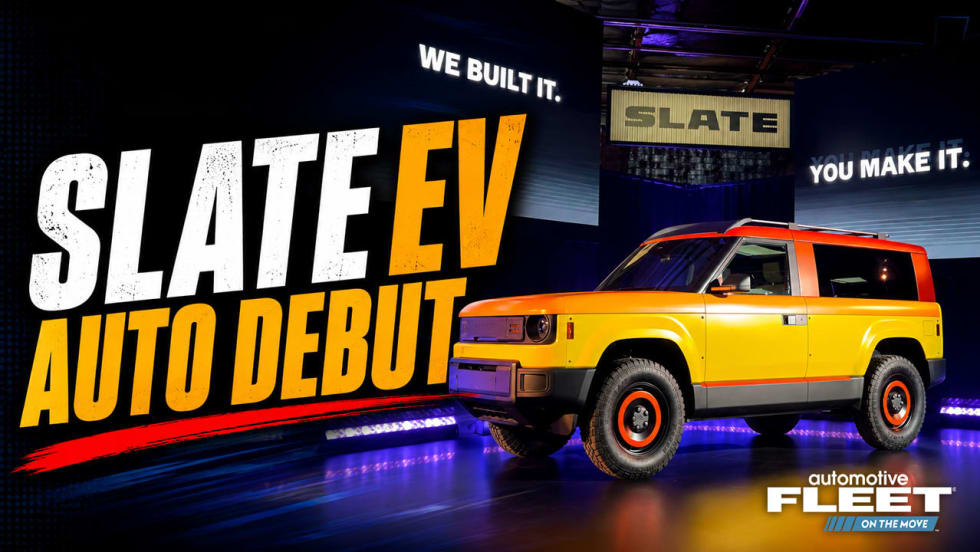
First Look: Slate Auto's Electric Fleet Pickup
Could an affordable, modular EV pickup make electrification more practical for fleets?
Read More →
Slate Debuts Colorful, Unique EV Models
A recent media and client event, studded with electric vehicles dressed up on platforms, planted a new position for the manufacturer in the wider EV market. Fleets will find cost-saving advantages.
Read More →
Slate Electric SUV, Pickup Switchable Model Aims For Light-Duty Fleets
Everything about this EV is counterintuitive and understated, making it stand out from the crowd.
Read More →
Inspiration Mobility Acquires Key Electrada Assets
Inspiration Mobility Group has acquired select assets of Electrada, adding the fleet electrification provider's team, technology, and charging infrastructure development capabilities to its energy management business.
Read More →
Turning Connected Vehicle Data Into Decisions That Matter
Fleet leaders have more data than ever, but turning that data into clear, actionable decisions remains a challenge. This white paper shows how leading organizations are using connected vehicle data to improve safety, reduce costs, and optimize fleet performance. Learn how to turn insight into action across your fleet.
Read More →
Are You Tracking Your Fleet's True Total Cost of Ownership?
Bobit Business Media surveyed 190 fleet professionals and found that while most fleets are tracking costs, fragmented systems and data gaps are keeping true TCO visibility out of reach. With rising pressure to control spend in an increasingly volatile environment, the gap between what fleets think they know and what the data actually shows is wider than you might expect. See how your peers are managing costs today and where the industry still has room to improve.
Read More →
Hybrids: Electrification Without the Challenges
For fleet managers, fuel is one of the biggest line items in the budget — and it's one hybrids can shrink without changing how your people work. Download the eBook to see the numbers, understand the technology, and get a step-by-step guide to making the switch.
Read More →