




Volvo Developing New Safety Systems to Prevent Collisions
GÖTEBORG SWEDEN – The automaker’s new safety research focuses on three main areas: staying safely in the current lane, avoiding accidents at crossroads and junctions, and avoiding collisions with wild animals.
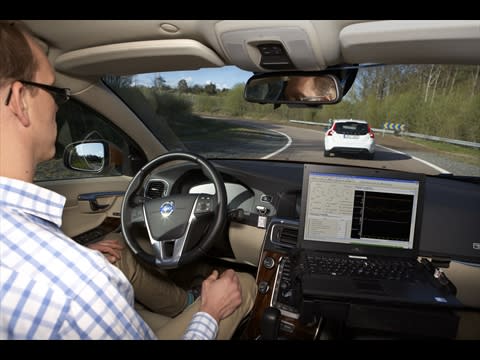
Andreas Ekenberg of Volvo drives a test car as part of the Autonomous Driving Support project.
GÖTEBORG SWEDEN – Volvo Car Corp. said that by developing several new high-tech safety solutions, the automaker is taking a major step toward its 2020 goal of having zero deaths or serious injuries in a new Volvo car. The automaker’s new safety research focuses on three main areas: staying safely in the current lane, avoiding accidents at crossroads and junctions, and avoiding collisions with wild animals.
Three research projects currently under way are Autonomous Driving Support, Intersection Support and Animal Detection.
“We have a number of research projects with the aim to develop technologies for future Volvo models," said Jan Ivarsson, senior manager of safety strategy and requirements at Volvo Car Corp.
Autonomous Driving in Queues
Autonomous Driving Support helps the driver stay in his or her lane and follow the rhythm of the traffic if queues build up.
"Driving in slow queues is a monotonous and boring part of many drivers' everyday lives," said Fredrik Lundholm, Volvo function developer at the safety functions department. "Thanks to technology for autonomous driving, the car can help the driver comfortably and safely follow the vehicle in front."
Using data from a camera and radar sensors, the car can follow the vehicle in front. The engine, brakes and steering respond automatically. If the vehicle in front is forced to make a quick move because of an obstacle in the road, the driver is assisted by the steering system, which makes the car veer in the same direction.
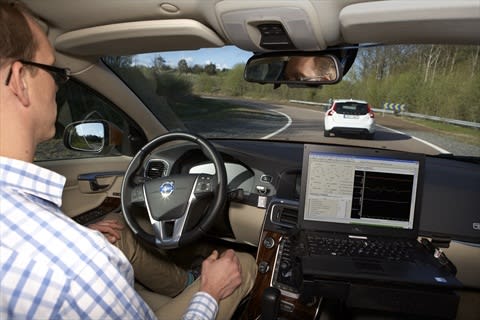
Andreas Ekenberg of Volvo drives a test car as part of the Autonomous Driving Support project.
"This function has considerable scope for making the driver's life easier," Lundholm explained. "Our first generation of advanced technology focuses on driving in queues at low speeds. The car follows the vehicle in front in the same lane. However, it is always the driver who decides. He or she can take control at any time."
Automatic Braking at Intersections
Crossroads and junctions are the most complex part of the modern traffic environment. When many road users cross each other's paths simultaneously and from different directions, just one small mistake can cause a serious accident.
In the U.S., 21.5 percent of all fatal accidents in 2007 occurred in intersections, and in 16 EU countries (excluding Sweden) the corresponding figure was 20.6 percent in 2006.
Mattias Brännström, who holds a doctorate degree in active safety functions, is responsible for the Intersection Support research project undertaken by Volvo in collaboration with the Department of Signals and Systems at Chalmers University of Technology. The system alerts and automatically brakes for crossing traffic when necessary.
"Intersection Support uses sensors to assess the entire traffic scenario. If a critical situation is registered, a decision to intervene is taken at lightning speed," Brännström said. He exemplifies this by drawing a queue of cars turning left at an intersection. When the light turns green, one car after another turns left. Suddenly an oncoming car drives through the red light -- and creates an immediate danger.
"In this situation, the turning car automatically brakes to avoid a collision. Intersection Support thus serves as a system that not only helps deal with the driver's own mistakes, but those of other road users too," Brännström said.
He explained that Volvo’s safety approach is about getting cars to behave like people. The sensors are the eyes, the computers are the brain, and the brakes are the muscles.
"With our advanced technology we're trying to do the same thing that people would do in the same situation if they have time to react. We want to provide assistance in as many situations as possible," Brännström said.
To obtain the necessary data for the development of these systems, cars are driven hundreds of thousands of miles in various traffic environments the world over. After all, the system has to be equally capable of helping drivers in Bangkok and Vancouver -- and in a way that is tailored to local variations in driving style and traffic intensity.
Animal Detection Focuses on Collisions with Wild Animals
Of course, this collection of data is not restricted to urban environments. Out in the countryside and in more remote areas there are many serious collisions involving wild animals.
Accidents involving wild animals are a major international traffic problem. In Canada, about 40,000 such accidents leading to vehicle damage are reported every year. Sweden reported 47,000 animal collisions in 2010. Of these, 7,000 were elk collisions. The conditions in Canada and Sweden are also found in Norway, Finland and Russia. In the U.S., about 200 people a year are killed in impacts with wild animals, mostly with deer.
However, these official accident statistics do not reveal the whole truth. For instance, they do not include all those accidents in which a driver swerves to avoid an animal and instead collides with another vehicle or veers off the road. According to a University of Umeå study of accidents between 2003 and 2010, no less than 23 percent of fatalities occurred after drivers swerved to avoid elk in the roadway -- and these figures do not show up in the official statistics of collisions with wild animals.
Volvo Car Corp. is now working on Animal Detection, a system that detects and automatically brakes for animals both in daylight and in the dark.
"The technology is a further development of our pedestrian protection system. Considerable attention has been focused on ensuring that the system works in the dark since most collisions with wild animals take place at dawn and dusk," said Andreas Eidehall, technical expert on active safety.
Accidents with wild animals often take place at cruising speeds. The aim is to reduce the speed of impact from about 62-68 miles per hour to below 50 miles per hour. Once speed drops below 50 mph, the car's safety systems are effective and the risk of serious injuries is small. This requires the ability to detect the animal from a distance of about 33 yards.
Another important aspect is response time -- the time lapse between object identification and system reaction.
"With advanced technology we can shorten the response time still further in order to enhance the system's effectiveness," Eidehall said.
The system is trained to recognize the shapes of animals and their movement patterns through a vast amount of collected data. The gathering of images of animals in motion takes place on a continuous basis. But since many wild animals have mastered the art of staying out of sight, this is a complex process.
"There is a huge challenge in collecting data that helps us understand how we can detect what nature has done its best to conceal,” Eidehall said. “The focus is on large animals since they cause the most damage and the most severe injuries. We have worked with elk and large stags, but have now also included horses and cattle. One future step will be the ability to detect smaller animals such as deer and wild boar."
Success Requires Cooperation
"Development of these technologies is progressing very quickly," Ivarsson concluded. "And with steadily lower prices for sensors and other electronic components, it is our intention that these advanced solutions will in the future be fitted to all our cars. Having said that, close cooperation with the relevant public authorities, insurance companies and other car manufacturers is also vital for achieving the vision of an accident-free traffic environment."
More Safety

Tips for Driving Safely on Halloween Night
This video features a reminder from the Connecticut Department of Transportation (DOT) and the Connecticut Police Chiefs Association, urging drivers to prioritize safety this Halloween.
Read More →
IIHS Crash Avoidance Tests Reveal Safety Gaps in Cargo Vans and Work Trucks
New IIHS crash avoidance ratings show uneven performance among cargo vans and heavy-duty pickups, with most struggling to avoid vehicle-to-vehicle collisions.
Read More →
What’s Next for Fleet? Safety, AI & Industry Recognition | AF News Recap
Could your company's culture be encouraging distracted driving? This week, we're exploring how workplace expectations affect driver safety, what AI, EVs, and autonomous vehicles could mean for the future of fleet management, and how fleet professionals can strengthen their award nominations.
Read More →
Does Your Fleet's Culture Encourage Distracted Driving?
What happens when the people responsible for enforcing safety rules are the ones setting the wrong example? The answer may reveal why some of the biggest risks to fleet drivers have little to do with what's written in the employee handbook.
Read More →
Fleet Manager’s Ultimate Playbook: Navigating the New Standard in OEM Connectivity
Rising operating costs, driver safety concerns, and unplanned downtime are putting unprecedented pressure on modern fleets. Discover how fleet managers use embedded OEM connectivity and real-time vehicle data to cut TCO, prevent downtime, and protect drivers without aftermarket telematics hardware.
Read More →
From Driver Well-Being to EV Charging | AF News Recap
Mental health belongs in the fleet safety conversation. This week, we’re looking at five ways fleets can support employee well-being before a crisis, plus Holman’s expansion in Mexico, new one-day Fleet Forward passes, and why EV charging demand is outpacing infrastructure growth.
Read More →
Nexar-Nauto Merger Aims to Give Fleets Better Safety Intelligence Through Larger Driving Dataset
Stefan Heck tells Automotive Fleet that combining more than 10 billion miles of driving history with Nexar's AI models will give fleets deeper insights into driver risk and roadway conditions than either company could provide independently.
Read More →
Don't Wait for a Crisis: 5 Ways to Build Mental Health Into Your Fleet Safety Program
For Suicide Prevention Month, fleet and safety leaders have an opportunity to put mental health where it belongs: at the center of workplace safety.
Read More →
How Camera Data Can Strengthen a Fleet’s Insurance Renewal
Insights from a commercial insurance carrier and a broker show how fleets can turn video telematic data, driver coaching, and improved claims results into a stronger case at insurance renewal.
Read More →
The Safest Fleets Aren’t the Ones with the Most Technology
You’ve made the telematics investment. Here’s how to capture the other half of its value and build the safest fleet on the road.
Read More →