




Volkswagen to Introduce Electric e-Golf to U.S. Market by 2015
The zero emissions, four-door passenger Volkswagen e-Golf fully electric vehicle will launch in Asia and North America in late 2014 or early 2015. It will be available in Europe in spring 2014, according to Volkswagen.
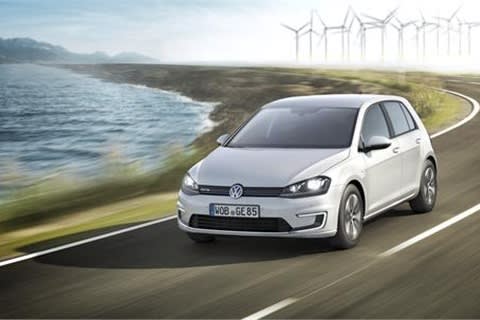
The Volkswagen e-Golf, a zero emissions electric passeger car, was shown at the 2013 International Automobile-Ausstellung (International Automobile Exhibition) Motor Show.
Photo courtesy Volkswagen
Volkswagen introduced its new zero emissions, four-door passenger e-Golf fully electric vehicle at the Frankfurt Auto Show in Germany. The automaker said this new vehicle will be available in the U.S. by early 2015, but will be released first in Europe in spring 2014. The following information is based on the European driving cycle and version of the vehicle; information based on the American driving cycle and model will be available closer to the e-Golf's U.S. launch date.
The e-Golf is powered by an 85 kW1/115 PS1 electric motor with a battery capacity of 24.2 kWh. A central element of the drive system is the power-electronics module, Volkswagen said. Acting as the link, this module controls the flow of high-voltage energy between the electronic motor and the lithium-ion battery (depending on battery voltage, which is available between 250 and 430 volts). The lithium-ion battery was integrated into a stabilizing frame in the vehicle floor, under the front and rear seats and in the area of the center tunnel, to save space. The e-Golf's driving range is between 130 and 190 km1 due to its larger battery (24.2 kWh), according to Volkswagen.
The VW will supply a charging cable as standard with the car, which is meant for a 230-volt electrical socket. Regaining a full charge from a depleted battery takes 8 hours, Volkswagen stated. The e-Golf can also optionally be prepared for the combined charging system (CCS), using a direct current (DC) power supply. In this case, the e-Golf can be recharged via special CCS charging stations at power levels of up to 40 kW, allowing the battery to be charged to 80 percent in around 30 minutes.
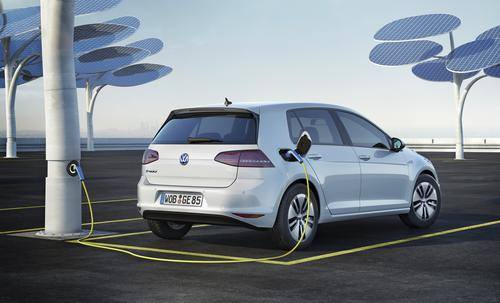
The Volkswagen e-Golf.
Photo courtesy Volkswagen
The e-Golf provides three driving profiles: Normal, Eco, and Eco+. The vehicle automatically starts in Normal mode; the driver may then change into the extended range Eco driving mode. Selecting this mode reduces the electronic motor’s maximum power output to 70 kW and the starting torque to 220 Nm, which increases fuel economy, Volkswagen said. In Eco+ mode, the system limits the power output to 55 kW and starting torque to 175 Nm, further increasing fuel economy. Nevertheless, even with the reduced electric output, drivers can still obtain full power, maximum torque, and a top speed of 140 km/hr, Volkswagen said.
In addition to these different driving modes, the vehicle's regenerative braking system can influence its range. Regenerative braking recaptures much of the car's kinetic energy and converts it into electricity, so that it can be used to recharge the car's batteries. There are five levels available: D (no regenerative braking), D1, D2, D3, and B. In an electric car, this number of levels leads to a different way of driving, VW stated. Level D1 regenerates energy and slows down the car the least, while level B has the strongest regenrative effect.
The e-Golf’s safety performance includes driver assistance systems such as adaptive cruise control and City Emergency Braking. The battery is fitted in the front of the vehicle and is equipped with a battery management controller, which performs safety diagnostics and monitoring functions. Also, when the car is not in use, or in the event of a crash, power from the battery is automatically turned off.
The motors, gearboxes, and batteries inside the e-Golf were produced in Volkswagen component plants in Kassel, Germany. The e-Golf will launch in Asia and North America in late 2014 or early 2015. It will be available in Europe in spring 2014, Volkswagen said.
According to Volkswagen, the next model to be introduced will be a Golf plug-in hybrid, which, in contrast to the standard hybrid, can also cover longer distances (50 km) solely on electric power thanks to a battery (with greater capacity) that can be charged from an external power source. The automaker hasn't stated whether this specific model will be available in the U.S. marketplace.
More Green Fleet

EV Charging Use Is Outpacing Infrastructure Growth
ChargePoint’s 2026 Charging Forward Report points to rising charger use, higher-powered charging, commercial vehicle electrification, and energy-management technology. Here’s what fleets should know.
Read More →
Merchants Fleet Reports 290M EV Miles as Fleets Navigate Changing Electrification Market
From millions in operating savings to hundreds of millions of EV miles, Merchants Fleet’s latest report reveals what’s working and what’s changing in fleet electrification.
Read More →
The EV Breakdown Nobody's Talking About: Why Most Electric Vehicle Roadside Calls Aren't Mechanical Failures
Here's why EV breakdowns are widely misunderstood.
Read More →
ChargePoint Now Available in Energy Pass
ChargePoint and additional planned charging network integrations were added to GM's Energy Pass.
Read More →

First Look: Slate Auto's Electric Fleet Pickup
Could an affordable, modular EV pickup make electrification more practical for fleets?
Read More →
Slate Debuts Colorful, Unique EV Models
A recent media and client event, studded with electric vehicles dressed up on platforms, planted a new position for the manufacturer in the wider EV market. Fleets will find cost-saving advantages.
Read More →
Slate Electric SUV, Pickup Switchable Model Aims For Light-Duty Fleets
Everything about this EV is counterintuitive and understated, making it stand out from the crowd.
Read More →
Inspiration Mobility Acquires Key Electrada Assets
Inspiration Mobility Group has acquired select assets of Electrada, adding the fleet electrification provider's team, technology, and charging infrastructure development capabilities to its energy management business.
Read More →
Turning Connected Vehicle Data Into Decisions That Matter
Fleet leaders have more data than ever, but turning that data into clear, actionable decisions remains a challenge. This white paper shows how leading organizations are using connected vehicle data to improve safety, reduce costs, and optimize fleet performance. Learn how to turn insight into action across your fleet.
Read More →