




Video: Nissan Showcases Self-Driving Concept Car
The IDS concept vehicle showcases the company’s evolving autonomous drive technology, dubbed “Nissan Intelligent Driving,” as well as new electric vehicle technology.
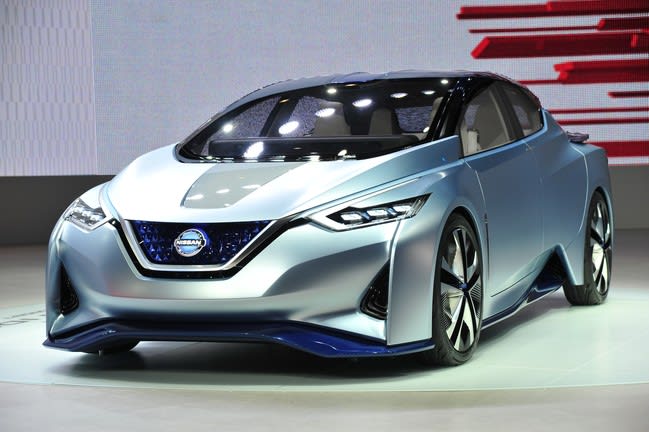
Photo of Nissan IDS Concept car courtesy of Nissan.
Photo of Nissan IDS Concept car courtesy of Nissan.
Nissan Motor Co. on Oct. 28 unveiled a concept vehicle that showcases the company’s evolving autonomous drive technology, dubbed “Nissan Intelligent Driving,” as well as new electric vehicle technology.
The automaker introduced the IDS Concept vehicle, a hatchback, at the Tokyo Motor Show. The car combines advanced vehicle control and safety technologies with artificial intelligence (AI).
“Nissan Intelligent Driving improves a driver’s ability to see, think and react,” said Carlos Ghosn, Nissan president and CEO. “It compensates for human error, which causes more than 90 percent of all car accidents. As a result, time spent behind the wheel is safer, cleaner, more efficient and more fun.”
The company stressed that Nissan Intelligent Driving allows drivers to personalize self-driving functions. Even when the driver selects “piloted drive” and turns over driving to the vehicle, the car’s performance – from accelerating to braking to cornering – imitates the driver’s own style and preferences.
In “manual drive” mode, the driver has control. But behind the scenes, the Nissan IDS Concept continues to provide assistance. Sensors continually monitor conditions, and assistance is available even while the driver is in control. In the event of imminent danger, the Nissan IDS Concept will assist the driver in taking evasive action, Nissan said.
The Nissan IDS Concept’s long wheelbase enables enough seating space for four adults. But the cabin becomes even more spacious when the driver selects “piloted drive.” In this mode, the steering wheel recedes into the center of the instrument panel and a large flat screen comes out. AI, voice and gestures from the driver handle various driving-related operations.
“In every situation, it is about giving the driver more choices and greater control. And the driver will remain the focus of our technology development efforts,” Ghosn said at the show.
To view a Nissan video depicting the company’s vision for future intelligent mobility, click on the photo or link below the headline.
In a related matter, Nissan also began testing its first prototype vehicle that demonstrates piloted drive on both highway and city streets. The prototype vehicle made its public debut Oct. 29 in Yokohama, Japan.
The car will be tested in actual traffic conditions to further develop Nissan Intelligent Driving for public use. Based on the Nissan LEAF electric car, this vehicle is equipped with such features as millimeter-wave radar, laser scanners, cameras, high-speed computer chips, and a specialized HMI (human machine interface).
Nissan has developed two new technologies that can make piloted drive possible on city streets, the automaker said. The first is the miniature, high-spec laser scanner. Currently in its prototype stages, the laser scanner determines the distance between the vehicle and its surroundings through the use of precise three-dimensional measurement that enables the vehicle to navigate routes in tight spaces.
The other new technology is an eight-way, 360-degree view camera system that allows for accurate routing decisions when driving through intersections and sharp curving roads. The new prototype vehicle possesses both of these features, facilitating travel through complex traffic environments.
Ultimately, Nissan Intelligent Driving will be introduced in stages, the company said.
For Stage One, Nissan will offer “Piloted Drive 1.0” by the end of 2016 in Japan. Piloted Drive 1.0 allows for autonomous driving under heavy highway traffic conditions. By 2018, the company hopes to implement a multiple-lane piloted drive that can conduct lane changes on highways. And by 2020, a new technology will be introduced that allows vehicles to successfully manage city streets, including intersections, autonomously.
More Safety

Nexar-Nauto Merger Aims to Give Fleets Better Safety Intelligence Through Larger Driving Dataset
Stefan Heck tells Automotive Fleet that combining more than 10 billion miles of driving history with Nexar's AI models will give fleets deeper insights into driver risk and roadway conditions than either company could provide independently.
Read More →
Don't Wait for a Crisis: 5 Ways to Build Mental Health Into Your Fleet Safety Program
For Suicide Prevention Month, fleet and safety leaders have an opportunity to put mental health where it belongs: at the center of workplace safety.
Read More →
How Camera Data Can Strengthen a Fleet’s Insurance Renewal
Insights from a commercial insurance carrier and a broker show how fleets can turn video telematic data, driver coaching, and improved claims results into a stronger case at insurance renewal.
Read More →
The Safest Fleets Aren’t the Ones with the Most Technology
You’ve made the telematics investment. Here’s how to capture the other half of its value and build the safest fleet on the road.
Read More →
Hidden in Plain Sight: Fleet Compliance Risks
Fleet compliance isn't just about having policies — it's about consistently enforcing them. This practical guide reveals six hidden compliance risks common in public sector and shared fleet operations and outlines proven strategies to improve visibility, accountability, and audit readiness
Read More →
NETS Sets 2026 Fleet Safety Benchmark Conference for Indianapolis
The Sept. 15–17 program will feature fleet benchmarking data, case studies, emerging technologies, and implementation strategies while running alongside the NSC Safety Congress & Expo.
Read More →
Off-the-Job Crashes Account for 43% of Employers’ $61.7 Billion Crash Burden
NETS quantifies costs dispersed across fleet, risk, HR, and other departments while providing new per-crash benchmarks for employers.
Read More →
Ram Recalls More Than 1.27 Million 1500 Pickups for Seat Belt Anchor Issue
The recall affects certain 2019-2026 Ram 1500 pickups that may have improperly attached second-row seat belt buckle anchors.
Read More →
How Better Visibility Cut Speeding Violations by 48%
Fleet leaders don't need more data, they need clearer visibility into what the data is saying. This case study explores how one utility replaced speeding-event counts with a single metric — miles driven in violation — to strengthen safety and significantly reduce speeding violations.
Read More →
Operation Safe Driver Week: Why the Industry's Oldest Safety Campaign Still Matters to Fleets
A look at how a 2007 enforcement initiative became one of the most consequential weeks on the fleet safety calendar, and what it means for your drivers in 2026.
Read More →