




Video: Michigan Readies for Connected-Car Test Site
The University of Michigan campus will soon be home to a 32-acre testing facility for connected and automated vehicle technologies.
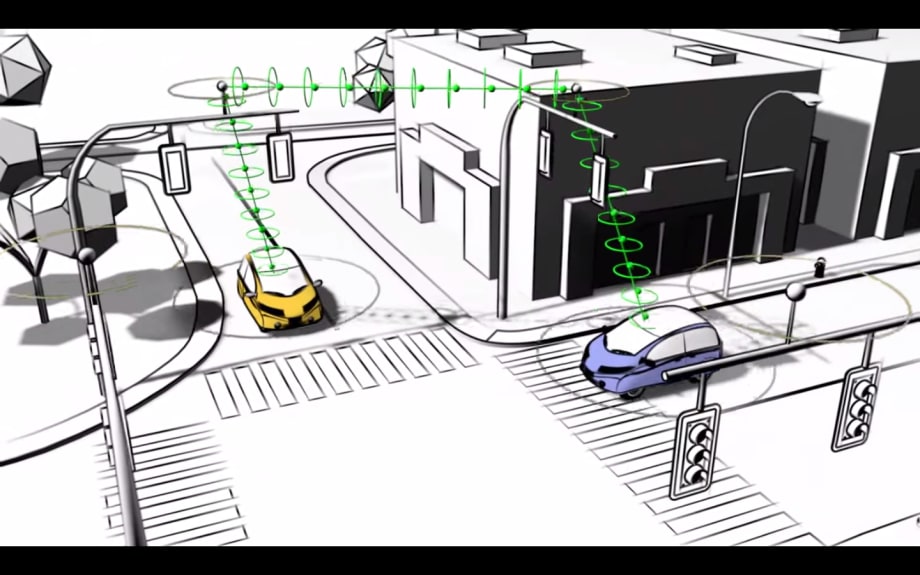
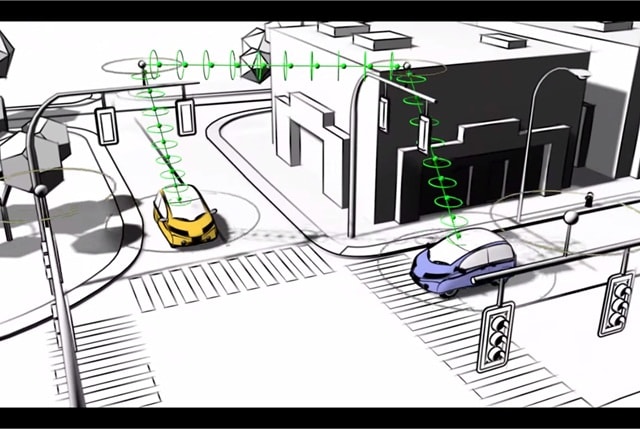
A 32-acre "mini-city" – designed for testing connected and automated vehicle systems as well as other smart city technologies – is taking shape on the University of Michigan's North Campus.
Called M City, the one-of-a-kind facility will include roads with intersections, roundabouts, roadway markings, traffic signs and signals, sidewalks, bus facilities, benches, simulated buildings, streetlights, parked cars, pedestrians and obstacles such as construction barriers.
"Connected and automated vehicle technology will usher in a revolution in the mobility of people and goods comparable to that sparked by the introduction of the automobile a century ago," said Peter Sweatman, director of U-M's Mobility Transformation Center. "M City will allow us to rigorously test new approaches in a safe, controlled and realistic environment before we implement them on actual streets."
M City is being built under the auspices of the Mobility Transformation Center, an industry-government partnership laying the foundations for connected and automated mobility. A key goal of the U-M initiative, which involves researchers from a wide range of disciplines, is to implement a connected and automated mobility system on the streets of southeastern Michigan by 2021.
The MTC is also developing on-roadway deployments of more than 20,000 cars, trucks and buses across southeastern Michigan to serve as test beds for evaluating consumer behavior and exploring market opportunities.
"Connected" means that vehicles talk to each other and to elements of the infrastructure, according to a nationally defined standard of quality and reliability.
Connected vehicles anonymously and securely exchange data – including location, speed and direction – with other vehicles and the surrounding infrastructure via wireless communication devices. This data can warn individual drivers of traffic tie-ups or emerging dangerous situations, such as a car slipping on ice around an upcoming curve, or a car that may be likely to run a red light ahead.
"Automated" vehicles are equipped with new systems of situation awareness and control that increasingly replace elements of human response and behavior. Such vehicles respond automatically to traffic situations by activating certain driving functions, such as acceleration, braking or steering. The highest level of automation allows for cars to be driverless.
The convergence of connected and automated technologies accelerates the transformation of mobility services for people and freight.
When implemented on a large scale, systems of connected and automated vehicles can dramatically improve safety, relieve traffic congestion, cut back on emissions, conserve energy and maximize transportation accessibility, according to researchers.
Designed and built in cooperation with the Michigan Department of Transportation, M City's roadway construction was completed in December. The facility will be operational in the spring and a formal opening is planned for July.
To watch a video about M City, click on the illustration or the link below the headline.
More Safety

Nexar-Nauto Merger Aims to Give Fleets Better Safety Intelligence Through Larger Driving Dataset
Stefan Heck tells Automotive Fleet that combining more than 10 billion miles of driving history with Nexar's AI models will give fleets deeper insights into driver risk and roadway conditions than either company could provide independently.
Read More →
Don't Wait for a Crisis: 5 Ways to Build Mental Health Into Your Fleet Safety Program
For Suicide Prevention Month, fleet and safety leaders have an opportunity to put mental health where it belongs: at the center of workplace safety.
Read More →
How Camera Data Can Strengthen a Fleet’s Insurance Renewal
Insights from a commercial insurance carrier and a broker show how fleets can turn video telematic data, driver coaching, and improved claims results into a stronger case at insurance renewal.
Read More →
The Safest Fleets Aren’t the Ones with the Most Technology
You’ve made the telematics investment. Here’s how to capture the other half of its value and build the safest fleet on the road.
Read More →
Hidden in Plain Sight: Fleet Compliance Risks
Fleet compliance isn't just about having policies — it's about consistently enforcing them. This practical guide reveals six hidden compliance risks common in public sector and shared fleet operations and outlines proven strategies to improve visibility, accountability, and audit readiness
Read More →
NETS Sets 2026 Fleet Safety Benchmark Conference for Indianapolis
The Sept. 15–17 program will feature fleet benchmarking data, case studies, emerging technologies, and implementation strategies while running alongside the NSC Safety Congress & Expo.
Read More →
Off-the-Job Crashes Account for 43% of Employers’ $61.7 Billion Crash Burden
NETS quantifies costs dispersed across fleet, risk, HR, and other departments while providing new per-crash benchmarks for employers.
Read More →
Ram Recalls More Than 1.27 Million 1500 Pickups for Seat Belt Anchor Issue
The recall affects certain 2019-2026 Ram 1500 pickups that may have improperly attached second-row seat belt buckle anchors.
Read More →
How Better Visibility Cut Speeding Violations by 48%
Fleet leaders don't need more data, they need clearer visibility into what the data is saying. This case study explores how one utility replaced speeding-event counts with a single metric — miles driven in violation — to strengthen safety and significantly reduce speeding violations.
Read More →
Operation Safe Driver Week: Why the Industry's Oldest Safety Campaign Still Matters to Fleets
A look at how a 2007 enforcement initiative became one of the most consequential weeks on the fleet safety calendar, and what it means for your drivers in 2026.
Read More →