




Video: Driver Monitoring Systems Gain Favor
This increasing demand for DMS reflects a broader acceptance of the safety benefits of advanced driver assistance systems.
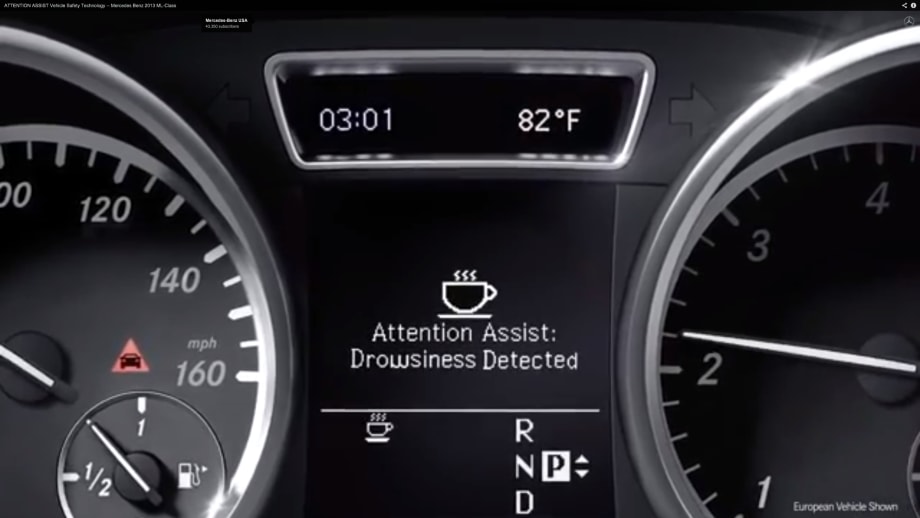
Mercedes-Benz's Attention Assist alerts the driver when there are signs of drowsy driving.
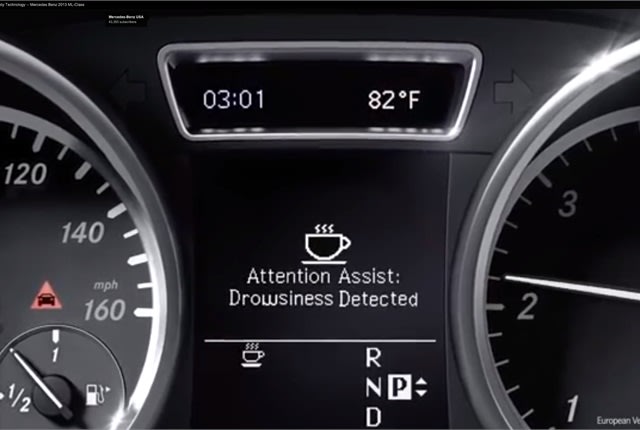
Mercedes-Benz's Attention Assist alerts the driver when there are signs of drowsy driving.
ABI Research forecasts that the global market for driver monitoring systems (DMS) will reach 64.8 million units by the end of 2020, with the majority of shipments for vehicles sold in the Asia-Pacific region.
Driver monitoring systems were first introduced as far back as 2006, when Toyota launched its Driver Attention Monitor system. Toyota’s system functions by directly monitoring the driver’s face using a discrete in-dash camera. The system was initially offered as an option in the company’s luxury Lexus models. Other OEMs soon followed suit and announced their own DMS products, which were typically based on monitoring the vehicle rather than the driver’s face.
“DMS systems such as Mercedes-Benz’s Attention Assist and Volvo and Volkswagen’s Driver Alert systems were the first ADAS systems to be offered as standard equipment by OEMs, albeit only in a small selection of models,” said Gareth Owen, principal analyst at ABI Research.
Today, an increasing number of advanced driver assistance systems (ADAS) are becoming standard equipment in new cars, particularly in some European and Japanese brands such as Volvo, Mercedes-Benz, Nissan Infiniti, Lexus and Mazda. More are being offered as options.
Although some of the big U.S. brands offer ADAS features in their European models, they typically do not offer the same features in their U.S. models. But this is beginning to change, ABI Research noted. Ford is a good example of this with its Ford Focus model.
“Another very observable trend in 2013 is that ADAS features are migrating from the luxury brands into B, C and even A segment cars,” Owen said. “Typically, the focus here is on offering ADAS systems, mostly as options, designed specifically for low-speed urban driving.”

A new technology package offered on the 2014 Toyota RAV4 Limited includes a Blind Spot Monitor with Rear Cross Traffic Alert, Lane Departure Alert and Auto High Beam.
Prices are decreasing too. For example, the European Ford Focus offers an emergency braking system plus lane departure warning and lane-keep assist, driver alert and blind spot monitoring as an optional package for £550 ($880) in the UK. Meanwhile, Volkswagen offers its City Emergency Braking System for £225-£405 ($360-$648), depending on model, on its budget A segment Up! car. This uses a laser sensor to detect the risk of an imminent collision and is active at speeds under 30 km/hour (18 mph).
These findings are part of ABI Research’s Intelligent Transportation Systems Research Service. ABI Research provides analysis and forecasting of trends in global connectivity and other emerging technologies. For more information visit www.abiresearch.com.
More Global Fleet
Holman Takes Full Ownership of ARIZA in Mexico
Holman is bringing its Mexican fleet management operation fully under its own brand after more than 30 years as a joint venture. The change gives multinational fleet customers a single Holman operation across the U.S., Canada, and Mexico.
Read More →
Proven Ways to Reduce Work Truck Downtime
The age-old problem of downtime will always be a reality, but with new strategies at hand, fleets have more ways to keep trucks on the road longer.
Read More →
The Top 300 Commercial Fleets
The Top 300 Commercial Fleets: See the List
Read More →


Cameras, Safety and Insurance: From Reactive Claims to Real-Time Prevention (Part 2 of 2)
Part Two: Commercial auto remains one of the most challenging and costly lines of coverage for fleet operators and insurers alike. Continue learning more about how to effectively address these issues from Onur Aksan, Enterprise Business Development Executive, Geotab
Read More →
Cameras, Safety and Insurance: From Reactive Claims to Real-time Prevention
Commercial auto remains one of the most challenging and costly lines of coverage for fleet operators and insurers alike. Learn more about how to effectively address these issues from Onur Aksan, Enterprise Business Development Executive, Geotab.
Read More →
Fleet Costs Are Rising: Here’s How Leaders Are Responding
Fleet leaders are under pressure to reduce costs, adapt to economic uncertainty, and make smarter decisions. See how peers across North America are responding with real data, proven strategies, and forward-looking insights. Download the 2026 Market Pulse Report to benchmark your strategy and uncover where you can gain an edge.
Read More →
Enterprise Fleet Management Surpasses 900,000 Vehicles in U.S. & Canada
Enterprise Mobility connects with mobility solutions around the globe
Read More →
Automotive Fleet's Guide to Fleet Electrification
Unlock the secrets to a successful transition to electric fleets with Automotive Fleet's comprehensive Fleet Electrification Guide!
Read More →
Sumitomo Rubber Industries to Acquire Viaduct
Viaduct will join Sumitomo as an independent subsidiary. Partnership strengthens global reach and accelerates AI-driven innovation for fleets and manufacturing.
Read More →