The project will make use of the cognitive computing power of IBM’s Watson computer system to create more intuitive driver support systems.
by Staff
December 15, 2016
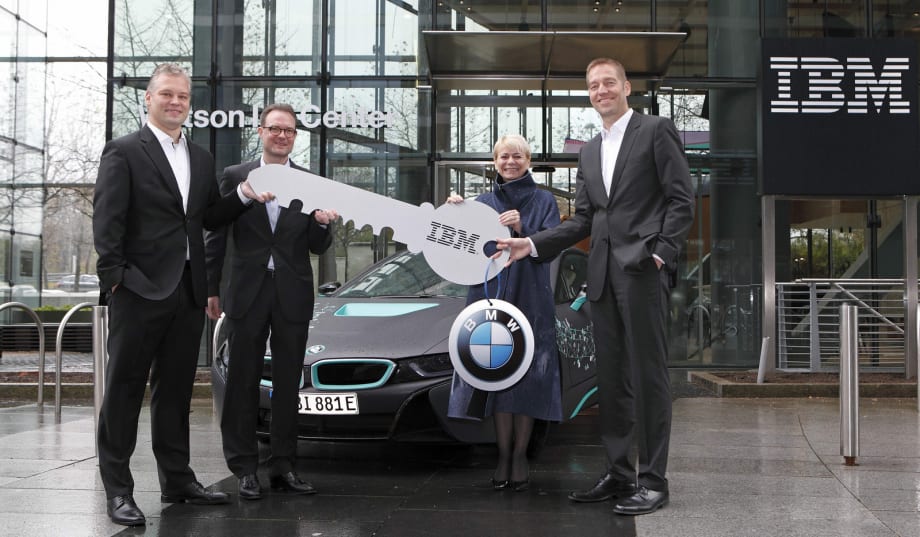
BMW and IBM executives celebrate their companies’ new collaboration at the Watson IoT headquarters in Munich, Germany. IBM’s Harriet Green and Niklaus Waser present a symbolic key to BMW’s Marcus Raisch and Alexander Kraubitz. Photo courtesy of IBM.
2 min to read
BMW and IBM executives celebrate their companies’ new collaboration at the Watson IoT headquarters in Munich, Germany. IBM’s Harriet Green and Niklaus Waser present a symbolic key to BMW’s Marcus Raisch and Alexander Kraubitz. Photo courtesy of IBM.
BMW and IBM executives celebrate their companies’ new collaboration at the Watson IoT headquarters in Munich, Germany. IBM’s Harriet Green and Niklaus Waser present a symbolic key to BMW’s Marcus Raisch and Alexander Kraubitz. Photo courtesy of IBM.
IBM and the BMW Group have agreed to collaborate on a project exploring the use conversational interfaces in vehicles to better personalize the driving experience and create more intuitive driver support systems, according to IBM.
Ad Loading...
The project will make use of the cognitive computing power of IBM’s Watson computer system, which relies on artificial intelligence and advanced analytical software to offer verbal responses to spoken questions. Watson’s machine learning capabilities offer opportunities for vehicles to learn about the preferences, needs, and driving habits of their drivers over time, improving both safety and comfort, IBM said.
The project's mission reflects the future transition to fully autonomous, connected vehicles that can adapt themselves to a driver's personal preferences. Like other smart devices, these vehicles will be integrated parts of the Internet of Things, according to IBM.
As part of the agreement, the BMW Group will relocate a team of researchers as well as four BMW i8 hybrid sports cars to IBM’s global headquarters for Watson Internet of Things (IoT) in Munich, Germany. Prototype solutions, running on IBM’s Bluemix cloud platform, will help demonstrate how Watson can enable new conversational interfaces between cars and drivers, IBM said.
“Watson is transforming how people interact with the physical world — helping to create safer, more efficient and personal experiences at home, at work and on the road,” said Harriet Green, global head of IBM’s Watson IoT business. “With this agreement, our companies will work together to lay the foundations so that drivers can benefit from Watson’s conversational and machine learning capabilities. Our insight shows that while the car will remain a fixture in personal transportation, the driving experience will change more over the next decade than at any other time of the automobile’s existence.”
To view a video about the project, click on the photo or link below the headline.
Stefan Heck tells Automotive Fleet that combining more than 10 billion miles of driving history with Nexar's AI models will give fleets deeper insights into driver risk and roadway conditions than either company could provide independently.
Insights from a commercial insurance carrier and a broker show how fleets can turn video telematic data, driver coaching, and improved claims results into a stronger case at insurance renewal.
Fleet compliance isn't just about having policies — it's about consistently enforcing them. This practical guide reveals six hidden compliance risks common in public sector and shared fleet operations and outlines proven strategies to improve visibility, accountability, and audit readiness
The Sept. 15–17 program will feature fleet benchmarking data, case studies, emerging technologies, and implementation strategies while running alongside the NSC Safety Congress & Expo.
Fleet leaders don't need more data, they need clearer visibility into what the data is saying. This case study explores how one utility replaced speeding-event counts with a single metric — miles driven in violation — to strengthen safety and significantly reduce speeding violations.
A look at how a 2007 enforcement initiative became one of the most consequential weeks on the fleet safety calendar, and what it means for your drivers in 2026.