




Video: 2014 Hyundai Veloster Earns 5-Star Safety Rating
The car employs a vehicle stability management (VSM) system, which monitors electronic stability control (ESC) and motor-driven power steering (MDPS).
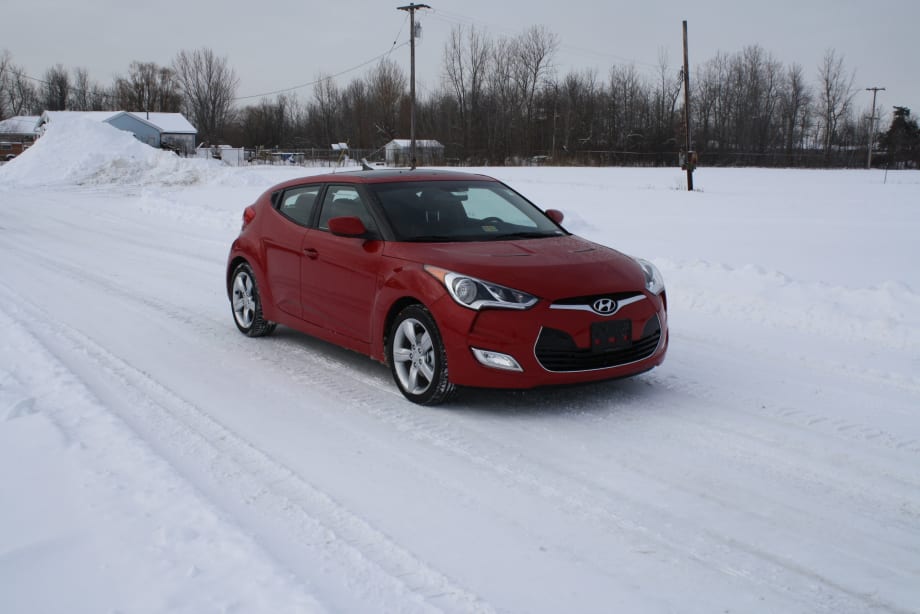
Photo of 2014 Hyundai Veloster, just before it underwent front crash testing, courtesy of NHTSA.
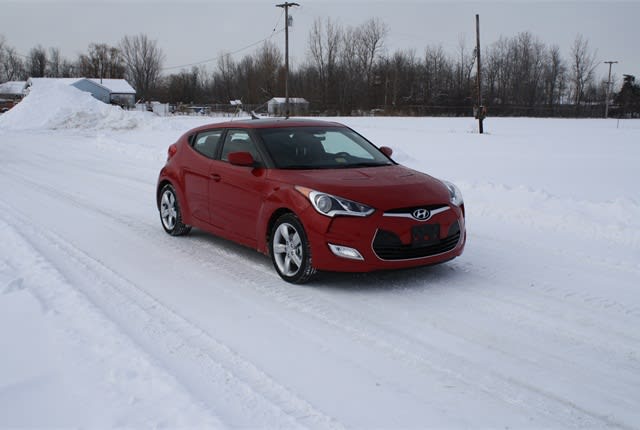
Photo of 2014 Hyundai Veloster, just before it underwent front crash testing, courtesy of NHTSA.
The National Highway Traffic Safety Administration (NHTSA) has awarded a five-star overall safety rating -- the agency’s highest overall score given -- to the all-new 2014 Hyundai Veloster.
The Veloster scored four stars in front and rollover crash tests, and five stars in the side crash test. Calspan Corp. conducted the crash tests in mid-February.
This is the first time the Veloster has been rated under NHTSA’s tougher tests and five-star rating system as part of the agency’s New Car Assessment Program (NCAP).
The Veloster employs a vehicle stability management (VSM) system, which monitors electronic stability control (ESC) and motor-driven power steering (MDPS).
For the 2014 model year, the Veloster comes in several configurations: Veloster, Veloster Turbo and the RE:FLEX and Veloster Turbo R-Spec. All variants use Hyundai’s 1.6-liter Gasoline Direct Injection (GDI) engine. Veloster Turbo and Veloster Turbo R-Spec receive a force-fed diet of high-pressure air through a new, twin-scroll turbocharger.
“The Veloster nameplate was designed to bring a new, unconventional look to the subcompact car segment without compromising occupant safety,” said Scott Margason, director of product planning for Hyundai Motor America. “Through the employment of high-tech safety systems like Electronic Brake-force Distribution and Brake Assist and the use of high-strength yet lightweight materials during construction, we are able to deliver a package that is unique, but safer than ever.”
All Velosters are given Hyundai’s braking package, featuring four-wheel disc brakes and an anti-lock braking system (ABS). The system’s brake assist provides maximum braking force when a panic stop is detected, and electronic brake-force distribution (EBD) automatically adjusts the braking force to front and rear axles based on vehicle loading conditions.
Additionally, all Velosters feature six airbags, including dual front, front seat-mounted side-impact, and front and rear side curtain airbags, along with a rear-view camera and daytime running lights.
The Veloster joins the Hyundai Elantra, Elantra GT, Genesis, Genesis Coupe, Santa Fe, Santa Fe Sport and Sonata, which all received a five-star overall rating from NHTSA in their most-recent model years.
More Safety
Managing Road Risk at Scale: Why Fleet Safety Needs a Data-Driven Framework
Insights from the FIA Road and Driver Safety Indexes reveal how to manage road risk on a larger scale.
Read More →
Stellantis Recalls 1.3 Million Jeep Vehicles Worldwide Over Fire Risk
Stellantis is recalling more than 1.3 million Jeep Wrangler and Gladiator models worldwide over a fire risk linked to power steering pump wiring.
Read More →
Coaching Is Not Training, Even When AI Is Doing It
AI-powered safety platforms can detect risky behaviors and deliver immediate feedback. But effective driver development still requires a foundation of training followed by coaching that reinforces those skills.
Read More →

How Emotions Behind the Wheel Can Affect Fleet Safety
During National Safety Month, fleets are encouraged to look beyond distracted driving and recognize how stress, fatigue, and emotional well-being influence driver performance and crash risk.
Read More →
Nominations Open for 2026 Fleet Safety Award
Nominations have officially opened for the 2026 Fleet Safety Award Winner.
Read More →
Turning Connected Vehicle Data Into Decisions That Matter
Fleet leaders have more data than ever, but turning that data into clear, actionable decisions remains a challenge. This white paper shows how leading organizations are using connected vehicle data to improve safety, reduce costs, and optimize fleet performance. Learn how to turn insight into action across your fleet.
Read More →
Cameras, Safety and Insurance: From Reactive Claims to Real-time Prevention
Commercial auto remains one of the most challenging and costly lines of coverage for fleet operators and insurers alike. Learn more about how to effectively address these issues from Onur Aksan, Enterprise Business Development Executive, Geotab.
Read More →
NAFA Fleet Safety Symposium to Collocate With 2026 Fleet Forward Conference
The daylong certificate program will precede the Fleet Forward Conference at the Gaylord National Harbor in Maryland.
Read More →
The Distractions You Can’t Turn Off: What Drivers Face Outside the Vehicle
Fleet drivers face constant visual, cognitive, and environmental interruptions the moment they hit the road. From roadside chaos to mental fatigue and digital overload, today’s biggest driving risks often come from outside the vehicle itself.
Read More →
FLASH Weather AI Launches First Deep-Learning Hail Prediction Model With High-Resolution Forecasting
FLASH Weather AI has launched a first-of-its-kind hail prediction model capable of forecasting hail size and arrival time at 1-kilometer resolution up to 55 minutes ahead, giving fleets and insurers critical time to prepare for severe storms.
Read More →