




Verizon to Offer New Connected-Vehicle Service
Verizon Vehicle will include diagnostic technology, push-button live assistance, and roadside assistance using GPS to hasten the tow truck’s arrival.
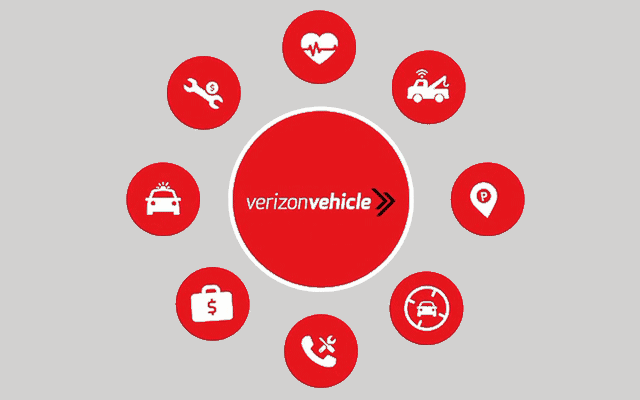
Image courtesy of Verizon.
Image courtesy of Verizon.
Verizon this year will begin providing a new connected-vehicle service aimed at modernizing traditional roadside assistance.
Verizon Vehicle, set to debut commercially in the spring, will include diagnostic technology, push-button live assistance, and roadside assistance using GPS to hasten the tow truck’s arrival. The service will also connect drivers with live A.S.E.-certified mechanics to diagnose potential problems and offer solutions.
Verizon unveiled plans for the new service at the North American International Auto Show in Detroit.
There are more than 200 million vehicles in the U.S. without connected capabilities, noted Erik Goldman, president of Verizon Telematics. Verizon Vehicle is an aftermarket solution that fosters “a safer, smarter and more economical way to drive and maintain a vehicle,” he said.
Compatible with nearly every vehicle made and sold in the U.S. since 1996 – more than 9,000 makes and models – Verizon Vehicle will launch as a subscription-based service. It will be available to drivers regardless of the wireless service provider they use for their mobile devices. Members also receive travel discounts.
The subscription-based service operates through an OBD reader easily installed in the under-dash diagnostic port, a Bluetooth-enabled speaker attached to the visor and a complementary smartphone app. Members can choose to use the app or set up the service to contact them -- by phone, text, push notification or email -- if a potential issue is detected with their vehicle.
The speaker offers one-button push connection to the member care group, the mechanics hotline and roadside assistance. A second button is for SOS emergency situations.
The subscription-based service will include:
GPS-Directed Pinpoint Roadside Assistance for breakdowns, flat tires, overheating, a dead battery -- anything that might require towing or immediate repair. Dispatches are made to the exact location of a disabled vehicle.
Automatic Urgent Incident AlertSystem, which places a call to the Verizon Vehicle Member Care Center in the event of a suspected accident. Help is immediately dispatched to the location if a crash is confirmed or the driver isn’t responsive.
One-Button SOS Assistance, which immediately connects the driver to a live agent for emergency aid.
Auto Health System with Predictive Diagnostics, which translates most “Check Engine” light occurrences into real terms, including the description and severity of the matter, the probable solutions for the problem, and the appropriate cost for the repairs. The system is also designed to provide early warnings relating to some vehicle functions, even before a warning light comes on, to help keep drivers off the side of the road.
Mechanic’s Hotline, whichis staffed with A.S.E.-certified mechanics.
Parking & Meter Tools, which help drivers find where they left their vehicle – using the Verizon Vehicle smartphone app – while also keeping track of how much time is left on the meter.
Maintenance Alerts, which inform when scheduled maintenance is required.
Stolen Vehicle Location Assistance, which guides drivers through the process of reporting a theft and helps authorities recover the stolen vehicle.
Travel & Repair Savings, which include discounts on hotels, vehicle rentals, auto maintenance, repairs and related travel expenses.
More Safety

What’s Next for Fleet? Safety, AI & Industry Recognition | AF News Recap
Could your company's culture be encouraging distracted driving? This week, we're exploring how workplace expectations affect driver safety, what AI, EVs, and autonomous vehicles could mean for the future of fleet management, and how fleet professionals can strengthen their award nominations.
Read More →
Does Your Fleet's Culture Encourage Distracted Driving?
What happens when the people responsible for enforcing safety rules are the ones setting the wrong example? The answer may reveal why some of the biggest risks to fleet drivers have little to do with what's written in the employee handbook.
Read More →
Fleet Manager’s Ultimate Playbook: Navigating the New Standard in OEM Connectivity
Rising operating costs, driver safety concerns, and unplanned downtime are putting unprecedented pressure on modern fleets. Discover how fleet managers use embedded OEM connectivity and real-time vehicle data to cut TCO, prevent downtime, and protect drivers without aftermarket telematics hardware.
Read More →
From Driver Well-Being to EV Charging | AF News Recap
Mental health belongs in the fleet safety conversation. This week, we’re looking at five ways fleets can support employee well-being before a crisis, plus Holman’s expansion in Mexico, new one-day Fleet Forward passes, and why EV charging demand is outpacing infrastructure growth.
Read More →
Nexar-Nauto Merger Aims to Give Fleets Better Safety Intelligence Through Larger Driving Dataset
Stefan Heck tells Automotive Fleet that combining more than 10 billion miles of driving history with Nexar's AI models will give fleets deeper insights into driver risk and roadway conditions than either company could provide independently.
Read More →
Don't Wait for a Crisis: 5 Ways to Build Mental Health Into Your Fleet Safety Program
For Suicide Prevention Month, fleet and safety leaders have an opportunity to put mental health where it belongs: at the center of workplace safety.
Read More →
How Camera Data Can Strengthen a Fleet’s Insurance Renewal
Insights from a commercial insurance carrier and a broker show how fleets can turn video telematic data, driver coaching, and improved claims results into a stronger case at insurance renewal.
Read More →
The Safest Fleets Aren’t the Ones with the Most Technology
You’ve made the telematics investment. Here’s how to capture the other half of its value and build the safest fleet on the road.
Read More →
Hidden in Plain Sight: Fleet Compliance Risks
Fleet compliance isn't just about having policies — it's about consistently enforcing them. This practical guide reveals six hidden compliance risks common in public sector and shared fleet operations and outlines proven strategies to improve visibility, accountability, and audit readiness
Read More →
NETS Sets 2026 Fleet Safety Benchmark Conference for Indianapolis
The Sept. 15–17 program will feature fleet benchmarking data, case studies, emerging technologies, and implementation strategies while running alongside the NSC Safety Congress & Expo.
Read More →