




Related: Electric Truck Maker Developing Drone Deployment System
USPS Considering Drone Delivery Vehicle
The Workhorse Group — with its electric truck and a drone delivery system — is among the 15 companies qualified by the U.S. Postal Service as potential suppliers of its next-generation delivery vehicle.

Paul Clinton・Former Senior Web Editor
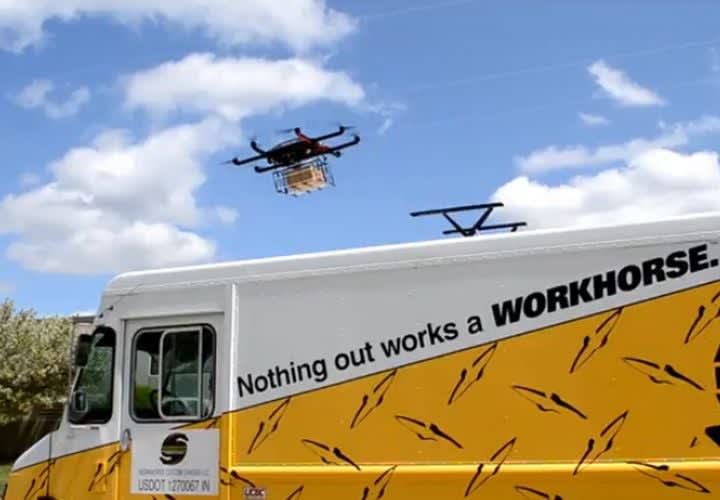
Screenshot via Workhorse.
2 min to read
Screenshot via Workhorse.
The Workhorse Group — with its electric truck and a drone delivery system — is among the 15 companies qualified by the U.S. Postal Service as potential suppliers of its next-generation delivery vehicle.
Whether the USPS will embrace innovative technology that's poised to disrupt the "last mile" of traditional package delivery remains an open question, but Workhorse CEO Steve Burns believes an order for 180,000 vehicles that could reach $6.3 billion could play into his favor. The USPS has said it's seeking a vehicle that will serve for two decades.
"When you’ve got a deal that big, it’s a chance to leapfrog" other delivery methods, Burns said. "That’s a big enough bounty where innovation can happen. It's going to cause a quantum leap."
Burns faces tough competition on a list of potential suppliers that includes Fiat Chrysler Automobiles, Ford, Nissan, and Freightliner. The list also includes AM General, Emerald Automotive, Karsan, Mahindra, Morgan Olson, OEM Systems, Oshkosh, Utilimaster, VT Hackney, and ZAP Jonway.
Workhorse, which officially changed its name from Amp in April, would submit its E-Gen range-extended truck chassis and HorseFly package delivery drone. The company is partnering with a body builder to develop a custom service body that would include a drone deployment port in the roof that allows the drone to exit and return from delivery jobs.
The drone would use the vehicle's battery to charge its pair of Panasonic 18650 (18-by-65 mm size) lithium ion batteries. The drone uses a 3G cellular signal and point-to-point signal from the truck to reach its target. The driver uses a tablet mounted inside the truck to pinpoint the final delivery location at the address, and the landing is managed by certified pilots in a Workhorse command center.
The latest E-Gen chassis features a 200-kilowatt Sumo motor from Canada's TM4, a Panasonic 18650 battery pack, and 2.4-liter engine from Power Solutions International in the hybrid model. The engine can be set up to run on gasoline, CNG or propane autogas.
Burns is waiting for the USPS to issue its RFP this month so he can submit a detailed proposal. The USPS would then select several suppliers to build prototypes for testing. Drone operation would still need federal regulatory approval before moving forward.
More Operations

Fleet Has a Talent Pipeline Problem. What Comes Next? | AF News Recap
Where will fleet’s next generation of leaders come from? This week, we’re looking at the industry’s talent pipeline, what certification can add to a fleet career, how to build an award-worthy track record, and the return of Automotive Fleet’s Personal Use Survey.
Read More →
Smith System Launches Driver Risk Management Program
Fleets have more driver data than ever, but identifying risky behavior doesn't necessarily correct it. Smith System's new Driver Risk Management program combines monitoring, training, and follow-up coaching to help fleets connect risk signals with driver intervention.
Read More →
Automotive Fleet Opens 2026 Personal Use Survey for Commercial Fleet Managers
Less than two weeks left! Commercial and corporate fleet managers are invited to share how their organizations handle company vehicle personal-use policies, charges, and driver eligibility.
Read More →
From AI Prompts to AI-Generated Safety Songs | AF News Recap
Can better prompts make AI more useful for fleet managers? This week, we’re breaking down smarter fleet analysis, an AI-assisted experiment that turned safety training into music, and what happened to fuel prices in August.
Read More →
How to Write Better AI Prompts for Fleet Analysis
Include these six elements in your fleet prompts to generate more relevant analysis and accurate answers.
Read More →
Fleet Meets: Eric Kilgore
This edition of the Fleet Meets series features one of the industry's best leaders driving multi-market and national operations.
Read More →
Why Reactive Fleet Management Is Becoming Too Expensive to Sustain
Research highlights a growing need for proactive management strategies to address rising costs in fleet operations effectively.
Read More →
Sponsored•August 12, 2026
What Your Fleet KPIs Aren’t Telling You
Tracking fleet metrics is only useful when the data leads to better decisions. This guide helps fleet leaders assess cost, utilization, and downtime more accurately, identify performance gaps, and prioritize the actions that can improve operational results.
Read More →
Sponsored•August 7, 2026
Hidden in Plain Sight: Fleet Compliance Risks
Fleet compliance isn't just about having policies — it's about consistently enforcing them. This practical guide reveals six hidden compliance risks common in public sector and shared fleet operations and outlines proven strategies to improve visibility, accountability, and audit readiness
Read More →
Turning Fleet Payment Data into Executive Insights
Does data alone drive results in operations?
Read More →