




U.S. Lags Behind in Road Death Reductions
A new CDC report concludes that among 19 high-income countries, the U.S. saw the lowest-percentage decline in vehicle crash death rate from 2000-2013.

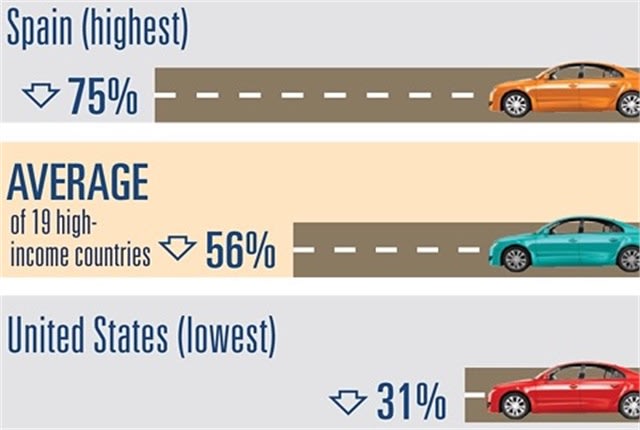
Countries with the highest and lowest reductions in crash deaths, 2000-2013. Deaths per 100,000 people. Source: International Road Traffic and Accident Database (IRTAD) Road Safety Annual Report, 2015.
Countries with the highest and lowest reductions in crash deaths, 2000-2013. Deaths per 100,000 people. Source: International Road Traffic and Accident Database (IRTAD) Road Safety Annual Report, 2015.
About 90 people die each day from motor vehicle crashes in the U.S., resulting in the highest death rate among 19 high-income countries used for comparison, according to a new report released by the Centers for Disease Control and Prevention (CDC).
Though the U.S. has made progress in road safety, reducing crash deaths by 31% from 2000 to 2013, other high-income countries have reduced crash deaths even further by an average of 56% during the same period, the CDC found.
The discrepancy underscores the potential for the U.S. to decrease road fatalities further using proven enforcement methods.
“It is important to compare us not to our past but to our potential,” said Debra Houry, director of CDC’s National Center for Injury Prevention and Control. “Seeing that other high-income countries are doing better, we know we can do better too.”
Compared with other high-income countries, the U.S. had the most motor vehicle crash deaths per 100,000 population and per 10,000 registered vehicles; the second-highest percentage of deaths involving alcohol (31%); and the third-lowest front seat belt use (87%).
If the U.S. had the same motor vehicle crash death rate as Belgium — the country with the second highest death rate after the U.S. — about 12,000 fewer lives would have been lost and an estimated $140 million in direct medical costs would have been averted in 2013. And if the U.S. had the same rate as Sweden — the country with the lowest crash death rate — about 24,000 fewer lives would have been lost and an estimated $281 million in direct medical costs would have been averted in 2013, according to researchers.
The CDC analyzed data compiled by the World Health Organization (WHO) and the Organization for Economic Co-operation and Development (OECD). Researchers determined the number and rate of motor vehicle crash deaths in the U.S. and 19 other high-income countries and reported national seat belt use and percentage of deaths that involved alcohol-impaired driving or speeding, by country, when available.
Countries included in the study were Australia, Austria, Belgium, Canada, Denmark, Finland, France, Germany, Ireland, Israel, Japan, Netherlands, New Zealand, Norway, Slovenia, Spain, Sweden, Switzerland, the United Kingdom, and the U.S.
“With a projected increase in U.S. crash deaths in 2015, the time is right to reassess U.S. progress and set new goals,” the CDC said in a summary of the report. “By implementing effective strategies, including those that increase seat belt use and reduce alcohol-impaired driving and speeding, the United States can prevent thousands of motor vehicle crash-related injuries and deaths and hundreds of millions of dollars in direct medical costs every year.”
Researchers recommended using seat belts in both front and rear seats, properly using car seats and booster seats for children through at least age 8, never drinking and driving, obeying speed limits, and eliminating distracted driving.
Each year about half the passenger vehicle occupants who die in crashes in the U.S. are unrestrained. The report noted that “implementing primary enforcement seat belt laws that cover occupants in all seating positions, and requiring the use of car seats and booster seats for motor vehicle passengers through at least age 8 years, could increase restraint use and prevent injuries and deaths in the United States.”
“It’s unacceptable for 90 people to die on our roads each day, especially when we know what works to prevent crashes, injuries, and deaths,” said Erin Sauber-Schatz, transportation safety team lead for CDC’s National Center for Injury Prevention and Control. “About 3,000 lives could be saved each year by increasing seat belt use to 100%, and up to 10,000 lives could be saved each year by eliminating alcohol-impaired driving.”
To download the full report, click here.
More Safety

Nexar-Nauto Merger Aims to Give Fleets Better Safety Intelligence Through Larger Driving Dataset
Stefan Heck tells Automotive Fleet that combining more than 10 billion miles of driving history with Nexar's AI models will give fleets deeper insights into driver risk and roadway conditions than either company could provide independently.
Read More →
Don't Wait for a Crisis: 5 Ways to Build Mental Health Into Your Fleet Safety Program
For Suicide Prevention Month, fleet and safety leaders have an opportunity to put mental health where it belongs: at the center of workplace safety.
Read More →
How Camera Data Can Strengthen a Fleet’s Insurance Renewal
Insights from a commercial insurance carrier and a broker show how fleets can turn video telematic data, driver coaching, and improved claims results into a stronger case at insurance renewal.
Read More →
The Safest Fleets Aren’t the Ones with the Most Technology
You’ve made the telematics investment. Here’s how to capture the other half of its value and build the safest fleet on the road.
Read More →
Hidden in Plain Sight: Fleet Compliance Risks
Fleet compliance isn't just about having policies — it's about consistently enforcing them. This practical guide reveals six hidden compliance risks common in public sector and shared fleet operations and outlines proven strategies to improve visibility, accountability, and audit readiness
Read More →
NETS Sets 2026 Fleet Safety Benchmark Conference for Indianapolis
The Sept. 15–17 program will feature fleet benchmarking data, case studies, emerging technologies, and implementation strategies while running alongside the NSC Safety Congress & Expo.
Read More →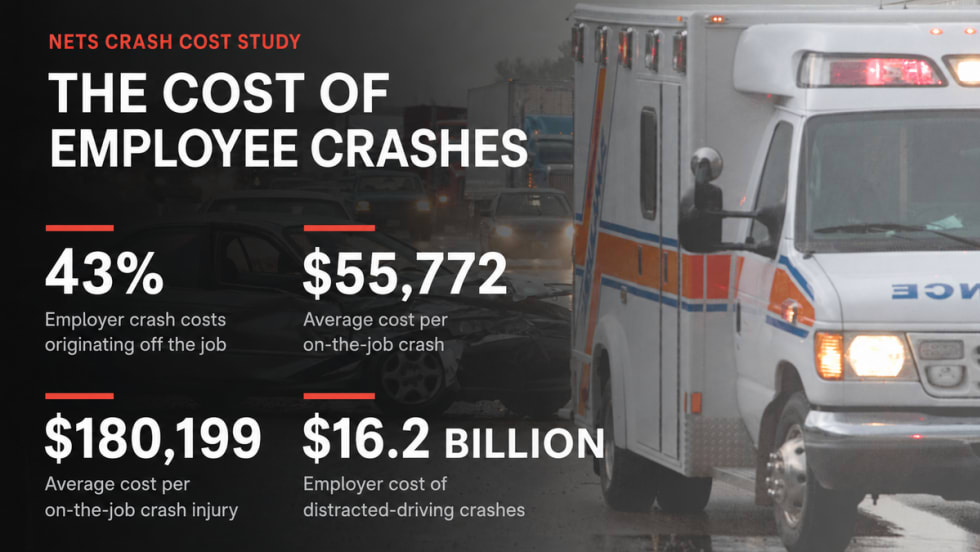
Off-the-Job Crashes Account for 43% of Employers’ $61.7 Billion Crash Burden
NETS quantifies costs dispersed across fleet, risk, HR, and other departments while providing new per-crash benchmarks for employers.
Read More →
Ram Recalls More Than 1.27 Million 1500 Pickups for Seat Belt Anchor Issue
The recall affects certain 2019-2026 Ram 1500 pickups that may have improperly attached second-row seat belt buckle anchors.
Read More →
How Better Visibility Cut Speeding Violations by 48%
Fleet leaders don't need more data, they need clearer visibility into what the data is saying. This case study explores how one utility replaced speeding-event counts with a single metric — miles driven in violation — to strengthen safety and significantly reduce speeding violations.
Read More →
Operation Safe Driver Week: Why the Industry's Oldest Safety Campaign Still Matters to Fleets
A look at how a 2007 enforcement initiative became one of the most consequential weeks on the fleet safety calendar, and what it means for your drivers in 2026.
Read More →