




U.K. Study Praises Safety Technologies, Acknowledges Consumer Apathy
BROMSGROVE, United Kingdom --- A new United Kingdom report from just-auto.com forecasts a bright future for driver assistance technologies despite consumer apathy.
BROMSGROVE, United Kingdom --- A new United Kingdom report from just-auto.com forecasts a bright future for driver assistance technologies despite consumer apathy. The U.K. is expected to adopt more safety legislation in the near future, in response to research showing that driver error is one of the most common causes of traffic accidents. But surveys show that many drivers assign low priority to out-of-sight safety items such as anti-lock brakes (which are now mandatory in Europe), stability control and radar-controlled cruise control. The report found that the most popular comfort and safety features that U.K. drivers want in their cars are items such as satellite navigation, climate control, airbags, iPod ports and add-ons such as cup and mobile phone holders. Some manufacturers believe that if U.K. insurers offered a lower premium to drivers of cars fitted with driver assistance systems, consumer demand would rise. This was the case in the early stages of the introduction of anti-lock braking systems (ABS). Discussions with insurance groups are ongoing, though progress is reportedly slow. However, the automotive industry is convinced that a host of driver assistance technologies is coming, accompanied by the European Union's eSafety action program for road safety, which aims to cut in half the number of EU road fatalities by 2010. Driver assistance systems on the detection and analysis of the vehicle's surroundings are expected to make a major contribution to the achievement of this aim. Investigations carried out by the German Ministry of Transport have shown that such systems can have a preventive influence on more than 50 percent of all accidents. Driver assistance systems, either on the road or still on the drawing board, divide into three camps: ** Collision-warning systems --- This is the original term for forward and side radar systems that alert the driver but do not control engine speed. ** Collision-mitigation systems --- In addition to sending out a warning to the driver --- either through audio, visual or vibrating the steering wheel --- these systems aim to assess the danger ahead and trigger various active safety features, such as pretensioning the seatbelts. ** Collision-avoidance systems --- Use of these systems means that some degree of control is taken over from the driver if he or she doesn't react in time to avoid a crash. The most common suite of driver assistance technologies available today includes adaptive cruise control (ACC), lane change assistance, and parking assistance systems.
More Safety

Tips for Driving Safely on Halloween Night
This video features a reminder from the Connecticut Department of Transportation (DOT) and the Connecticut Police Chiefs Association, urging drivers to prioritize safety this Halloween.
Read More →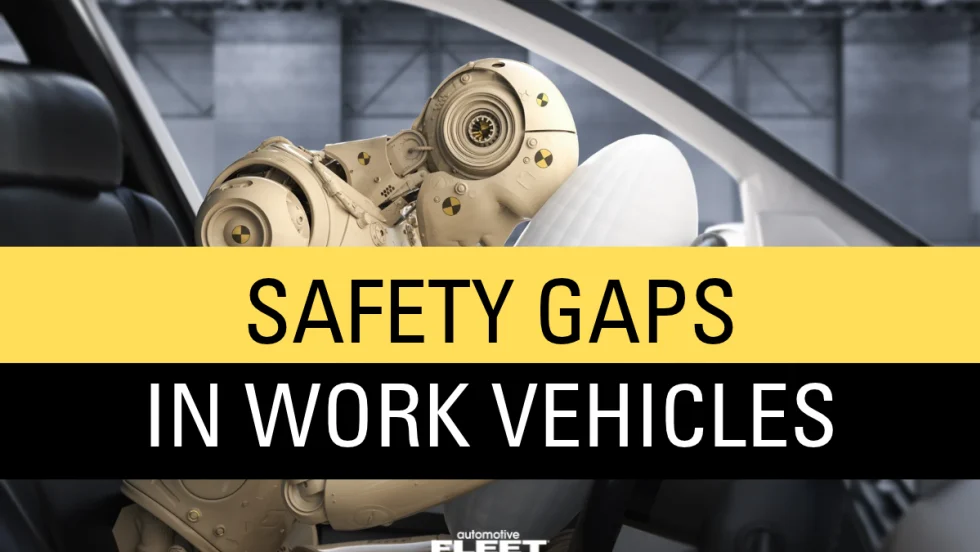
IIHS Crash Avoidance Tests Reveal Safety Gaps in Cargo Vans and Work Trucks
New IIHS crash avoidance ratings show uneven performance among cargo vans and heavy-duty pickups, with most struggling to avoid vehicle-to-vehicle collisions.
Read More →
What’s Next for Fleet? Safety, AI & Industry Recognition | AF News Recap
Could your company's culture be encouraging distracted driving? This week, we're exploring how workplace expectations affect driver safety, what AI, EVs, and autonomous vehicles could mean for the future of fleet management, and how fleet professionals can strengthen their award nominations.
Read More →
Does Your Fleet's Culture Encourage Distracted Driving?
What happens when the people responsible for enforcing safety rules are the ones setting the wrong example? The answer may reveal why some of the biggest risks to fleet drivers have little to do with what's written in the employee handbook.
Read More →
Fleet Manager’s Ultimate Playbook: Navigating the New Standard in OEM Connectivity
Rising operating costs, driver safety concerns, and unplanned downtime are putting unprecedented pressure on modern fleets. Discover how fleet managers use embedded OEM connectivity and real-time vehicle data to cut TCO, prevent downtime, and protect drivers without aftermarket telematics hardware.
Read More →
From Driver Well-Being to EV Charging | AF News Recap
Mental health belongs in the fleet safety conversation. This week, we’re looking at five ways fleets can support employee well-being before a crisis, plus Holman’s expansion in Mexico, new one-day Fleet Forward passes, and why EV charging demand is outpacing infrastructure growth.
Read More →
Nexar-Nauto Merger Aims to Give Fleets Better Safety Intelligence Through Larger Driving Dataset
Stefan Heck tells Automotive Fleet that combining more than 10 billion miles of driving history with Nexar's AI models will give fleets deeper insights into driver risk and roadway conditions than either company could provide independently.
Read More →
Don't Wait for a Crisis: 5 Ways to Build Mental Health Into Your Fleet Safety Program
For Suicide Prevention Month, fleet and safety leaders have an opportunity to put mental health where it belongs: at the center of workplace safety.
Read More →
How Camera Data Can Strengthen a Fleet’s Insurance Renewal
Insights from a commercial insurance carrier and a broker show how fleets can turn video telematic data, driver coaching, and improved claims results into a stronger case at insurance renewal.
Read More →
The Safest Fleets Aren’t the Ones with the Most Technology
You’ve made the telematics investment. Here’s how to capture the other half of its value and build the safest fleet on the road.
Read More →