




Uber's Self-Driving Vehicles Rely on Humans to Brake in Emergencies
A preliminary report by the National Transportation Safety Board found that Uber does not enable the automatic braking feature while its self-driving test vehicles are under computer control to “reduce the potential for erratic vehicle behavior.”

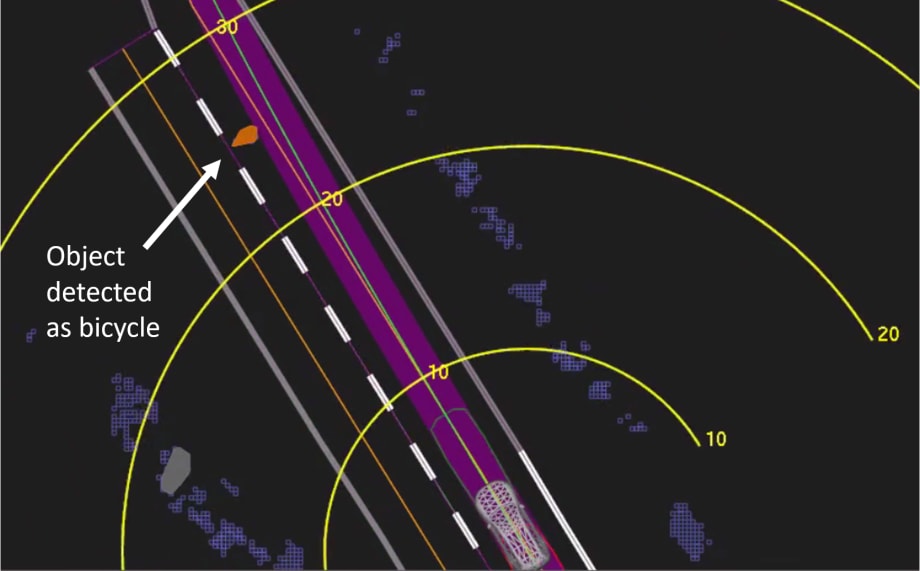
Uber self-driving system data playback from the fatal March 18, crash of an Uber test vehicle shows when, at 1.3 seconds before impact, the system determined emergency braking was needed to mitigate a collision. The yellow bands depict meters ahead of the vehicle, the orange lines show the center of mapped travel lanes, the purple area shows the path of the vehicle, and the green line depicts the center of that path. Photo courtesy of NTSB.
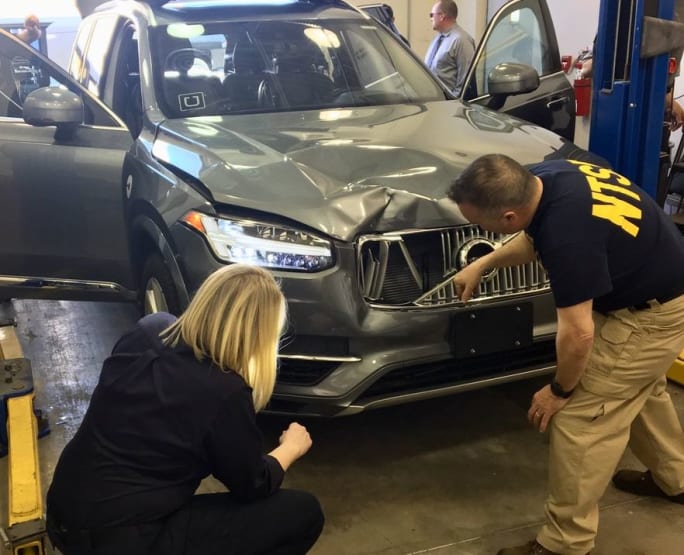
The report by the National Transportation Safety Board (NTSB) found that Uber does not enable the automatic braking feature while its test vehicles are under computer control to “reduce the potential for erratic vehicle behavior.” Photo via NTSB/Wikimedia.
Photo via NTSB/Wikimedia.
A preliminary government report on the March fatal crash involving an Uber self-driving test vehicle and a pedestrian in Tempe, Ariz., shows that the vehicle’s manufacturer installed automatic emergency braking system was disabled at the time.
The report by the National Transportation Safety Board (NTSB) found that Uber does not enable the automatic braking feature while its test vehicles are under computer control to “reduce the potential for erratic vehicle behavior.” Additionally, the safety system is not designed to alert the vehicle’s operator.
The San Francisco-based technology company confirmed this finding.
The test vehicle involved in the incident, a modified 2017 Volvo XC90, was operating with its self-driving system in computer control mode and had a vehicle safety operator inside it when the accident occurred. While the Volvo was factory equipped with a collision avoidance function, in addition to functions for detecting driver alertness and road sign information, all advanced driver assistance functions were disabled when it was put into computer control mode.
On the night of March 18, the vehicle and its safety operator were traveling a 43 mph. A pedestrian wearing dark clothes stepped into the roadway, about 360 feet south of the crosswalk. While the pedestrian was pushing a bicycle, it did not have any safety reflectors.
Related: Arizona Suspends Uber's Autonomous Vehicle Testing
“As the vehicle and pedestrian paths converged, the self-driving system software classified the pedestrian as an unknown object, as a vehicle, and then as a bicycle with varying expectations of future travel path,” the report says, in part. “At 1.3 seconds before impact, the self-driving system determined that emergency braking was needed to mitigate a collision.”
Data from the Volvo shows that the safety operator engaged with the steering wheel less than a second before impact and began braking less than a second after impact.
“The vehicle operator said in an NTSB interview that she had been monitoring the self-driving interface and that while her personal and business phones were in the vehicle neither were in use until after the crash,” the report says.
Since the NTSB report is preliminary, it does not contain any probably cause for the accident.
After the initial accident, Uber indefinitely halted all self-driving vehicle testing across the country. Yesterday, Uber revealed to its Arizona employees that it will be shuttering its autonomous vehicle test program in the state, following mounting public pressure.
In an email, an Uber executive told employees that the company will be focusing on testing vehicles in Pittsburg and San Francisco, but in a “much more limited way.”
Currently, Uber does not have the approval of the California Department of Motor Vehicles to test its autonomous cars in the state.
Related: Uber to End Self-Driving Vehicle Testing in Arizona
Originally posted on Auto Rental News
More Safety
What’s Next for Fleet? Safety, AI & Industry Recognition | AF News Recap
Could your company's culture be encouraging distracted driving? This week, we're exploring how workplace expectations affect driver safety, what AI, EVs, and autonomous vehicles could mean for the future of fleet management, and how fleet professionals can strengthen their award nominations.
Read More →
Does Your Fleet's Culture Encourage Distracted Driving?
What happens when the people responsible for enforcing safety rules are the ones setting the wrong example? The answer may reveal why some of the biggest risks to fleet drivers have little to do with what's written in the employee handbook.
Read More →
Fleet Manager’s Ultimate Playbook: Navigating the New Standard in OEM Connectivity
Rising operating costs, driver safety concerns, and unplanned downtime are putting unprecedented pressure on modern fleets. Discover how fleet managers use embedded OEM connectivity and real-time vehicle data to cut TCO, prevent downtime, and protect drivers without aftermarket telematics hardware.
Read More →
From Driver Well-Being to EV Charging | AF News Recap
Mental health belongs in the fleet safety conversation. This week, we’re looking at five ways fleets can support employee well-being before a crisis, plus Holman’s expansion in Mexico, new one-day Fleet Forward passes, and why EV charging demand is outpacing infrastructure growth.
Read More →
Nexar-Nauto Merger Aims to Give Fleets Better Safety Intelligence Through Larger Driving Dataset
Stefan Heck tells Automotive Fleet that combining more than 10 billion miles of driving history with Nexar's AI models will give fleets deeper insights into driver risk and roadway conditions than either company could provide independently.
Read More →
Don't Wait for a Crisis: 5 Ways to Build Mental Health Into Your Fleet Safety Program
For Suicide Prevention Month, fleet and safety leaders have an opportunity to put mental health where it belongs: at the center of workplace safety.
Read More →
How Camera Data Can Strengthen a Fleet’s Insurance Renewal
Insights from a commercial insurance carrier and a broker show how fleets can turn video telematic data, driver coaching, and improved claims results into a stronger case at insurance renewal.
Read More →
The Safest Fleets Aren’t the Ones with the Most Technology
You’ve made the telematics investment. Here’s how to capture the other half of its value and build the safest fleet on the road.
Read More →
Hidden in Plain Sight: Fleet Compliance Risks
Fleet compliance isn't just about having policies — it's about consistently enforcing them. This practical guide reveals six hidden compliance risks common in public sector and shared fleet operations and outlines proven strategies to improve visibility, accountability, and audit readiness
Read More →
NETS Sets 2026 Fleet Safety Benchmark Conference for Indianapolis
The Sept. 15–17 program will feature fleet benchmarking data, case studies, emerging technologies, and implementation strategies while running alongside the NSC Safety Congress & Expo.
Read More →