




Related: Trucking Industry Debates Driver-Assistance Technologies
Trump Appointee Sworn In as NTSB Chairman
Robert L. Sumwalt III was sworn in as the National Transportation Safety Board’s 14th chairman for a two-year term following his nomination by President Donald Trump.
by Staff
August 14, 2017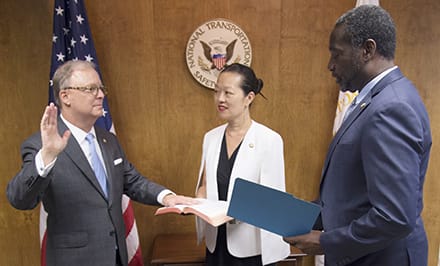
Robert L. Sumwalt III (left) sworn in as the National Transportation Safety Board’s 14th Chairman during a brief ceremony held at NTSB headquarters on August 10, 2017. NTSB Board Member Bella T. Dinh-Zarr (center) NTSB Acting Managing Director Dennis Jones (right). Photo: NTSB
2 min to read
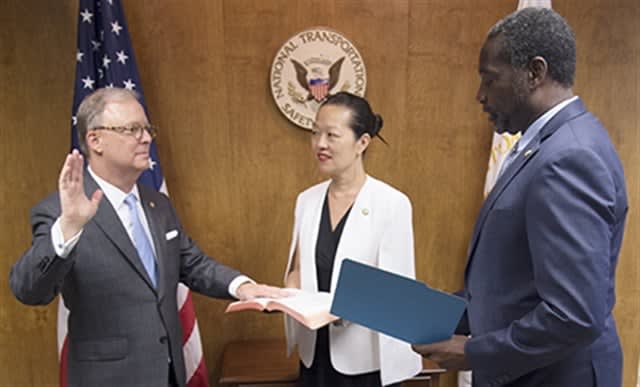
Robert L. Sumwalt III (left) sworn in as the National Transportation Safety Board’s 14th Chairman during a brief ceremony held at NTSB headquarters on August 10, 2017. NTSB Board Member Bella T. Dinh-Zarr (center) NTSB Acting Managing Director Dennis Jones (right).Photo: NTSB
Robert L. Sumwalt III was sworn in as the National Transportation Safety Board’s 14th chairman for a two-year term following his nomination by President Donald Trump.
Sumwalt has been serving as the acting chairman since March 31. He has been with the NTSB since 2006 when he was appointed as the 37th member of the board. President George W. Bush designated him as vice chairman for a two-year term, and President Barack Obama reappointed him to an additional five-year term as a board member in 2011.
The NTSB is an independent federal agency charged with determining the probable cause of transportation accidents, promoting transportation safety and assisting victims of transportation accidents and their families.
“The NTSB is commemorating 50 years of making transportation safer yesterday, today and tomorrow and I am humbled and honored to have the privilege of guiding the dedicated men and women of the NTSB as we take on the challenges of transportation safety in the 21st century,” said Sumwalt. “Transportation technologies continue to advance and the NTSB must continue to increase the breadth and depth of our knowledge and understanding of transportation innovations such as autonomous vehicles, intelligent infrastructure, commercial space transportation, hyper-speed rail, solar-powered planes, and new recording technologies. That knowledge enables us to craft safety recommendations that leverage technology to prevent accidents and save lives.”
The NTSB has five board members, each nominated by the president and confirmed by the Senate to serve five-year terms. By statute, the President designates a chariman with Senate confirmation. The President also designates a board member as vice chairman without requiring Senate confirmation.
The vice chairman and chairman each serve two-year terms. When there is no designated chairman, the vice chairman serves as acting chairman. Board members whose terms expire may remain on the board until their replacement is appointed.
Before joining the NTSB, Sumwalt was a pilot for 32 years with Piedmont Airlines and US Airways. During his tenure at US Airways he worked on special assignment to the flight safety department and also served on the airline’s Flight Operational Quality Assurance monitoring team. He chaired the Air Line Pilots Association’s Human Factors and Training Group and co-founded the association’s critical incident response program. He also spent eight years as a consultant to NASA’s Aviation Safety Reporting System and has written extensively on aviation safety matters.
More Safety

Nexar-Nauto Merger Aims to Give Fleets Better Safety Intelligence Through Larger Driving Dataset
Stefan Heck tells Automotive Fleet that combining more than 10 billion miles of driving history with Nexar's AI models will give fleets deeper insights into driver risk and roadway conditions than either company could provide independently.
Read More →
Don't Wait for a Crisis: 5 Ways to Build Mental Health Into Your Fleet Safety Program
For Suicide Prevention Month, fleet and safety leaders have an opportunity to put mental health where it belongs: at the center of workplace safety.
Read More →
How Camera Data Can Strengthen a Fleet’s Insurance Renewal
Insights from a commercial insurance carrier and a broker show how fleets can turn video telematic data, driver coaching, and improved claims results into a stronger case at insurance renewal.
Read More →
The Safest Fleets Aren’t the Ones with the Most Technology
You’ve made the telematics investment. Here’s how to capture the other half of its value and build the safest fleet on the road.
Read More →
Sponsored•August 7, 2026
Hidden in Plain Sight: Fleet Compliance Risks
Fleet compliance isn't just about having policies — it's about consistently enforcing them. This practical guide reveals six hidden compliance risks common in public sector and shared fleet operations and outlines proven strategies to improve visibility, accountability, and audit readiness
Read More →
NETS Sets 2026 Fleet Safety Benchmark Conference for Indianapolis
The Sept. 15–17 program will feature fleet benchmarking data, case studies, emerging technologies, and implementation strategies while running alongside the NSC Safety Congress & Expo.
Read More →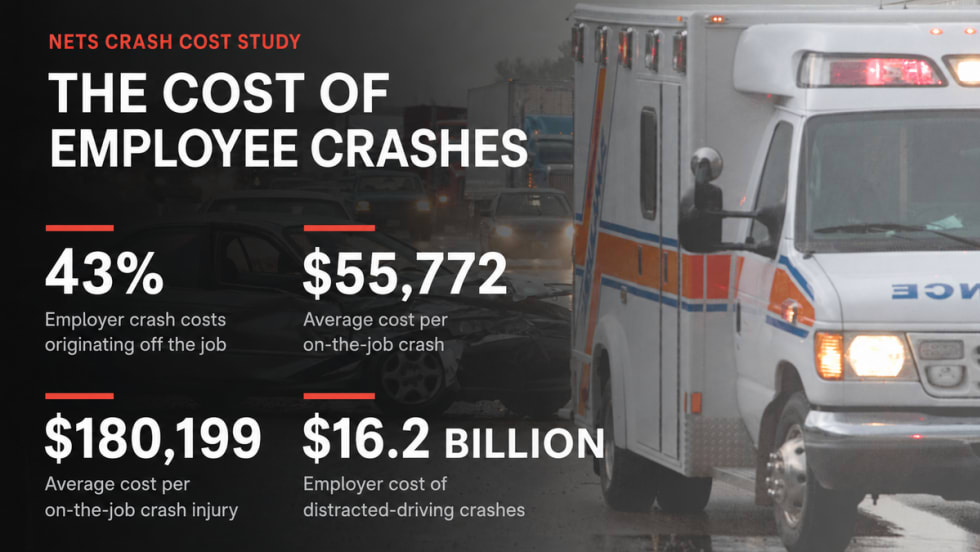
Off-the-Job Crashes Account for 43% of Employers’ $61.7 Billion Crash Burden
NETS quantifies costs dispersed across fleet, risk, HR, and other departments while providing new per-crash benchmarks for employers.
Read More →
Ram Recalls More Than 1.27 Million 1500 Pickups for Seat Belt Anchor Issue
The recall affects certain 2019-2026 Ram 1500 pickups that may have improperly attached second-row seat belt buckle anchors.
Read More →
Sponsored•July 17, 2026
How Better Visibility Cut Speeding Violations by 48%
Fleet leaders don't need more data, they need clearer visibility into what the data is saying. This case study explores how one utility replaced speeding-event counts with a single metric — miles driven in violation — to strengthen safety and significantly reduce speeding violations.
Read More →
Operation Safe Driver Week: Why the Industry's Oldest Safety Campaign Still Matters to Fleets
A look at how a 2007 enforcement initiative became one of the most consequential weeks on the fleet safety calendar, and what it means for your drivers in 2026.
Read More →