





Related: Predictive Maintenance: Tell Me Something I Don’t Know
Transportation Incidents Top Cause of Fatal Work Injuries
Inspired by the labor shortages in the transport and construction industries, Teletrac Navman assessed if the relationship between compensation and the danger of the jobs within those fields could potentially be affecting the size of the recruitment pool.
April 4, 2019
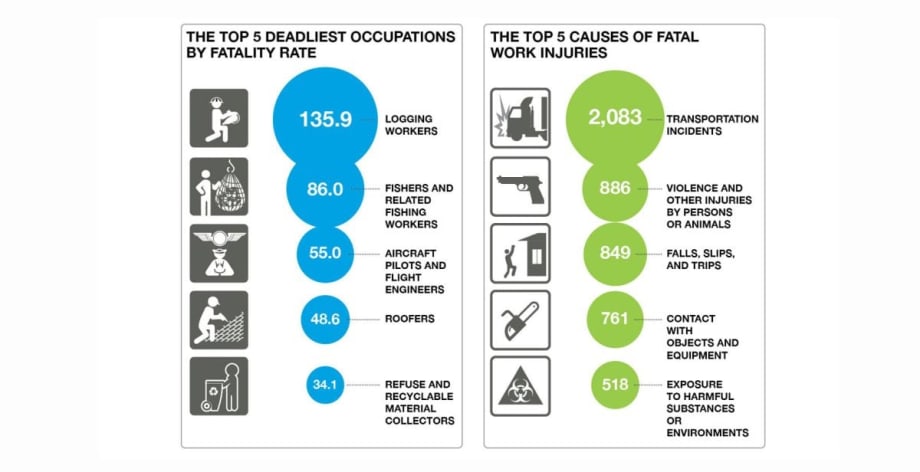
When it comes to tough or dangerous jobs, truck drivers top the list as one of the deadliest occupations.
Image courtesy of Teletrac Navman
2 min to read
Inspired by the labor shortages in the transport and construction industries, Teletrac Navman assessed if the relationship between compensation and the danger of the jobs within those fields could potentially be affecting the size of the recruitment pool.
By taking into account the fatality rate (a rate calculated by the Bureau of Labor Statistics by considering the number of fatal injuries and the number of hours worked) rather than just total fatalities, the telematics solutions provider gauged which truly are the riskiest and deadliest jobs in America.
Furthermore, Teletrac Navman dove a little deeper and took a look at how much the individuals within those professions are compensated for the level of danger they are subjected to. Are the most dangerous jobs also those with the highest compensation?
The most dangerous job in the U.S. right now is logging work. Logging workers have a fatality rate of 135.9, which is nearly 50-points higher than the closest second. About 91 loggers died in 2016, according to the bureau, and considering that the job only pays $40,830 as an annual mean wage, the job hardly seems worth it.
Here’s the list of the 10 most dangerous jobs in the U.S.:
Logging workers — 135.9 fatality rate (91 total fatalities)
Fishers and related fishing workers — 86.0 fatality rate (24 total fatalities)
Aircraft pilots and flight engineers — 55.0 fatality rate (75 total fatalities)
Roofers — 48.6 fatality rate (101 total fatalities)
Refuse and recyclable material collectors — 34.1 fatality rate (31 total fatalities)
Structural iron and steel workers — 25.1 fatality rate (16 total fatalities)
Delivery truck drivers and driver/sales workers — 24.7 fatality rate (918 total fatalities)
Farmers, ranchers, and other agricultural managers — 23.1 fatality rate (260 total fatalities)
First-line supervisors of construction trades and extraction workers — 18.0 fatality rate (134 total fatalities)
Grounds maintenance workers — 17.4 fatality rate (217 total fatalities)
It’s somewhat upsetting that some of the most stressful, hazardous, and riskiest jobs in America don’t have particularly high mean salaries at all. Most of these dangerous jobs, in fact, make less than the median household income in America (which is $61,372).
Dangerous jobs that pay well include aircraft pilots and flight engineers, who make an average of $138,690 per year. Also, farm managers and agricultural managers make an average of $80,320 per year, but the range between high earners and low earners can be very high.
In 2016, 570 individuals have died in the trucking industry, and 991 died in the construction industry. They might have fairly low fatality rates, but every individual death is one too many. Make your operation safer and more effective using our solutions.
Topics:Truck DriversSafety & ComplianceFleet SafetyTeletrac NavmanTransportation FleetsSafetyOperations
Originally posted on Work Truck Online
More Safety

Nexar-Nauto Merger Aims to Give Fleets Better Safety Intelligence Through Larger Driving Dataset
Stefan Heck tells Automotive Fleet that combining more than 10 billion miles of driving history with Nexar's AI models will give fleets deeper insights into driver risk and roadway conditions than either company could provide independently.
Read More →
Don't Wait for a Crisis: 5 Ways to Build Mental Health Into Your Fleet Safety Program
For Suicide Prevention Month, fleet and safety leaders have an opportunity to put mental health where it belongs: at the center of workplace safety.
Read More →
How Camera Data Can Strengthen a Fleet’s Insurance Renewal
Insights from a commercial insurance carrier and a broker show how fleets can turn video telematic data, driver coaching, and improved claims results into a stronger case at insurance renewal.
Read More →
The Safest Fleets Aren’t the Ones with the Most Technology
You’ve made the telematics investment. Here’s how to capture the other half of its value and build the safest fleet on the road.
Read More →
Sponsored•August 7, 2026
Hidden in Plain Sight: Fleet Compliance Risks
Fleet compliance isn't just about having policies — it's about consistently enforcing them. This practical guide reveals six hidden compliance risks common in public sector and shared fleet operations and outlines proven strategies to improve visibility, accountability, and audit readiness
Read More →
NETS Sets 2026 Fleet Safety Benchmark Conference for Indianapolis
The Sept. 15–17 program will feature fleet benchmarking data, case studies, emerging technologies, and implementation strategies while running alongside the NSC Safety Congress & Expo.
Read More →
Off-the-Job Crashes Account for 43% of Employers’ $61.7 Billion Crash Burden
NETS quantifies costs dispersed across fleet, risk, HR, and other departments while providing new per-crash benchmarks for employers.
Read More →
Ram Recalls More Than 1.27 Million 1500 Pickups for Seat Belt Anchor Issue
The recall affects certain 2019-2026 Ram 1500 pickups that may have improperly attached second-row seat belt buckle anchors.
Read More →
Sponsored•July 17, 2026
How Better Visibility Cut Speeding Violations by 48%
Fleet leaders don't need more data, they need clearer visibility into what the data is saying. This case study explores how one utility replaced speeding-event counts with a single metric — miles driven in violation — to strengthen safety and significantly reduce speeding violations.
Read More →
Operation Safe Driver Week: Why the Industry's Oldest Safety Campaign Still Matters to Fleets
A look at how a 2007 enforcement initiative became one of the most consequential weeks on the fleet safety calendar, and what it means for your drivers in 2026.
Read More →