




Toyota Shows Advanced Active Safety Research Vehicle at CES
LAS VEGAS – Toyota and its Lexus division showed a research vehicle that demonstrates the new safety technologies the automaker is developing, which the company said is part of its “Safety Management Concept” strategy.
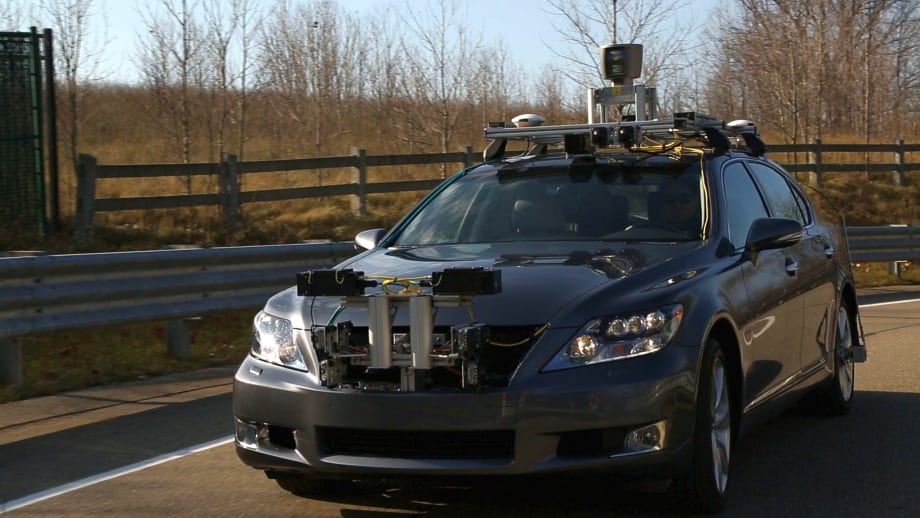
Toyota's advanced safety research vehicle features a number of sensor technologies designed to enhance driving skills.
Toyota's advanced safety research vehicle features a number of sensor technologies designed to enhance driving skills.
LAS VEGAS – Toyota and its Lexus division showed a research vehicle at the 2013 Consumer Electronics Show that demonstrates the new safety technologies the automaker is developing, which the company said is part of its “Safety Management Concept” strategy.
The research vehicle, which Toyota said is based on the Lexus LS, is equipped with a range of sensors and automated control systems. They include GPS, stereo cameras, radar, and Light Detection and Ranging (LIDAR) laser tracking. The vehicle uses three color cameras to detect objects roughly 492 ft. away and the radar sensors on the vehicle’s front and sides measure the location and speed of nearby objects.
The GPS antennas on the roof estimate the angle and orientation of the vehicle before it’s in motion, and the LIDAR detects objects around the vehicle up to about 230 ft. away. Beyond these sensors, a device that detects the vehicle’s inertia measures acceleration and angle changes, and a distance measurement indicator located on a rear wheel measures vehicle speed and travel distance.
Toyota said that although these systems and related technologies could lead to the eventual development of an autonomous vehicle, its goal is to develop technologies that enhance driving skills. The research vehicle is a testing platform designed to help Toyota develop technologies that can enhance the driver’s ability to perceive his or her environment and assist in making safe driving decisions while on the road.
The automaker said the research vehicle is one element of its overall efforts, and explained that it has committed to conducting new research toward developing an “Intelligent Transportation System” (ITS), which would allow for vehicle-to-vehicle and vehicle-to-roadside infrastructure communications. Toyota began this research effort in November, 2012, at its new proving grounds in Susono City, Japan. The company said it modeled the proving grounds after urban roads, simulating real-life traffic conditions with other vehicles on the road and pedestrians.
Toyota’s current ITS technology uses dedicated short-wave signals to enable vehicles to communicate with one another and with area infrastructure, enabling alerts that include an impending collision at a blind intersection, a vehicle changing lanes into another vehicle’s blind spot, and a potential collision with a stopped vehicle up ahead.
The company went on to say that it is developing its ITS research globally and cooperatively with other automakers and government regulators. In the U.S., Toyota is a member of the rash Avoidance Metrics Partnership (CAMP) Vehicle Safety Communications 3 (VSC3) Consortium. As part of this program, Toyota is researching technologies such as emergency electronic brake lights, forward collision warning, blind spot warning/lane change warning, do not pass warning, intersection movement assist and left turn assist at its Toyota Research Institute, North America (TRiNA), in Ann Arbor, Mich. Although this is purely a research effort, its operations in Japan take the resulting information and use it for future product development.
The automaker announced in late 2012 that it had also developed a new "pre-collision" system that can help detect if a vehicle is going to collide with one in front of it, even at high speeds.
More Safety
What’s Next for Fleet? Safety, AI & Industry Recognition | AF News Recap
Could your company's culture be encouraging distracted driving? This week, we're exploring how workplace expectations affect driver safety, what AI, EVs, and autonomous vehicles could mean for the future of fleet management, and how fleet professionals can strengthen their award nominations.
Read More →
Does Your Fleet's Culture Encourage Distracted Driving?
What happens when the people responsible for enforcing safety rules are the ones setting the wrong example? The answer may reveal why some of the biggest risks to fleet drivers have little to do with what's written in the employee handbook.
Read More →
Fleet Manager’s Ultimate Playbook: Navigating the New Standard in OEM Connectivity
Rising operating costs, driver safety concerns, and unplanned downtime are putting unprecedented pressure on modern fleets. Discover how fleet managers use embedded OEM connectivity and real-time vehicle data to cut TCO, prevent downtime, and protect drivers without aftermarket telematics hardware.
Read More →
From Driver Well-Being to EV Charging | AF News Recap
Mental health belongs in the fleet safety conversation. This week, we’re looking at five ways fleets can support employee well-being before a crisis, plus Holman’s expansion in Mexico, new one-day Fleet Forward passes, and why EV charging demand is outpacing infrastructure growth.
Read More →
Nexar-Nauto Merger Aims to Give Fleets Better Safety Intelligence Through Larger Driving Dataset
Stefan Heck tells Automotive Fleet that combining more than 10 billion miles of driving history with Nexar's AI models will give fleets deeper insights into driver risk and roadway conditions than either company could provide independently.
Read More →
Don't Wait for a Crisis: 5 Ways to Build Mental Health Into Your Fleet Safety Program
For Suicide Prevention Month, fleet and safety leaders have an opportunity to put mental health where it belongs: at the center of workplace safety.
Read More →
How Camera Data Can Strengthen a Fleet’s Insurance Renewal
Insights from a commercial insurance carrier and a broker show how fleets can turn video telematic data, driver coaching, and improved claims results into a stronger case at insurance renewal.
Read More →
The Safest Fleets Aren’t the Ones with the Most Technology
You’ve made the telematics investment. Here’s how to capture the other half of its value and build the safest fleet on the road.
Read More →
Hidden in Plain Sight: Fleet Compliance Risks
Fleet compliance isn't just about having policies — it's about consistently enforcing them. This practical guide reveals six hidden compliance risks common in public sector and shared fleet operations and outlines proven strategies to improve visibility, accountability, and audit readiness
Read More →
NETS Sets 2026 Fleet Safety Benchmark Conference for Indianapolis
The Sept. 15–17 program will feature fleet benchmarking data, case studies, emerging technologies, and implementation strategies while running alongside the NSC Safety Congress & Expo.
Read More →