




Toyota Settlement to Fund Auto Safety Research
The University of Iowa is awarded three grants totaling $17.2 million. Projects include research into whether multiple car sensor systems can be used together to prevent crashes.
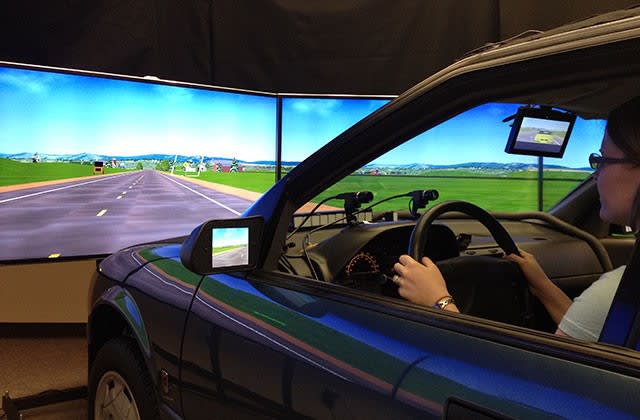
Tara Ohrt, a research assistant at the University of Iowa Simulator for Interdisciplinary Research in Ergonomics and Neuroscience, drives through a testing scenario. Photo by Sarah D. Hacker.
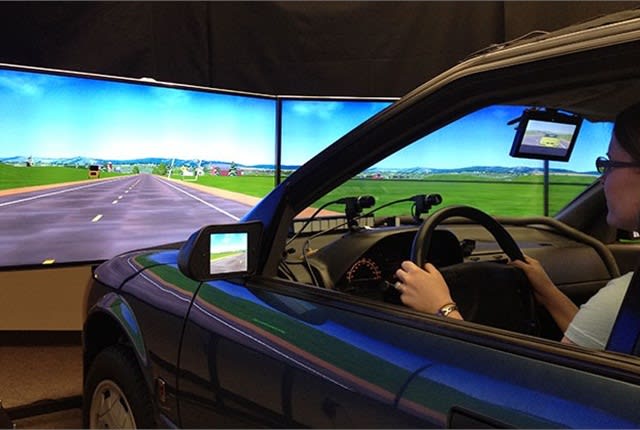
Tara Ohrt, a research assistant at the University of Iowa Simulator for Interdisciplinary Research in Ergonomics and Neuroscience, drives through a testing scenario. Photo by Sarah D. Hacker.
The University of Iowa Public Policy Center (PPC) has won three grants totaling $17.2 million to fund automotive safety research and a new national campaign to help drivers understand vehicle safety systems.
The grant funding is part of the safety research and education program established by the recent Toyota class-action settlement in California.
The projects resulting from the grant will include:
An engineering analysis conducted by NADS and the Department of Geography to determine whether multiple car sensor systems can be used together to prevent certain types of crashes.
A national survey on public perceptions of vehicle safety technologies.
A national educational campaign on vehicle safety technology, in which the UI has partnered with the National Safety Council and Iowa City-based Digital Artefacts LLC.
A study at the National Advanced Driving Simulator (NADS) that examines replicating emergency events in a controlled and safe environment.
A study in the UI Department of Neurology to measure and improve younger and older driver behavior when accelerating and decelerating.
“The work we will do can significantly advance driver safety,” said Daniel V. McGehee, director of the PPC’s Human Factors and Vehicle Safety Research Program. “When large sums are invested into basic research, innovation follows. This is a win-win for both drivers and for science.”
McGehee also serves as adjunct professor of mechanical and industrial engineering, occupational and environmental health, and emergency medicine.
The UI Social Science Research Center will conduct the national survey on public perceptions of auto safety technologies. This survey will assess knowledge and familiarity with vehicle safety systems and will examine drivers’ understanding and use of defensive driving techniques.
The results of this survey will be developed into a national education campaign, designed to reach 90 percent of U.S. adults multiple times.
The UI has partnered with the National Safety Council to conduct the national multi-media and education campaign. It will be supported by scientific research and will enhance and promote safer driving among motorists.
“We look forward to working with the University of Iowa to educate drivers to better understand their vehicles and how to most effectively use vehicle safety systems,” said John Ulczycki, vice president of the National Safety Council.
Digital Artefacts, an Iowa City-based research and development firm specializing in multi-media, games, mobile applications, and software, will develop interactive computing as part of the education campaign. Digital Artefacts’ multidisciplinary team of scientists, artists and engineers has worked with the UI since 1999, creating interactive experiences for education and research communities.
“We are delighted to collaborate with the University of Iowa and the National Safety Council to design and develop engaging and effective educational media and content to advance driver safety,” says Joan Severson, president of Digital Artefacts.
More Safety

Nexar-Nauto Merger Aims to Give Fleets Better Safety Intelligence Through Larger Driving Dataset
Stefan Heck tells Automotive Fleet that combining more than 10 billion miles of driving history with Nexar's AI models will give fleets deeper insights into driver risk and roadway conditions than either company could provide independently.
Read More →
Don't Wait for a Crisis: 5 Ways to Build Mental Health Into Your Fleet Safety Program
For Suicide Prevention Month, fleet and safety leaders have an opportunity to put mental health where it belongs: at the center of workplace safety.
Read More →
How Camera Data Can Strengthen a Fleet’s Insurance Renewal
Insights from a commercial insurance carrier and a broker show how fleets can turn video telematic data, driver coaching, and improved claims results into a stronger case at insurance renewal.
Read More →
The Safest Fleets Aren’t the Ones with the Most Technology
You’ve made the telematics investment. Here’s how to capture the other half of its value and build the safest fleet on the road.
Read More →
Hidden in Plain Sight: Fleet Compliance Risks
Fleet compliance isn't just about having policies — it's about consistently enforcing them. This practical guide reveals six hidden compliance risks common in public sector and shared fleet operations and outlines proven strategies to improve visibility, accountability, and audit readiness
Read More →
NETS Sets 2026 Fleet Safety Benchmark Conference for Indianapolis
The Sept. 15–17 program will feature fleet benchmarking data, case studies, emerging technologies, and implementation strategies while running alongside the NSC Safety Congress & Expo.
Read More →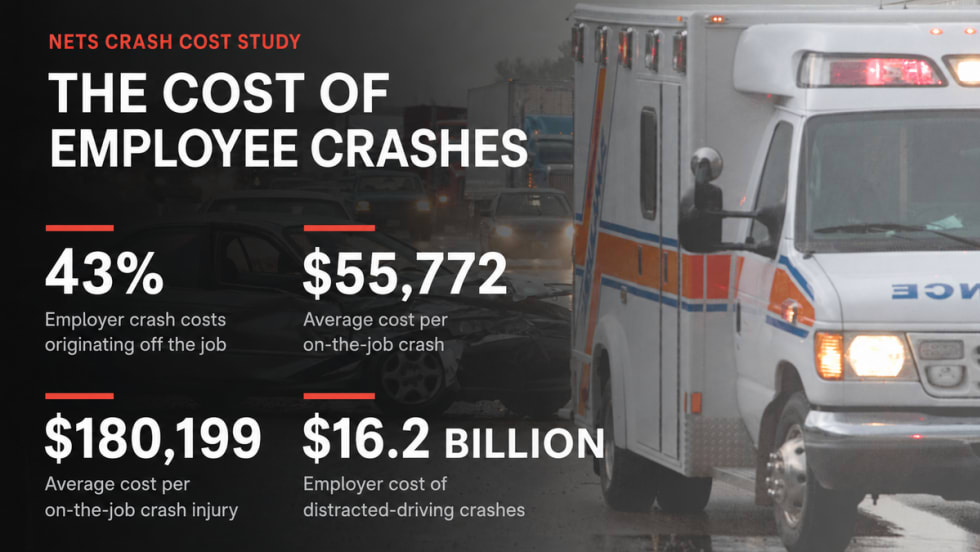
Off-the-Job Crashes Account for 43% of Employers’ $61.7 Billion Crash Burden
NETS quantifies costs dispersed across fleet, risk, HR, and other departments while providing new per-crash benchmarks for employers.
Read More →
Ram Recalls More Than 1.27 Million 1500 Pickups for Seat Belt Anchor Issue
The recall affects certain 2019-2026 Ram 1500 pickups that may have improperly attached second-row seat belt buckle anchors.
Read More →
How Better Visibility Cut Speeding Violations by 48%
Fleet leaders don't need more data, they need clearer visibility into what the data is saying. This case study explores how one utility replaced speeding-event counts with a single metric — miles driven in violation — to strengthen safety and significantly reduce speeding violations.
Read More →
Operation Safe Driver Week: Why the Industry's Oldest Safety Campaign Still Matters to Fleets
A look at how a 2007 enforcement initiative became one of the most consequential weeks on the fleet safety calendar, and what it means for your drivers in 2026.
Read More →