




Toyota Brings Driver Awareness Vehicle to Los Angeles
Toyota presented a driver safety vehicle that helps keep the driver's attention and awareness on the road ahead at the Los Angeles Auto Show. The Driver Awareness Vehicle (DAR-V) is a Sienna minivan that incorporates Microsoft Kinect console technology.
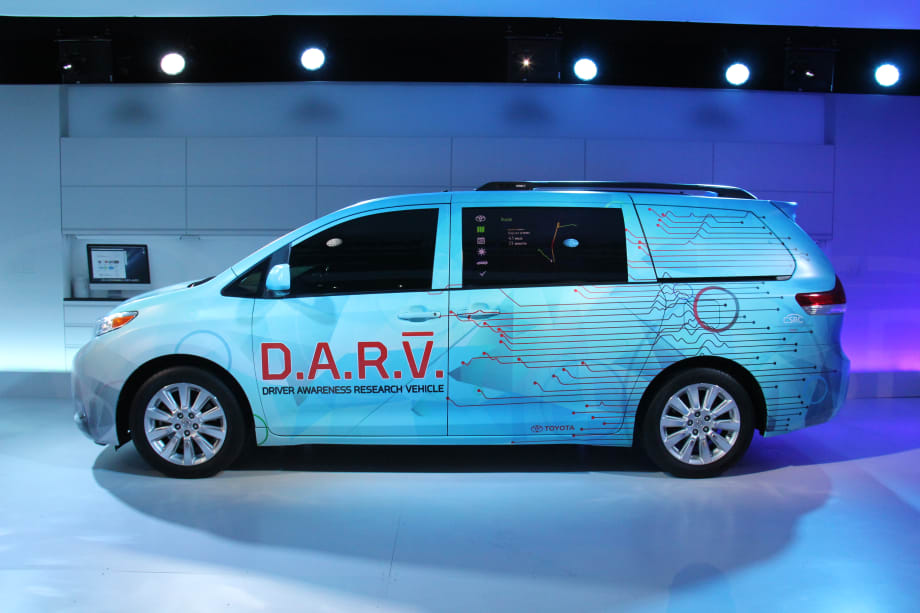
Photo by Paul Clinton.
Photo by Paul Clinton.
Toyota presented a driver safety vehicle that helps keep the driver's attention and awareness on the road ahead at the Los Angeles Auto Show.
The Driver Awareness Vehicle (DAR-V) is a Sienna minivan that incorporates Microsoft Kinect console technology.
The vehicle displays personalized information on the side window as the driver approaches, and using a combination of gesture control, voice and a key fob, drivers can navigate information such as updates on traffic and the weather, appointments and schedules, or details about nearby gas stations.
"By addressing these critical daily priorities before even setting foot in the vehicle, a driver potentially has more mental bandwidth to focus on driving," according to Chuck Gulash, director of Toyota's Collaborative Safety Research Center.
The DAR-V system can reduce driver distractions in other ways by differentiating between individuals. For example, children might play a game designed to help them buckle their seatbelts quickly so parents can focus their attention on the road.
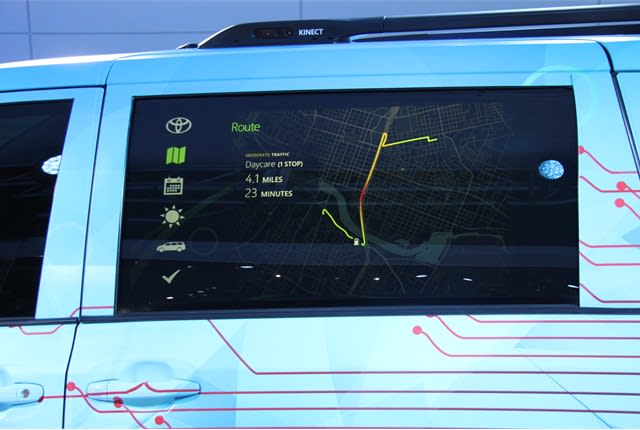
Photo by Paul Clinton.
Gulash also said the automaker has partnered with MIT's AgeLab to further study voice recognition. Researchers found that the mental demands on drivers while using voice commands were actually lower than expected, potentially because drivers compensate by slowing down, changing lanes less frequently or increasing the distance to other vehicles.
However, in several of the voice interactions studied, the amount of time drivers took their eyes off the road during voice-command tasks was greater than expected. The situation is often more pronounced among older drivers, some of whom physically oriented their bodies toward the system's graphical interface.
More Safety
Tips for Driving Safely on Halloween Night
This video features a reminder from the Connecticut Department of Transportation (DOT) and the Connecticut Police Chiefs Association, urging drivers to prioritize safety this Halloween.
Read More →
IIHS Crash Avoidance Tests Reveal Safety Gaps in Cargo Vans and Work Trucks
New crash-avoidance ratings from the Insurance Institute for Highway Safety reveal inconsistent performance among commercial vehicles, with several popular cargo vans and heavy-duty pickups struggling to avoid collisions with other vehicles and pedestrians.
Read More →
What’s Next for Fleet? Safety, AI & Industry Recognition | AF News Recap
Could your company's culture be encouraging distracted driving? This week, we're exploring how workplace expectations affect driver safety, what AI, EVs, and autonomous vehicles could mean for the future of fleet management, and how fleet professionals can strengthen their award nominations.
Read More →
Does Your Fleet's Culture Encourage Distracted Driving?
What happens when the people responsible for enforcing safety rules are the ones setting the wrong example? The answer may reveal why some of the biggest risks to fleet drivers have little to do with what's written in the employee handbook.
Read More →
Fleet Manager’s Ultimate Playbook: Navigating the New Standard in OEM Connectivity
Rising operating costs, driver safety concerns, and unplanned downtime are putting unprecedented pressure on modern fleets. Discover how fleet managers use embedded OEM connectivity and real-time vehicle data to cut TCO, prevent downtime, and protect drivers without aftermarket telematics hardware.
Read More →
From Driver Well-Being to EV Charging | AF News Recap
Mental health belongs in the fleet safety conversation. This week, we’re looking at five ways fleets can support employee well-being before a crisis, plus Holman’s expansion in Mexico, new one-day Fleet Forward passes, and why EV charging demand is outpacing infrastructure growth.
Read More →
Nexar-Nauto Merger Aims to Give Fleets Better Safety Intelligence Through Larger Driving Dataset
Stefan Heck tells Automotive Fleet that combining more than 10 billion miles of driving history with Nexar's AI models will give fleets deeper insights into driver risk and roadway conditions than either company could provide independently.
Read More →
Don't Wait for a Crisis: 5 Ways to Build Mental Health Into Your Fleet Safety Program
For Suicide Prevention Month, fleet and safety leaders have an opportunity to put mental health where it belongs: at the center of workplace safety.
Read More →
How Camera Data Can Strengthen a Fleet’s Insurance Renewal
Insights from a commercial insurance carrier and a broker show how fleets can turn video telematic data, driver coaching, and improved claims results into a stronger case at insurance renewal.
Read More →
The Safest Fleets Aren’t the Ones with the Most Technology
You’ve made the telematics investment. Here’s how to capture the other half of its value and build the safest fleet on the road.
Read More →