




Toyota Adds Child Models to Crash Dummy Software
These models will be included in Toyota's
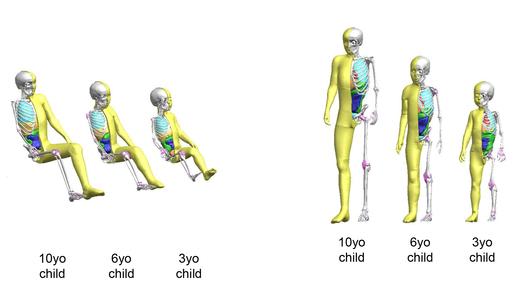
Images of virtual crash dummies courtesy of Toyota.
Images of virtual crash dummies courtesy of Toyota.
Toyota Motor Corp. has added three new digital models — representing children ages 10, six, and three — to its virtual crash dummy software that allows computer crash simulations.
Sales of the new models will begin this autumn.
Toyota’s Total Human Model for Safety (THUMS) can forecast the extent of injuries sustained throughout the human body. As a result, THUMS is used in the development of passenger protection devices such as air bags.
The 10-year old (138cm tall), six-year old (118cm tall), and three-year old (94cm tall) model additions to THUMS Version 4 represent the average physiques of children at each respective age.
As with the large male (189cm tall), average-build adult male (179cm tall), and small female (153cm tall) models already being sold, the new models will come in two versions — a passenger version and a pedestrian version. That makes for a total of six new additions to the THUMS lineup. This expanded lineup takes into consideration the influence of age and physique, and allows for a more thorough injury analysis, according to Toyota.
Ever since THUMS Version 1 was launched in the year 2000, Toyota has continued to improve the software. For Version 2, which was released in 2003, faces and bone structure were added to the models. Version 3, launched in 2008, added a brain simulation and in 2010, Version 4 was upgraded with detailed modeling of the brain and the addition of internal organs and their placement and interaction within the body. In 2015, Version 5 added simulated musculature, allowing the models to assume the same bracing positions that a human might just before a crash.
The newly launched child-spec models were created as a result of collaborative research between Wayne State University, the University of Michigan, and the Collaborative Safety Research Center located in the Toyota Technical Center in Ann Arbor, Mich. THUMS is available for purchase through the Tokyo-based JSOL Corporation and ESI Japan. Automakers, parts manufacturers, and universities all use THUMS.
Toyota will use THUMS to analyze injuries sustained by both passengers and pedestrians during collisions with and between vehicles, and to further research and improve safety technologies of all kinds, the company said.
More Safety

Ram Recalls More Than 1.27 Million 1500 Pickups for Seat Belt Anchor Issue
The recall affects certain 2019-2026 Ram 1500 pickups that may have improperly attached second-row seat belt buckle anchors.
Read More →
Top 50 Executive Fleets
It is that time of year again! Time for the 2026 list of the Top 50 Executive Fleets, presented by Automotive Fleet and Volvo as part of its annual Fleet 500. Download now to see this year's list of companies!
Read More →
How Better Visibility Cut Speeding Violations by 48%
Fleet leaders don't need more data, they need clearer visibility into what the data is saying. This case study explores how one utility replaced speeding-event counts with a single metric — miles driven in violation — to strengthen safety and significantly reduce speeding violations.
Read More →
Operation Safe Driver Week: Why the Industry's Oldest Safety Campaign Still Matters to Fleets
A look at how a 2007 enforcement initiative became one of the most consequential weeks on the fleet safety calendar, and what it means for your drivers in 2026.
Read More →
Nexar-Nauto Merger Aims to Give Fleets Better Safety Intelligence Through Larger Driving Dataset
Stefan Heck tells Automotive Fleet that combining more than 10 billion miles of driving history with Nexar's AI models will give fleets deeper insights into driver risk and roadway conditions than either company could provide independently.
Read More →
From Silos to Solutions: Relationship Management for Safer Fleets
From telematics adoption and driver accountability to policy consistency and risk mitigation, this episode breaks down what it really takes to build a safer fleet culture without slowing business down.
Read More →
IIHS Launches First Commercial Vehicle Safety Evaluations
The Insurance Institute for Highway Safety has begun evaluating heavy-duty pickups and cargo vans for driver protection. Which models earned top marks?
Read More →
Reducing Risk by Eliminating Phone Use Behind the Wheel
Hosted with the cofounder of Lifesaver Mobile, this episode addresses phone use behind the wheel and how to design a driving environment that actually helps prevents accidents.
Read More →
Cameras, Safety and Insurance: From Reactive Claims to Real-Time Prevention (Part 2 of 2)
Part Two: Commercial auto remains one of the most challenging and costly lines of coverage for fleet operators and insurers alike. Continue learning more about how to effectively address these issues from Onur Aksan, Enterprise Business Development Executive, Geotab
Read More →
How 5-Second Telematics Data Is Changing Fleet Safety
This episode connects with Steve Santostasi of Ford Pro and covers how a few seconds of data can make a difference in fleet safety.
Read More →