




Three Sedans Earn IIHS Top Safety Pick+
The Insurance Institute for Highway Safety (IIHS) has given its most prestigious safety award to three luxury models.

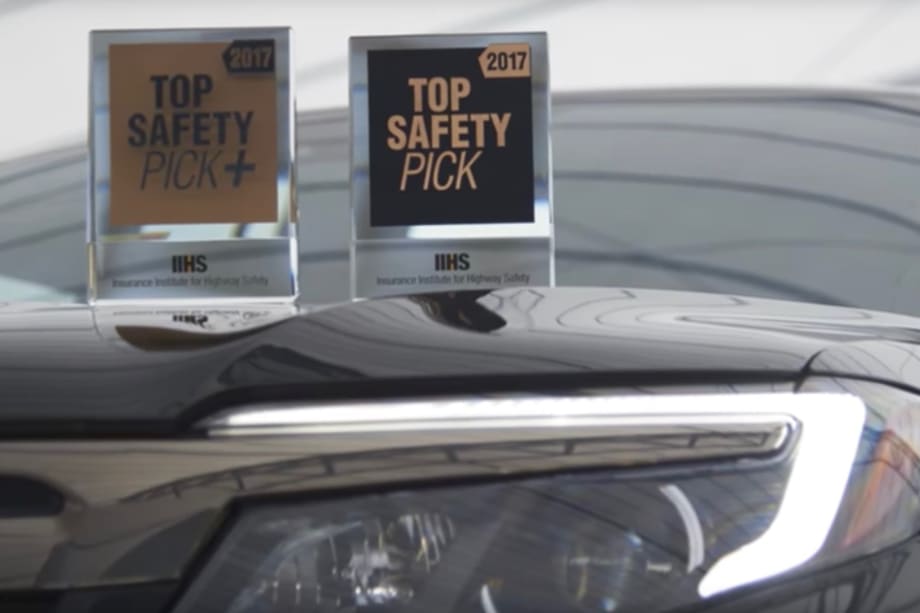
Photo: IIHS
The Lincoln Continental, Mercedes-Benz E-Class, and Toyota Avalon have all qualified for the Top Safety Pick+ award from the Insurance Institute for Highway Safety, IIHS said.
During this latest round of vehicle safety testing, the Tesla Model S, Chevrolet Impala, and Ford Taurus fell short of IIHS award criteria because they each drew only an “acceptable” rating in the small overlap front test, IIHS noted.
“This group of large cars includes some with stellar ratings, but our small overlap front test remains a hurdle for some vehicles,” said David Zuby, IIHS executive vice president and chief research officer.
Vehicles qualify for either the Top Safety Pick award or Top Safety Pick+ award if they garner the top IIHS rating of “good” in five crashworthiness tests — small overlap front, moderate overlap front, side, roof strength and head restraints -– and they have an available front crash prevention system that draws a “superior” or “advanced” rating. To qualify for the Top Safety Pick+ award, a vehicle also must have “good”- or “acceptable”-rated headlights.
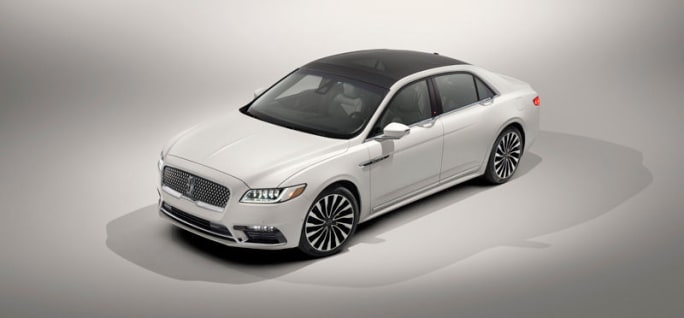
2017 Lincoln Continental
Photo: Lincoln
The 2017 Continental, an all-new vehicle with a revived model name, replaces the Lincoln MKS. The Continental’s optional front crash prevention system earned a “superior” rating, IIHS said. When equipped with the system, the car avoided collisions in IIHS track tests at 12 mph and 25 mph. The system also has a forward collision-warning component that meets National Highway Traffic Safety Administration (NHTSA) criteria.
The Continental’s LED projector headlights, an option on the Reserve trim line, drew a “good” rating, providing ample lighting on a straightaway and most kinds of curves, IIHS said. These headlights are available with high-beam assist, a feature that automatically switches between high beams and low beams — depending on the presence of other vehicles. However, the vehicle is also available with high-intensity discharge (HID) lights that drew a “poor” rating from IIHS.
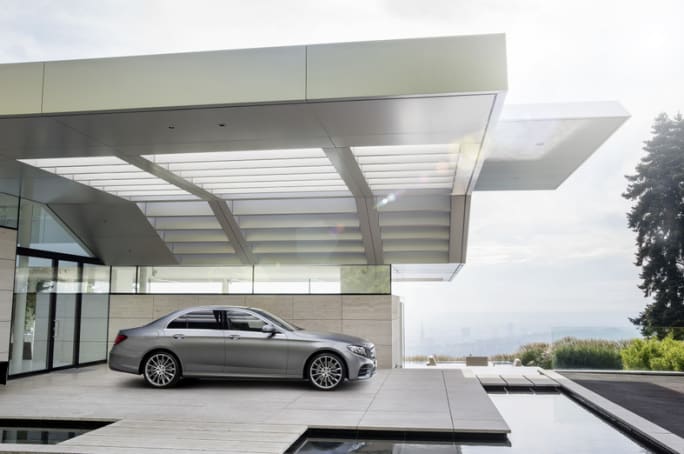
2017 Mercedes-Benz E-Class sedan.
Photo: Mercedes-Benz
The E-Class, completely redesigned for 2017, has two different front crash prevention systems — one standard and the other optional. Both earned “superior” IIHS ratings, avoiding collisions in the track tests at both speeds and earning credit for forward collision warning that meets NHTSA criteria, IIHS said.
The E-Class is available with two different headlight systems. One attracted a “good” rating, while the other drew an “acceptable” rating. The top-rated headlights, which come on the E-300 trim when equipped with the Premium II or Premium III package, earned the highest score of any headlights IIHS has rated.
The low beams provide enough light on the straightaway and all curves, though they create a bit of glare for oncoming drivers, the institute said. The high beams provide fair visibility on the left side of the straightaway but good visibility everywhere else. The “good”-rated headlights also come with high-beam assist.
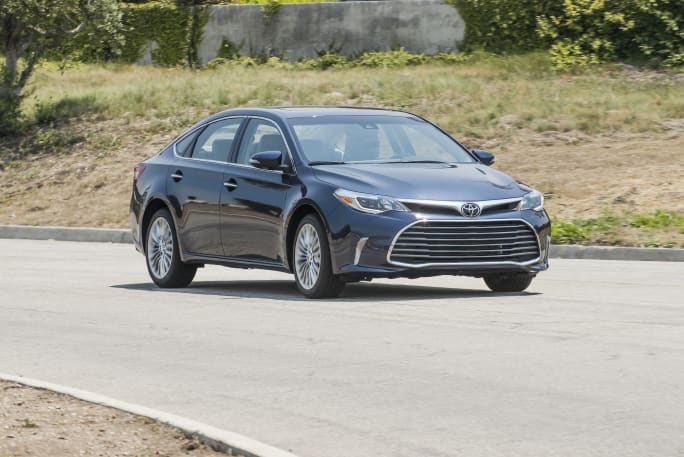
2017 Toyota Avalon
Photo: Toyota
The Avalon also joined the ranks of Top Safety Pick+ winners. The car was previously recognized as a Top Safety Pick award winner. At that time, the Avalon fell short of the highest award because it had only “marginal”- and “poor”-rated headlights available. Toyota improved the aim of the headlights on Avalon sedans built after March. As a result, the Limited and Hybrid Limited trim lines now come with “acceptable”-rated headlights. Other trims have “marginal”-rated headlights, but none are rated “poor” anymore, according to IIHS.
Toyota wasn’t the only automaker to try to boost safety ratings with midyear improvements. The Tesla Model S initially drew an “acceptable” rating in the small overlap test, which simulates the type of crash that occurs when the front driver-side corner of a vehicle hits a tree or utility pole or collides with another vehicle. The main problem with the performance of the Model S was that the safety belt let the dummy's torso move too far forward, allowing the dummy’s head to strike the steering wheel hard through the air bag, IIHS said.
Tesla changed the safety belt in vehicles built after January, with the goal of reducing the dummy’s forward movement. However, when IIHS tested the modified Model S, the same problem occurred and the rating didn’t change, IIHS said.
Although the two tested vehicles had identical structure, the second test resulted in greater intrusion into the driver’s space because the left front wheel movement wasn’t consistent, according to the institute. Maximum intrusion increased from less than 2 inches to 11 inches in the lower part and to 5 inches at the instrument panel in the second test. The first test resulted in a “good” rating for structural integrity, while the second test resulted in an “acceptable” structural rating. The two tests’ structural ratings were combined, resulting in an “acceptable” structure rating and an “acceptable” rating overall for the Model S.
“The greater deformation in the second test also resulted in damage to the left front corner of the battery case,” IIHS explained in a released statement. “The deformation was limited to an area that didn’t contain battery cells in the tested vehicle, so this damage didn’t affect the rating. Higher-performance variants of the Model S could have battery cells in this area, but, according to Tesla, they also have different structure. They haven't been tested separately and aren’t covered by this rating.”
The Model S is only available with headlights that drew a “poor” IIHS rating, and the vehicle hasn't been rated yet for front crash prevention. While automatic braking comes standard, the software for the feature was only recently activated.
Before this round of testing, the Chevrolet Impala hadn’t been put through all the institute’s evaluations since a redesign in 2014. What’s more, the Impala has never been rated for small overlap protection. The 2017 model attracted an “acceptable” IIHS rating for small overlap protection and “good” ratings in the other crashworthiness tests.
In the small overlap crash, the Impala's structure held up reasonably well, IIHS said, with maximum intrusion of 4 inches at the lower door-hinge pillar.
“The dummy's head hit the front airbag, but then slid off the left side, leaving the head partially unprotected,” IIHS said. “Measures taken from the dummy indicated a low risk of any significant injuries.”
The Impala’s optional front crash prevention system earned a “superior” rating. It avoided a crash in the 12 mph test, while its impact speed was reduced by an average of 10 mph in the 25 mph test. The system meets NHTSA criteria for forward collision warning, but all the available headlights on the Impala drew a “poor” IIHS rating.
The Taurus is another vehicle that hadn't been tested previously for small overlap protection. Maximum intrusion reached 5 inches at the lower door-hinge pillar, according to IIHS.
“In contrast to the Impala’s test, the dummy’s movement in the Taurus was well-controlled,” IIHS said. “However, measures from the dummy indicate that injuries to the left lower leg would be possible in a crash of this severity.”
The Taurus drew “good” ratings in the other crashworthiness tests. For front crash prevention, the Taurus drew a rating of “basic.” It has forward collision warning that meets NHTSA criteria but lacks automatic braking. All the available headlights for the Taurus drew an IIHS rating of “poor.”
To watch a video report about the testing, click on the photo or link below the headline.
More Safety

Nexar-Nauto Merger Aims to Give Fleets Better Safety Intelligence Through Larger Driving Dataset
Stefan Heck tells Automotive Fleet that combining more than 10 billion miles of driving history with Nexar's AI models will give fleets deeper insights into driver risk and roadway conditions than either company could provide independently.
Read More →
Don't Wait for a Crisis: 5 Ways to Build Mental Health Into Your Fleet Safety Program
For Suicide Prevention Month, fleet and safety leaders have an opportunity to put mental health where it belongs: at the center of workplace safety.
Read More →
How Camera Data Can Strengthen a Fleet’s Insurance Renewal
Insights from a commercial insurance carrier and a broker show how fleets can turn video telematic data, driver coaching, and improved claims results into a stronger case at insurance renewal.
Read More →
The Safest Fleets Aren’t the Ones with the Most Technology
You’ve made the telematics investment. Here’s how to capture the other half of its value and build the safest fleet on the road.
Read More →
Hidden in Plain Sight: Fleet Compliance Risks
Fleet compliance isn't just about having policies — it's about consistently enforcing them. This practical guide reveals six hidden compliance risks common in public sector and shared fleet operations and outlines proven strategies to improve visibility, accountability, and audit readiness
Read More →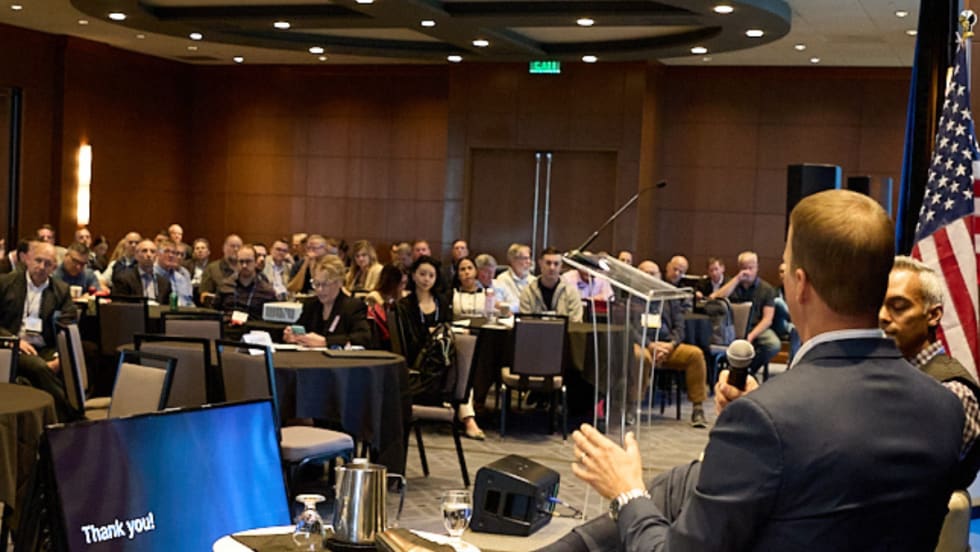
NETS Sets 2026 Fleet Safety Benchmark Conference for Indianapolis
The Sept. 15–17 program will feature fleet benchmarking data, case studies, emerging technologies, and implementation strategies while running alongside the NSC Safety Congress & Expo.
Read More →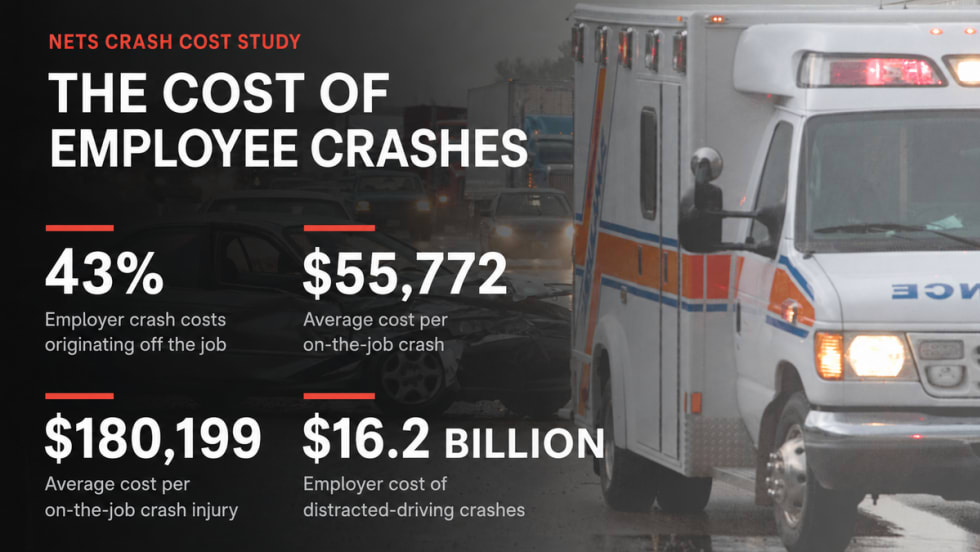
Off-the-Job Crashes Account for 43% of Employers’ $61.7 Billion Crash Burden
NETS quantifies costs dispersed across fleet, risk, HR, and other departments while providing new per-crash benchmarks for employers.
Read More →
Ram Recalls More Than 1.27 Million 1500 Pickups for Seat Belt Anchor Issue
The recall affects certain 2019-2026 Ram 1500 pickups that may have improperly attached second-row seat belt buckle anchors.
Read More →
How Better Visibility Cut Speeding Violations by 48%
Fleet leaders don't need more data, they need clearer visibility into what the data is saying. This case study explores how one utility replaced speeding-event counts with a single metric — miles driven in violation — to strengthen safety and significantly reduce speeding violations.
Read More →
Operation Safe Driver Week: Why the Industry's Oldest Safety Campaign Still Matters to Fleets
A look at how a 2007 enforcement initiative became one of the most consequential weeks on the fleet safety calendar, and what it means for your drivers in 2026.
Read More →