




Takata Recalls 2.7M More Air Bag Inflators
The latest recall expansion affects driver frontal air bag inflators that use calcium sulfate as a drying agent.
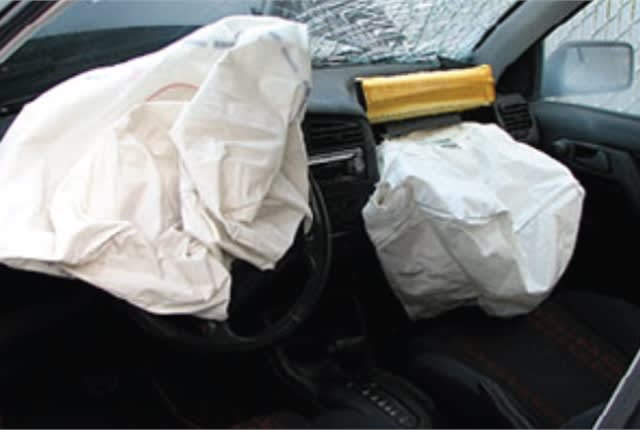
Photo courtesy of NHTSA.
Photo courtesy of NHTSA.
Because of new safety test results, automotive supplier Takata Corp. is recalling an additional 2.7 million driver-side frontal air bag inflators that are at risk for rupturing, the National Highway Traffic Safety Administration reported.
The PSDI-5 air bag inflators at issue use calcium sulfate as a drying agent, NHTSA said. But the inflator’s propellant might still degrade after long-term exposure to high humidity and temperatures. Such degradation can lead the propellant to burn too quickly and create excessive pressure that the inflator can’t withstand. If the inflator ruptures as a result, shrapnel can strike and injure vehicle occupants.
These air bag inflators were assembled as part of the frontal air bag modules used as original or replacement equipment in Ford, Nissan and Mazda vehicles, according to a Reuters report.
This latest recall expansion covers only inflators containing calcium sulfate as a drying agent. Takata, which filed for bankruptcy protection last month, is now working with the affected automakers to determine which vehicles will be subject to recall as a result of the new safety test conclusions. NHTSA will announce those recalls at a later date, with Ford vehicles representing the lion’s share.
On Monday, July 10, a 12th death in the U.S. was tied to an exploding Takata air bag inflator, according to a report from USA Today. The victim was performing repairs inside a 2001 Honda Accord on June 18, 2016, in Hialeah, Fla., when the inflator ruptured. He died the following day.
A total of 17 deaths globally have been linked to the air bag inflators. Eventually, Takata’s recalled air bag inflators are expected to reach the 100 million mark worldwide. Because of the scarcity of replacement inflators, the recalls are being conducted in phases in the U.S. Vehicles at a higher risk, based on age and location climate, have higher priority.
More Safety

From Driver Well-Being to EV Charging | AF News Recap
Mental health belongs in the fleet safety conversation. This week, we’re looking at five ways fleets can support employee well-being before a crisis, plus Holman’s expansion in Mexico, new one-day Fleet Forward passes, and why EV charging demand is outpacing infrastructure growth.
Read More →
Nexar-Nauto Merger Aims to Give Fleets Better Safety Intelligence Through Larger Driving Dataset
Stefan Heck tells Automotive Fleet that combining more than 10 billion miles of driving history with Nexar's AI models will give fleets deeper insights into driver risk and roadway conditions than either company could provide independently.
Read More →
Don't Wait for a Crisis: 5 Ways to Build Mental Health Into Your Fleet Safety Program
For Suicide Prevention Month, fleet and safety leaders have an opportunity to put mental health where it belongs: at the center of workplace safety.
Read More →
How Camera Data Can Strengthen a Fleet’s Insurance Renewal
Insights from a commercial insurance carrier and a broker show how fleets can turn video telematic data, driver coaching, and improved claims results into a stronger case at insurance renewal.
Read More →
The Safest Fleets Aren’t the Ones with the Most Technology
You’ve made the telematics investment. Here’s how to capture the other half of its value and build the safest fleet on the road.
Read More →
Hidden in Plain Sight: Fleet Compliance Risks
Fleet compliance isn't just about having policies — it's about consistently enforcing them. This practical guide reveals six hidden compliance risks common in public sector and shared fleet operations and outlines proven strategies to improve visibility, accountability, and audit readiness
Read More →
NETS Sets 2026 Fleet Safety Benchmark Conference for Indianapolis
The Sept. 15–17 program will feature fleet benchmarking data, case studies, emerging technologies, and implementation strategies while running alongside the NSC Safety Congress & Expo.
Read More →
Off-the-Job Crashes Account for 43% of Employers’ $61.7 Billion Crash Burden
NETS quantifies costs dispersed across fleet, risk, HR, and other departments while providing new per-crash benchmarks for employers.
Read More →
Ram Recalls More Than 1.27 Million 1500 Pickups for Seat Belt Anchor Issue
The recall affects certain 2019-2026 Ram 1500 pickups that may have improperly attached second-row seat belt buckle anchors.
Read More →
Operation Safe Driver Week: Why the Industry's Oldest Safety Campaign Still Matters to Fleets
A look at how a 2007 enforcement initiative became one of the most consequential weeks on the fleet safety calendar, and what it means for your drivers in 2026.
Read More →