





Further Reading: Why Used Vehicle Values Will Not Crash
Supply Shortfall Remains Factor in Used Car Market Values
The top five European markets registered 6.5 million fewer vehicles in 2020 and 2021 compared to the previous two years. As the used market depends on new vehicles to push stock through, further pressures are inevitable.
August 11, 2022
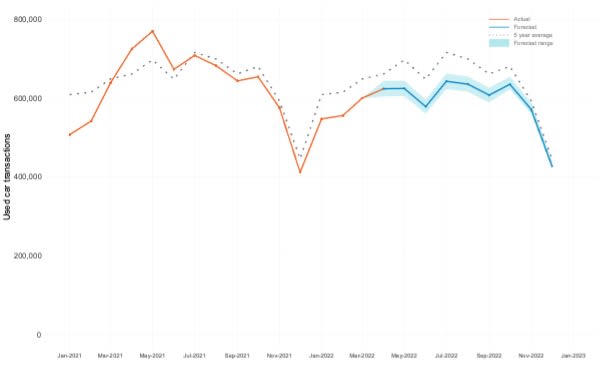
Prices are expected to remain stable in the short to medium term, while a downwards trajectory is inevitable in the longer term.
Photo: Cox Automotive
2 min to read
Despite signs of an end to significant rises in used vehicle values, the lack of new available stock means an imminent drop in pricing is unlikely, according to data compiled by Cox Automotive, a global remarketing, funding, retail and mobility solutions provider.
The data is compiled in the company’s latest AutoFocus quarterly insight roundout. The analysis outlines a range of scenarios to predict the best, middle-, and worst-case outcomes for the used vehicle market based on current market data.

Photo: Nothard
Philip Nothard, Insight and Strategy Director, Cox Automotive, said a 31 million shortfall in new vehicles over the past two years will cause supply constraints within the used car market.
“While the sector has become accustomed to fewer vehicles and higher prices, the full extent of the global new vehicle shortfall will have a significant effect in the coming months,” he explained.
The top five European markets registered 6.5 million fewer vehicles in 2020 and 2021 compared to the previous two years. As the used market depends on new vehicles to push stock through, further pressures are inevitable.
“Challenges exist mostly in the zero to six, and sub-12-month market, although we will soon see more of the same within the one-to-three-year sector, particularly over the next 24 months. Eventually, shortages will trickle down to the late three-year and five-year market,” said Norhard.
While used vehicle values indicate a realignment in wholesale and retail markets, the lack of new vehicles means “they are not about to fall off a cliff edge,” Norhard said.
Retailers are receiving stiff competition for product from new competitors who adjusted their stock profile during the pandemic, for example, daily rental companies that turned to the used market to compensate for the lack of new vehicles. Prices are expected to remain stable in the short to medium term, while a downwards trajectory is inevitable in the longer term.
In a resilient used vehicle market, retailers are seeking profit from new avenues, said Norhard.
“Most retailers have seen remarkable profits during the past few months from increased margins, full retail prices for new vehicles, minimal discounts, and a lack of targets – a dynamic the industry has not seen for a while. While supply and demand challenges still exist, many retailers display innovation and inventiveness to position them strongly against several headwinds.”
Norhard does not anticipate values for the majority of sub-sectors to return to pre-pandemic levels for several years, if at all. “Therefore, while current pricing conditions remain, and stock supply remains low for many manufacturers, it is more important than ever for retailers to grasp supply dynamics at a model and derivative level,” he advised.
The full AutoFocus analysis is available on the Cox Automotive site.
More Global Fleet
GeoFencing Adds to Your Truck Security Arsenal
Geofencing is a familiar fleet tool today, but its early adoption marked a major shift in vehicle tracking, route monitoring, and the debate over employee privacy.
Read More →
Holman Takes Full Ownership of ARIZA in Mexico
Holman is bringing its Mexican fleet management operation fully under its own brand after more than 30 years as a joint venture. The change gives multinational fleet customers a single Holman operation across the U.S., Canada, and Mexico.
Read More →
5 Tire Maintenance Tips to Help Prevent Work Truck Downtime
Regular tire checks can do more than extend tread life. These five maintenance practices can help work truck fleets catch problems early, reduce costs, and prevent downtime.
Read More →

Proven Ways to Reduce Work Truck Downtime
The age-old problem of downtime will always be a reality, but with new strategies at hand, fleets have more ways to keep trucks on the road longer.
Read More →


Cameras, Safety and Insurance: From Reactive Claims to Real-Time Prevention (Part 2 of 2)
Part Two: Commercial auto remains one of the most challenging and costly lines of coverage for fleet operators and insurers alike. Continue learning more about how to effectively address these issues from Onur Aksan, Enterprise Business Development Executive, Geotab
Read More →
Cameras, Safety and Insurance: From Reactive Claims to Real-time Prevention
Commercial auto remains one of the most challenging and costly lines of coverage for fleet operators and insurers alike. Learn more about how to effectively address these issues from Onur Aksan, Enterprise Business Development Executive, Geotab.
Read More →
Fleet Costs Are Rising: Here’s How Leaders Are Responding
Fleet leaders are under pressure to reduce costs, adapt to economic uncertainty, and make smarter decisions. See how peers across North America are responding with real data, proven strategies, and forward-looking insights. Download the 2026 Market Pulse Report to benchmark your strategy and uncover where you can gain an edge.
Read More →
Enterprise Fleet Management Surpasses 900,000 Vehicles in U.S. & Canada
Enterprise Mobility connects with mobility solutions around the globe
Read More →