




Study: U.S. Has Returned to 95% Commercial Driving Activity
Driving data collated by Samsara shows that while long haul transportation and food and beverage sectors have essentially reached pre-COVID-19 commercial driving activity, other industries, like transit, education, and oil and gas are far from recovery.

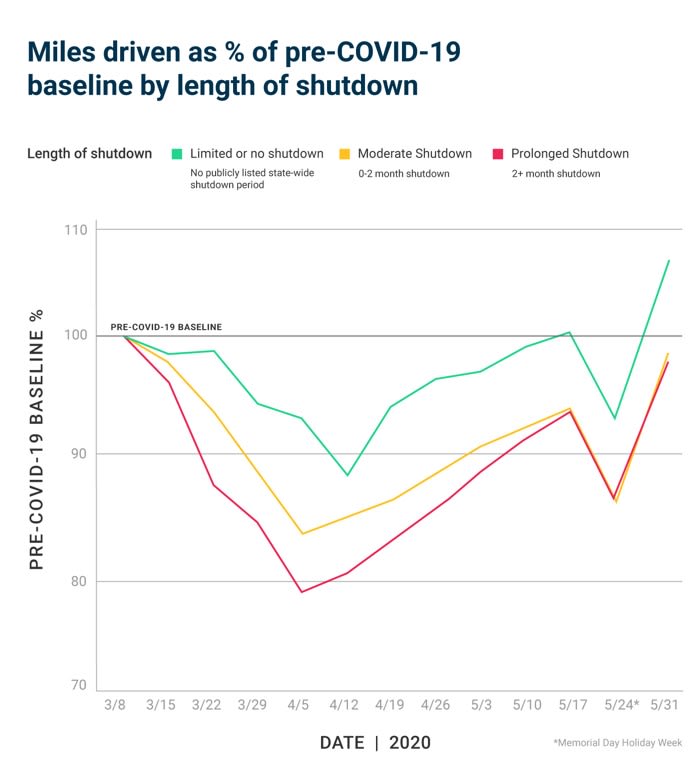
States with prolonged shutdowns are starting to reach the same level of miles driven as states with only moderate shutdowns. This is despite sharper declines in miles driven during peak periods of COVID-19.
Chart courtesy of Samsara.
In a race to stop the spread of COVID-19, millions of Americans across the country were ordered to stay home, except for essential activities. While all states have reopened in some capacity, the date they went into lockdown and the time they spent under that lockdown varies dramatically.
To see how these varying restrictions impacted commercial transportation in the United States, telematics service provider Samsara collated data from the nearly 130 million trips its 15,000 customers — operating across industries such as transportation and logistics, food production, local government, among others — have taken since the start of 2020.
Samsara analyzed transportation trends and safety incidents before, during, and after lockdowns across the United States. The data, collated in a report, outlines changes to commercial activity, industry-specific trends, and shifts in driver behavior.
Key findings
1. Commercial driving activity has returned to normal, or higher than normal, levels
On average, U.S. states have returned to be within 95% of pre-COVID-19 commercial driving activity, defined as miles driven and the number of operating vehicles on the road.
But this is not without some variation.
States that experienced limited to no lockdown restrictions are seeing a faster return to average commercial driving activity pre-pandemic. Not only have these states already seen a return to more than 100% of pre-COVID-19 commercial driving activity, but they also saw more modest declines during shutdown periods.
2. Industry impact varies widely — education most impacted, long haul and construction remain stable
Long haul transportation experienced a quick recovery from COVID-19. Food and beverage and wholesale trade transportation have also essentially reached pre-COVID-19 commercial driving activity.
This is in sharp contrast to other industries like passenger transit and education. Passenger transit activity has stabilized at around 35% of pre-COVID-19 levels and educational services activity remains below 10%.
Other industries, like oil and gas, have not yet recovered from COVID-19’s implications, operating at 60% of pre-COVID-19 commercial activity.
The construction industry, on the other hand, is starting to clock in more miles, operating at 5% above pre-COVID-19 levels in recent weeks.
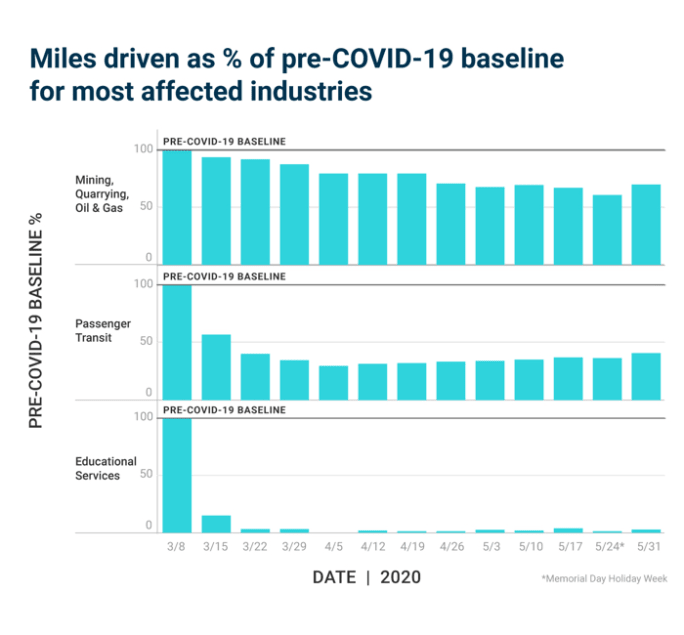
While passenger transit activity has stabilized at around 35% of pre-COVID-19 levels, educational services activity remains below 10%.
Chart courtesy of Samsara.
3. With emptier roads, harsh braking and acceleration decreased by 40%
There has been a decline in harsh braking and acceleration across all states, culminating at 40% below the pre-COVID-19 baseline.
The trend has become even more pronounced as commercial fleets are beginning to resume pre-COVID-19 levels of activity with significantly fewer passenger vehicles on the road, leading to fewer harsh braking and harsh acceleration events per 1000 miles driven.
States with comprehensive restrictions still in place are seeing even sharper declines in these behaviors.
4. Empty roads led to a 20% increase in severe speeding
With roads less congested, drivers might have been tempted to go speeds that they otherwise would not be able to reach on heavily trafficked roads.
In early April, severe speeding rose 20% above the pre-COVID-19 baseline, indicating that while there may be a decline in some risky driving behavior (like harsh braking and accelerations), there are certain driving behaviors that are making roads more dangerous too.
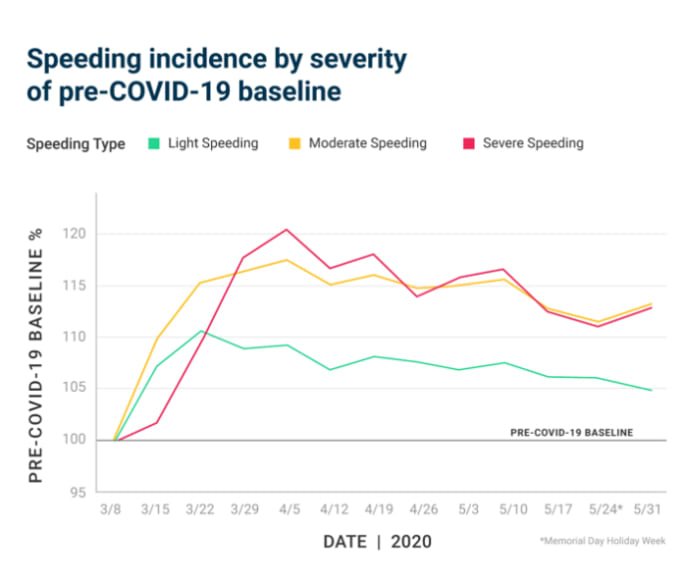
In early April, severe speeding rose 20% above the pre-COVID-19 baseline.
Chart courtesy of Samsara.
Originally posted on Work Truck Online
More Telematics
Samsara Driver Perks Adds New Benefit for Corporate Fleet Drivers
The rewards program gives eligible professional drivers access to discounts from more than 50 brands while giving fleets another way to support recruitment, retention, and the driver experience.
Read More →
Inside the Church of Jesus Christ of Latter-day Saints’ Two-Track Telematics Strategy
With 20,000 vehicles and two fundamentally different driver populations, the Church faced a fleet management problem that a single telematics program couldn't solve. How it responded offers a replicable framework for any fleet where one size doesn't fit every driver.
Read More →
How Conversational AI Can Make Fleet Tasks Easier for Drivers
While most generative AI tools help fleet managers interpret data at their desks, Connex2X is applying voice interaction to tasks behind the wheel.
Read More →
Why Fleets Are Creating Dedicated Fleet Analyst Positions
Are fleet analyst positions the new norm? Listen here to find out.
Read More →
Teletrac Navman Begins Next Chapter as Standalone Private Company
What's new with Teletrac Navman and its new owner?
Read More →
Why Fleets Are Creating Dedicated Fleet Analyst Positions
Telematics, AI, EVs, and connected technologies are generating more fleet data than traditional teams can effectively manage. Reed Jackson explains why dedicated fleet analytics roles are emerging to turn that information into better operational decisions.
Read More →
Deleting Driver Data Is No Longer Enough in Connected Vehicles
A factory reset may erase what's stored inside a vehicle, but it doesn't always end a former driver's digital connection. Here's how fleets can make digital offboarding part of every vehicle transition to reduce privacy, security, and compliance risks.
Read More →
How AI Can Help Fleet Managers Build Their Own Solutions
Syneos Health Fleet Manager Kristin Leary is exploring how AI-powered development tools, telematics data, and predictive analytics could help fleets solve operational challenges without waiting for a vendor roadmap.
Read More →
Cameras, Safety and Insurance: From Reactive Claims to Real-Time Prevention (Part 2 of 2)
Part Two: Commercial auto remains one of the most challenging and costly lines of coverage for fleet operators and insurers alike. Continue learning more about how to effectively address these issues from Onur Aksan, Enterprise Business Development Executive, Geotab
Read More →
100% Fleet Uptime? Here's Stellantis' Strategy
Keeping commercial vehicles on the road is becoming just as important as getting them into service. Stellantis’ U.S. fleet chief Michael Ferreira shares how connected technology and AI are changing the way fleets manage uptime.
Read More →