




Study Suggests Auto Insurers Need Narrower Mileage Bands to Set Rates
SAN FRANCISCO --- Quality Planning, a company providing data services for auto insurers, has released research findings that confirm a strong correlation between miles driven and auto insurance claim costs.
SAN FRANCISCO --- Quality Planning, a company providing data services for auto insurers, has released research findings that confirm a strong correlation between miles driven and auto insurance claim costs.
Some auto insurance companies are eliminating annual mileage as a factor for determining insurance premium pricing, but Quality Planning asserts that its recent study reveals why both consumers and companies get a better deal when auto insurance premiums are calculated in relation to miles driven.
During today's challenging economic times, many people are driving less -- and as a result, they expect their auto insurance premium to fall. However, many insurers are simply not able to respond to that dynamic. Over the past few years, a number of companies have relied less and less on individual driving habits. Their rates don't consider miles driven or even time spent inside a vehicle. Other companies group drivers into large mileage buckets (more than/less than 7,500 miles, for example) and price all members of the group similarly.
Quality Planning studied approximately 500,000 insurance policies and found a significant difference in average claim costs between high and low annual mileage groups. The lowest annual mileage group (0-3,000 miles) had 44 percent fewer claims as compared to the average, while the highest annual mileage group (more than 20,000 miles) had 28 percent more claims. Within a broad mileage range (for example, 0-7,500 miles) loss costs can be 12 to 15 percent higher for drivers at the high end of the mileage band, and 20 to 25 percent lower for drivers at the low end of the mileage band, as compared to the average for that range.
Many insurers are not providing consumers with clear incentives to accurately predict annual mileage and commute miles, nor are they taking steps to regularly validate these key rating variables. Many insurers have broad mileage bands that prevent them from offering competitive pricing. Broad bands such as '0-5,000,' '5,000-12,500' and 'more than 12,500 miles' fail to distinguish a pleasure-use vehicle owner who drives 5,500 miles a year from a heavy commuter who drives 12,400 miles per annum. With all other factors being the same, these two policyholders -- with very different driving habits -- would be charged the same premium, Quality Planning said.
To illustrate the potential of finely graduated annual mileage pricing, especially for low-mileage drivers, Quality Planning grouped average claim costs within narrow mileage bands and compared these with broader mileage bands used by some insurers. The baseline claims cost for the '0-3,000' mileage band is set at $100. As an example, someone in the '8,000-10,000' mileage band has a relative claims cost of $142 -- i.e., 42 percent higher than someone in the '0-3,000' mileage band.
Quality Planning's analysis suggests that companies with more mileage bands in their rating plan can benefit by the improved risk segmentation and pricing, and enjoy an advantage over their competitors (as long as they have an effective strategy to verify their customers' annual mileage every year). Conversely, if they do not assign the correct mileage categories for a policy, or if they have very few mileage bands in their rating plan, they risk losing customers, losing revenue, and facing higher claim costs not adequately covered by the premium they charge.
"Consumers justifiably believe that if they're driving less, they should pay less for their insurance, and indeed the claims statistics support that," said Dr. Raj Bhat, president of Quality Planning. "Our study shows that those insurers who fine-tune their premium to a customer's driving habits will be better positioned to offer competitive pricing. In the past, it was difficult to validate annual mileage and commute distances, which resulted in insurers having few or no mileage bands. Today, it's easy to integrate accurate annual mileage verification into the auto underwriting process, using the best available techniques. Insurers who do so will certainly outperform their peers."
Quality Planning sampled 459,599 single-vehicle policies from multiple carriers during 2003 to 2006. Claim data from that period was used to evaluate policy period claim costs. Bodily injury, property damage, and collision coverages were included in the analysis. The data was then separated into 20 annual mileage groups with the same number of vehicles in each group. The annual mileage estimates were obtained from a Quality Planning proprietary process that uses statistical estimates and odometer readings, when available.
Quality Planning is part of ISO, a leading source of information about risk. ISO provides data, analytics, and decision-support services to professionals in many fields, including insurance. Quality Planning is focused exclusively on providing rating integrity solutions to auto insurers. The company works with insurance companies to identify areas of significant rating errors using sophisticated database management, statistical analysis and modeling, customized survey design, and highly targeted customer interaction.
For more information, visit www.qualityplanning.com.
More Safety

Nexar-Nauto Merger Aims to Give Fleets Better Safety Intelligence Through Larger Driving Dataset
Stefan Heck tells Automotive Fleet that combining more than 10 billion miles of driving history with Nexar's AI models will give fleets deeper insights into driver risk and roadway conditions than either company could provide independently.
Read More →
Don't Wait for a Crisis: 5 Ways to Build Mental Health Into Your Fleet Safety Program
For Suicide Prevention Month, fleet and safety leaders have an opportunity to put mental health where it belongs: at the center of workplace safety.
Read More →
How Camera Data Can Strengthen a Fleet’s Insurance Renewal
Insights from a commercial insurance carrier and a broker show how fleets can turn video telematic data, driver coaching, and improved claims results into a stronger case at insurance renewal.
Read More →
The Safest Fleets Aren’t the Ones with the Most Technology
You’ve made the telematics investment. Here’s how to capture the other half of its value and build the safest fleet on the road.
Read More →
Hidden in Plain Sight: Fleet Compliance Risks
Fleet compliance isn't just about having policies — it's about consistently enforcing them. This practical guide reveals six hidden compliance risks common in public sector and shared fleet operations and outlines proven strategies to improve visibility, accountability, and audit readiness
Read More →
NETS Sets 2026 Fleet Safety Benchmark Conference for Indianapolis
The Sept. 15–17 program will feature fleet benchmarking data, case studies, emerging technologies, and implementation strategies while running alongside the NSC Safety Congress & Expo.
Read More →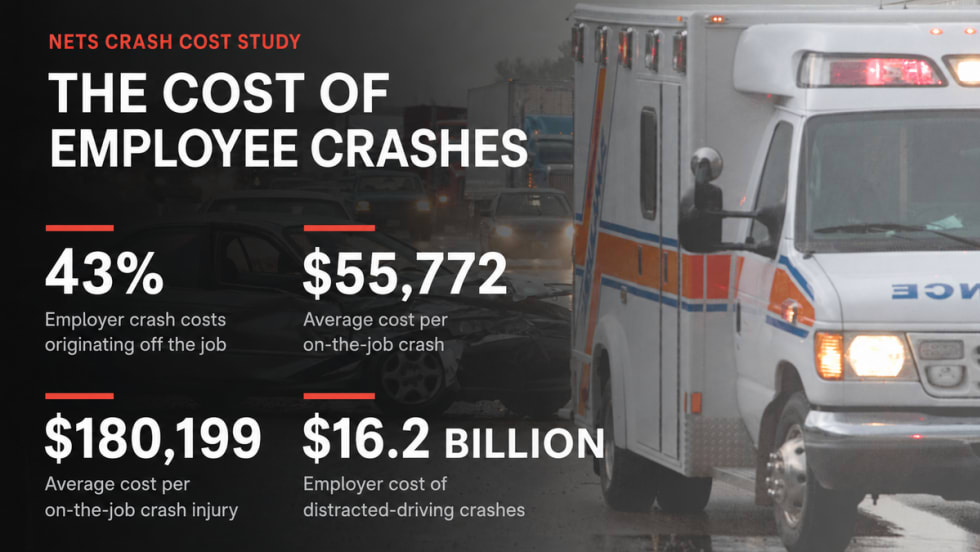
Off-the-Job Crashes Account for 43% of Employers’ $61.7 Billion Crash Burden
NETS quantifies costs dispersed across fleet, risk, HR, and other departments while providing new per-crash benchmarks for employers.
Read More →
Ram Recalls More Than 1.27 Million 1500 Pickups for Seat Belt Anchor Issue
The recall affects certain 2019-2026 Ram 1500 pickups that may have improperly attached second-row seat belt buckle anchors.
Read More →
How Better Visibility Cut Speeding Violations by 48%
Fleet leaders don't need more data, they need clearer visibility into what the data is saying. This case study explores how one utility replaced speeding-event counts with a single metric — miles driven in violation — to strengthen safety and significantly reduce speeding violations.
Read More →
Operation Safe Driver Week: Why the Industry's Oldest Safety Campaign Still Matters to Fleets
A look at how a 2007 enforcement initiative became one of the most consequential weeks on the fleet safety calendar, and what it means for your drivers in 2026.
Read More →