




Study Explores In-Vehicle Traffic Signs
The Virginia Tech Transportation Institute launches a research project focused on the feasibility of adaptive traffic signs – an application of connected-vehicle technology.
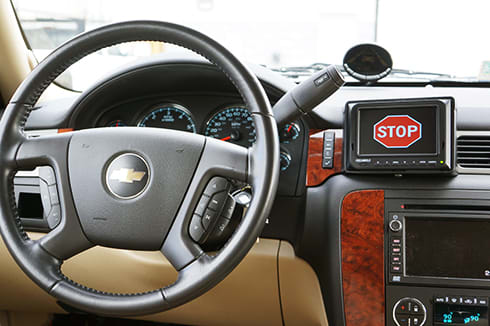
Photo courtesy of Virginia Tech Transportation Institute.
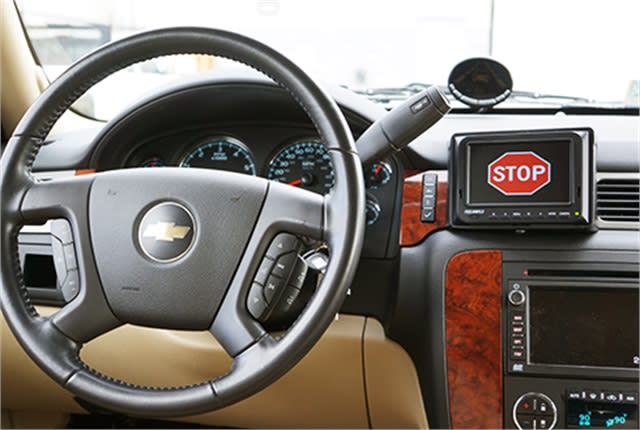
Photo courtesy of Virginia Tech Transportation Institute.
Researchers at Virginia Tech have launched a study exploring the use of a new connected-vehicle technology application, in which stop, yield and other traffic signs are displayed inside the car rather than outside.
The Virginia Tech Transportation Institute, located just a few miles off the main campus, is in the early stages of this so-called adaptive stop-yield study. The technology allows traffic signs to adapt to current traffic conditions. For example, if a car approaches an intersection with no other vehicles nearby, the driver is permitted to proceed without stopping. A dashboard screen automatically alerts the driver of what actions to take, if any.
“The idea is there would be no physical stop or yield signs on the side of the road, but they would be inside the vehicle,” said Alexandria Noble, a master’s student with the Virginia Tech Charles E. Via Jr. Department of Civil and Environmental Engineering.
Working with the Virginia Tech Transportation Institute, Noble is spearheading the proof-of-concept project. Engineering professor Thomas A. Dingus, the institute’s director, will serve as her adviser and project manager.
The U.S. Department of Transportation is providing project funding.
The study directly ties into the institute’s growing endeavor into connected-vehicle technology, a futuristic intranet-like grid system where “smart” cars and other vehicles can communicate not only with each other but with surrounding infrastructure to help prevent crashes and ease congestion.
“This is part of our initial efforts to integrate more revolutionary safety concepts with the growing field of connected-vehicle technology,” said Dingus. “While a relatively new area in the transportation realm, adaptive stop/yield signs have the potential to be a long-term solution for not only minimizing traffic problems experienced on increasingly congested roadways, they may also help mitigate negative environmental impacts.”
Noble recently finished a 17-week closed experiment at the Virginia Smart Road, directly behind the institute’s main base. The experiment involved dozens of local test participants, ages 18-25 and also older than 50, in cars outfitted with small GPS-like dashboard screens that would alert the driver with a flashing display to stop, yield or proceed through the intersection.
Cameras set up in the test vehicle captured images of the driver's upper body, line of sight, the dashboard, and the vehicle itself.
"The deployment of this technology in the real world would involve a whole reworking of the transportation system and is not likely to be deployed in the near future," Noble said. "However, this study will be useful in developing future connected-vehicle applications in a general sense and demonstrates that this is possible and how well it is received by naive drivers with minimal training on the subject."
More Safety

Nexar-Nauto Merger Aims to Give Fleets Better Safety Intelligence Through Larger Driving Dataset
Stefan Heck tells Automotive Fleet that combining more than 10 billion miles of driving history with Nexar's AI models will give fleets deeper insights into driver risk and roadway conditions than either company could provide independently.
Read More →
Don't Wait for a Crisis: 5 Ways to Build Mental Health Into Your Fleet Safety Program
For Suicide Prevention Month, fleet and safety leaders have an opportunity to put mental health where it belongs: at the center of workplace safety.
Read More →
How Camera Data Can Strengthen a Fleet’s Insurance Renewal
Insights from a commercial insurance carrier and a broker show how fleets can turn video telematic data, driver coaching, and improved claims results into a stronger case at insurance renewal.
Read More →
The Safest Fleets Aren’t the Ones with the Most Technology
You’ve made the telematics investment. Here’s how to capture the other half of its value and build the safest fleet on the road.
Read More →
Hidden in Plain Sight: Fleet Compliance Risks
Fleet compliance isn't just about having policies — it's about consistently enforcing them. This practical guide reveals six hidden compliance risks common in public sector and shared fleet operations and outlines proven strategies to improve visibility, accountability, and audit readiness
Read More →
NETS Sets 2026 Fleet Safety Benchmark Conference for Indianapolis
The Sept. 15–17 program will feature fleet benchmarking data, case studies, emerging technologies, and implementation strategies while running alongside the NSC Safety Congress & Expo.
Read More →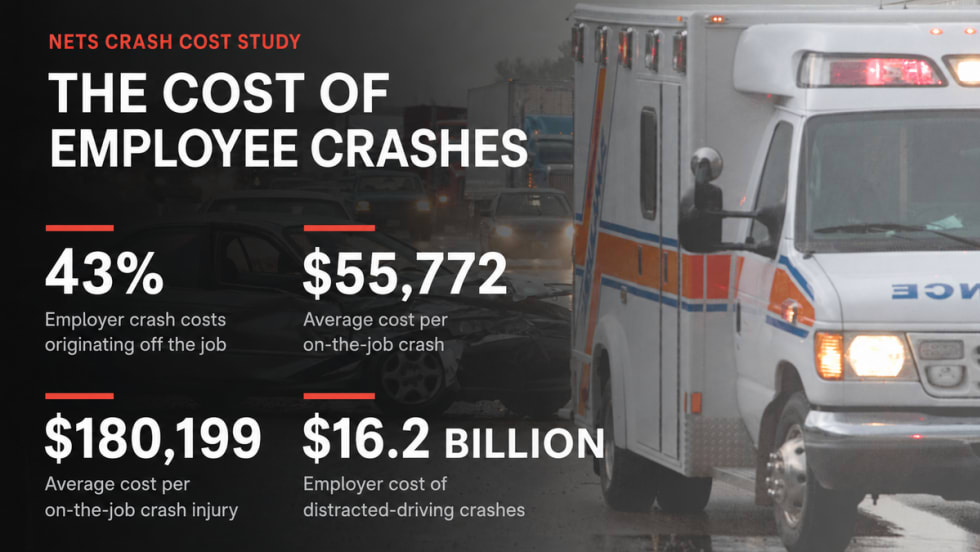
Off-the-Job Crashes Account for 43% of Employers’ $61.7 Billion Crash Burden
NETS quantifies costs dispersed across fleet, risk, HR, and other departments while providing new per-crash benchmarks for employers.
Read More →
Ram Recalls More Than 1.27 Million 1500 Pickups for Seat Belt Anchor Issue
The recall affects certain 2019-2026 Ram 1500 pickups that may have improperly attached second-row seat belt buckle anchors.
Read More →
How Better Visibility Cut Speeding Violations by 48%
Fleet leaders don't need more data, they need clearer visibility into what the data is saying. This case study explores how one utility replaced speeding-event counts with a single metric — miles driven in violation — to strengthen safety and significantly reduce speeding violations.
Read More →
Operation Safe Driver Week: Why the Industry's Oldest Safety Campaign Still Matters to Fleets
A look at how a 2007 enforcement initiative became one of the most consequential weeks on the fleet safety calendar, and what it means for your drivers in 2026.
Read More →