




Six California-Based Companies Help Develop Biodiesel Infrastructure
The Environmental Defense Fund profiled one company to represent each step of the value chain: research and development, feedstock, collection production, blending, and retail and distribution.
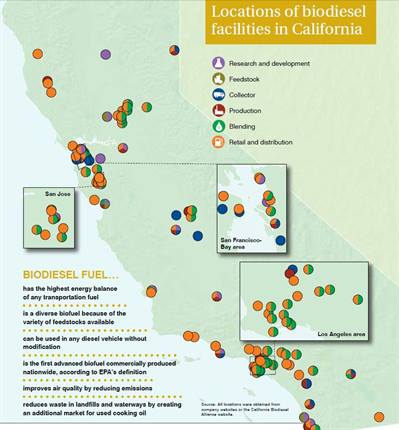
Biodiesel facilities throughout California.
Photo courtesy Environmental Defense Fund
The Environmental Defense Fund (EDF) released a report that detailed the progress six California-based companies have made in researching and developing the biodiesel infrastructure. The EDF stated the companies have been focusing on this alternative to traditional diesel fuel in response to California's Low Carbon Fuel Standard and the Renewable Fuel Standard.
According to the Environmental Defense Fund, the following six companies have successfully developed their businesses around biodiesel:
Biodico, a biofuels research and development company, was tasked by the U.S. Navy in 2002 to design, develop, and deploy modular biofuel and bioenergy systems that can use a variety of feedstocks and produce renewable on-demand primary heat and power. Since then, Biodico has built a sustainable biorefinery at Naval Base Ventura County that will have 10 million gallons per year of biodiesel production capacity and will supply biodiesel and bioenergy at competitive prices. They have six commercial units in California, Colorado, Nevada, Texas, and Australia.
North Star Biofuels, LLC is a feedstock production facility, formed as a joint venture between R Power Biofuels and Agri Beef Co. (AB). The company finished building its 20 million gallon per year production facility in Watsonville, California in June 2013. North Star’s feedstock consists of animal tallow and waste vegetable oils obtained from major suppliers. North Star’s output is almost fully committed to oil companies that have started blending 5 percent biodiesel (B5) in California.
Yokayo Biofuels, a feedstock collector, currently produces about 400,000 gallons of biodiesel per year. The entire process, from feedstock collection to production of a finished biodiesel product to distribution, is completed in Northern California. As a fully-licensed “inedible kitchen grease hauler,” the company has three trucks that collect oil from 900 restaurants and food service facilities.
Crimson Renewable Energy, LP, a biofuels production facility in Bakersfield, currently makes between 8–10 million gallons of biodiesel per year. Crimson originally began production with soy bean oil feedstock in 2009, then redesigned the plant to be able to process multiple types of low-carbon feedstocks and began producing biodiesel again in 2011. The facility today runs entirely on used cooking oil, yellow grease, and corn oil from ethanol plants.
Imperial Western Products (IWP), a biodiesel processing and blending company, produces nearly 8 million gallons of biodiesel per year. IWP originally produced cattle feed from organic matter, but the company expanded to biodiesel in 2001. All of the company's feedstock oil comes from a 250 mile radius, with most of its product sold in California.
Propel Fuels, a California-based fuel retailer, currently has 38 sites that sell biodiesel and E85 Flex Fuel alongside conventional fuels. Propel partners with conventional fueling stations or, in some cases, operates the whole station. Originally based in Seattle, Wash. Propel said the company relocated to California after seeing an unmet need for alternative fuels in California's market, especially given the state's Low Carbon Fuel Standard (LCFS) and Renewable Fuel Standard policies.
More Green Fleet

Merchants Fleet Reports 290M EV Miles as Fleets Navigate Changing Electrification Market
From millions in operating savings to hundreds of millions of EV miles, Merchants Fleet’s latest report reveals what’s working and what’s changing in fleet electrification.
Read More →
The EV Breakdown Nobody's Talking About: Why Most Electric Vehicle Roadside Calls Aren't Mechanical Failures
Here's why EV breakdowns are widely misunderstood.
Read More →
ChargePoint Now Available in Energy Pass
ChargePoint and additional planned charging network integrations were added to GM's Energy Pass.
Read More →

First Look: Slate Auto's Electric Fleet Pickup
Could an affordable, modular EV pickup make electrification more practical for fleets?
Read More →
Slate Debuts Colorful, Unique EV Models
A recent media and client event, studded with electric vehicles dressed up on platforms, planted a new position for the manufacturer in the wider EV market. Fleets will find cost-saving advantages.
Read More →
Slate Electric SUV, Pickup Switchable Model Aims For Light-Duty Fleets
Everything about this EV is counterintuitive and understated, making it stand out from the crowd.
Read More →
Inspiration Mobility Acquires Key Electrada Assets
Inspiration Mobility Group has acquired select assets of Electrada, adding the fleet electrification provider's team, technology, and charging infrastructure development capabilities to its energy management business.
Read More →
Turning Connected Vehicle Data Into Decisions That Matter
Fleet leaders have more data than ever, but turning that data into clear, actionable decisions remains a challenge. This white paper shows how leading organizations are using connected vehicle data to improve safety, reduce costs, and optimize fleet performance. Learn how to turn insight into action across your fleet.
Read More →
Are You Tracking Your Fleet's True Total Cost of Ownership?
Bobit Business Media surveyed 190 fleet professionals and found that while most fleets are tracking costs, fragmented systems and data gaps are keeping true TCO visibility out of reach. With rising pressure to control spend in an increasingly volatile environment, the gap between what fleets think they know and what the data actually shows is wider than you might expect. See how your peers are managing costs today and where the industry still has room to improve.
Read More →