




Scania Leads European Research Project on Vehicle Platooning
Scania will take the lead role in a three-year European research project to develop a system for implementing truck platooning on roads.
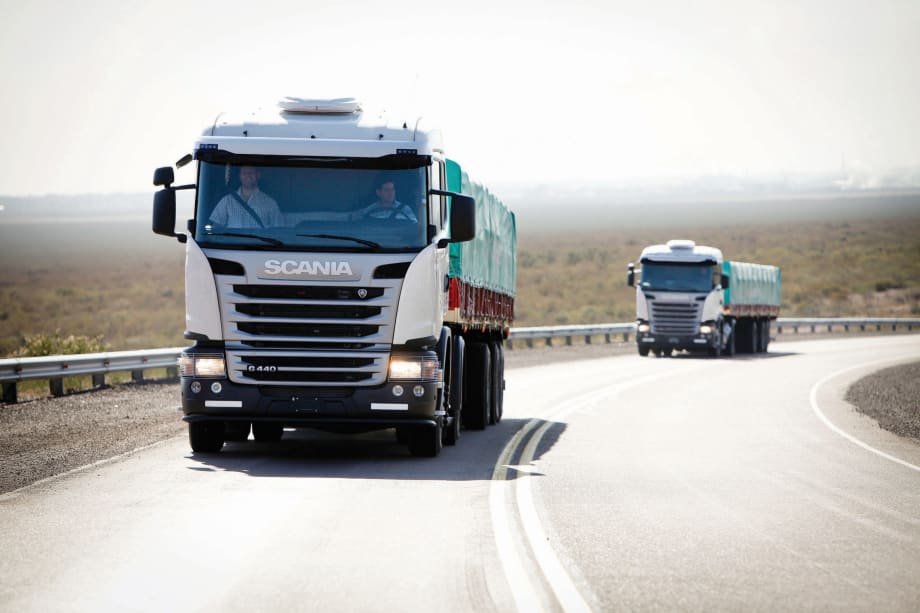
Scania will take a lead role in researching truck platooning in Europe.

Scania will take a lead role in researching truck platooning in Europe.
Scania will take the lead role in a three-year European research project to develop a system for implementing truck platooning on roads. Introducing platooning on European roads can significantly contribute towards reducing the carbon footprint of trucks, according to the company. The European Union has set a goal of reducing greenhouse gases by 20 percent by 2020. Heavy vehicles currently account for 17 percent of total CO2 emissions.
Through the EUR 5.4 m. COMPANION research project, of which EUR 3.4 m. is funded by the EU’s Seventh Framework Programme, the partners will identify means of implementing the platooning concept in practice in daily transport operations. The project also includes Volkswagen Group Research, Stockholm’s Royal Institute of Technology, (KTH), Oldenburger Institut für Informatik (OFFIS) in Germany, IDIADA Automotive Technology in Spain, Science [&]Corporation (S[&]T) in the Netherlands, and the Spanish haulage company Transportes Cerezuela.
The benefits of reduced aerodynamic drag are well-established, according to Scania. Over the past two years, Scania has implemented platooning concepts in its own transport operations and has shown that fuel savings of up to five percent can be achieved through reduced drag.
Depending on the transport assignment, haulage companies will be able to identify the optimal routes to save fuel. Through an integrated system, drivers will receive information on where they can join and leave platoons. This integrated information system will clearly describe available alternatives, taking into account such variables as weather conditions, the traffic situation and delivery schedules as well as the weight and speed of the truck combination.
The project will pay particular attention to how information is presented to drivers regarding where they can join and leave platoons. Since the driver is ultimately responsible for his or her vehicle, information will be designed to facilitate decision-making with tips on increasing or decreasing speed, for example. Moreover, the technical and safety aspects of platooning will be examined further, according to Scania.
The project will also propose common EU regulations permitting shorter distances between trucks in the platoon. The shorter the distance, the greater the fuel saving that can be achieved. However, this would require vehicles to be interconnected through wireless communication systems. With Spanish companies IDIADA and Transportes Cerezuela as partners, the aim is to test the entire system on Spanish roads during the autumn of 2016, according to Scania.
More Global Fleet
Holman Takes Full Ownership of ARIZA in Mexico
Holman is bringing its Mexican fleet management operation fully under its own brand after more than 30 years as a joint venture. The change gives multinational fleet customers a single Holman operation across the U.S., Canada, and Mexico.
Read More →
Proven Ways to Reduce Work Truck Downtime
The age-old problem of downtime will always be a reality, but with new strategies at hand, fleets have more ways to keep trucks on the road longer.
Read More →
The Top 300 Commercial Fleets
The Top 300 Commercial Fleets: See the List
Read More →

Cameras, Safety and Insurance: From Reactive Claims to Real-Time Prevention (Part 2 of 2)
Part Two: Commercial auto remains one of the most challenging and costly lines of coverage for fleet operators and insurers alike. Continue learning more about how to effectively address these issues from Onur Aksan, Enterprise Business Development Executive, Geotab
Read More →
Cameras, Safety and Insurance: From Reactive Claims to Real-time Prevention
Commercial auto remains one of the most challenging and costly lines of coverage for fleet operators and insurers alike. Learn more about how to effectively address these issues from Onur Aksan, Enterprise Business Development Executive, Geotab.
Read More →
Fleet Costs Are Rising: Here’s How Leaders Are Responding
Fleet leaders are under pressure to reduce costs, adapt to economic uncertainty, and make smarter decisions. See how peers across North America are responding with real data, proven strategies, and forward-looking insights. Download the 2026 Market Pulse Report to benchmark your strategy and uncover where you can gain an edge.
Read More →
Enterprise Fleet Management Surpasses 900,000 Vehicles in U.S. & Canada
Enterprise Mobility connects with mobility solutions around the globe
Read More →
Automotive Fleet's Guide to Fleet Electrification
Unlock the secrets to a successful transition to electric fleets with Automotive Fleet's comprehensive Fleet Electrification Guide!
Read More →
Sumitomo Rubber Industries to Acquire Viaduct
Viaduct will join Sumitomo as an independent subsidiary. Partnership strengthens global reach and accelerates AI-driven innovation for fleets and manufacturing.
Read More →