




Safety Tip: Responding to a Traffic Stop
The Massachusetts Registry of Motor Vehicles offers advice on what to do when a police officer pulls over your vehicle.
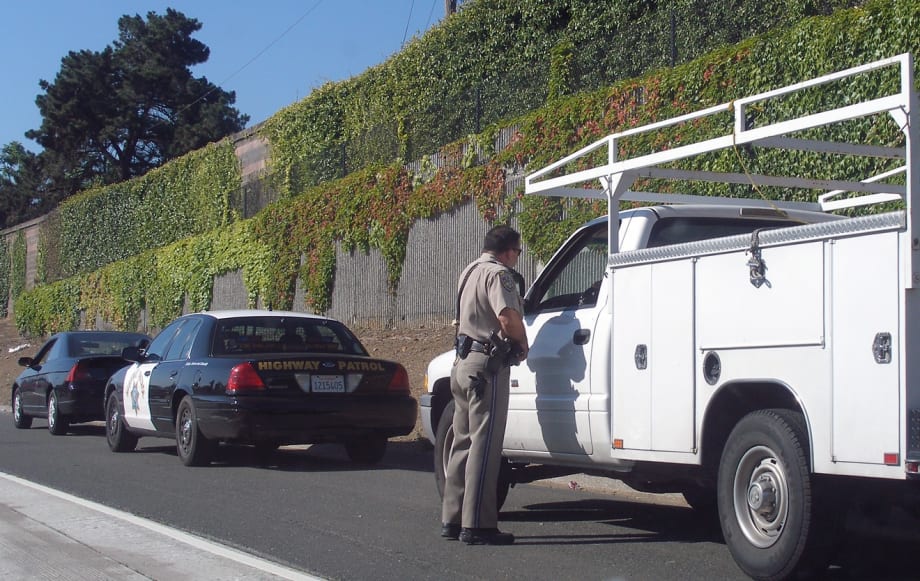
Photo by Coolcaesar at English language Wikipedia (via Wikimedia Commons).
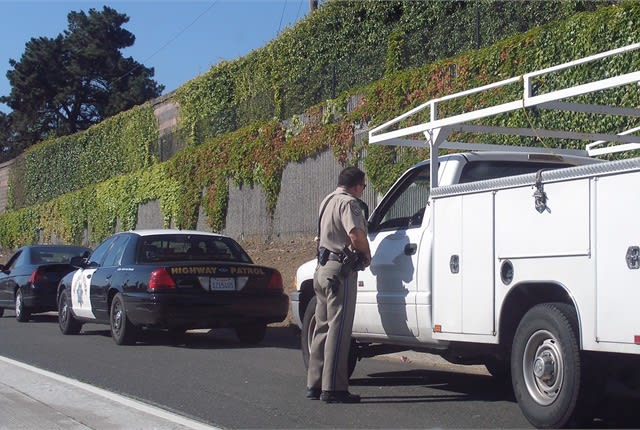
Photo by Coolcaesar at English language Wikipedia (via Wikimedia Commons).
When a law enforcement officer pulls your vehicle over for a traffic stop, the experience can be stressful. It's important for your own safety, however, to maintain control of your emotions so the officer never feels threatened. Here’s advice from the Massachusetts Registry of Motor Vehicles:
Don’t ignore the officer’s signal or pretend you didn’t see it.
Turn on your right-turn signal and check your mirrors. Carefully and slowly move your vehicle completely to the right side of the road. If the officer drives by and doesn’t stop, return to the travel lane when it is safe.
Do not stop your vehicle in an intersection, in front of a driveway, or in a travel lane. If the officer directs you to pull over in a certain place, pull over where directed.
Put the vehicle in park (if an automatic transmission) or in neutral with the parking brake on (if a standard transmission). Turn off the engine.
Stay in the vehicle (both you and your passengers). Only get out if you are instructed to by the officer.
If it is dark, leave your headlights on and put the interior overhead light on.
Roll down your window as the officer walks toward you.
Wait until the officer asks for your license and registration before reaching into your pockets or into the glove compartment. While you know you are only reaching for the appropriate documents, your movements may be reasonably seen by the officer as an attempt to reach for a weapon or to hide something. The officer may feel threatened and may react in a manner that you do not expect. Hand the documents to the officer when requested and do not present the documents in a wallet or holder.
Keep your hands in plain sight and tell your passengers to do the same.
Do not make any sudden movements or gestures that could seem threatening. Examples of this could be reaching under the seats or into unlit areas of the vehicle. Make sure your passengers do not do this either.
Stay in your vehicle when the officer goes back to the police car. If you have a question, wait until the officer returns. If you find something the officer requested, hold it out the window and wait for the officer to return.
Be polite when the officer returns your license and registration. If the officer gives you a ticket, do not argue. Once a citation is issued, the officer is required to file it and cannot take it back. You have the right to challenge the citation in court.
When the officer tells you that you can go, put on your left-turn signal, check your mirrors, and return to the travel lane. If you are on a highway, accelerate to a safe speed in the breakdown lane before merging into traffic.
If you believe that you were stopped by a police officer because of your race or your gender, you may report this by contacting the police department or law enforcement agency of the officer who stopped you.
More Safety

Nexar-Nauto Merger Aims to Give Fleets Better Safety Intelligence Through Larger Driving Dataset
Stefan Heck tells Automotive Fleet that combining more than 10 billion miles of driving history with Nexar's AI models will give fleets deeper insights into driver risk and roadway conditions than either company could provide independently.
Read More →
Don't Wait for a Crisis: 5 Ways to Build Mental Health Into Your Fleet Safety Program
For Suicide Prevention Month, fleet and safety leaders have an opportunity to put mental health where it belongs: at the center of workplace safety.
Read More →
How Camera Data Can Strengthen a Fleet’s Insurance Renewal
Insights from a commercial insurance carrier and a broker show how fleets can turn video telematic data, driver coaching, and improved claims results into a stronger case at insurance renewal.
Read More →
The Safest Fleets Aren’t the Ones with the Most Technology
You’ve made the telematics investment. Here’s how to capture the other half of its value and build the safest fleet on the road.
Read More →
Hidden in Plain Sight: Fleet Compliance Risks
Fleet compliance isn't just about having policies — it's about consistently enforcing them. This practical guide reveals six hidden compliance risks common in public sector and shared fleet operations and outlines proven strategies to improve visibility, accountability, and audit readiness
Read More →
NETS Sets 2026 Fleet Safety Benchmark Conference for Indianapolis
The Sept. 15–17 program will feature fleet benchmarking data, case studies, emerging technologies, and implementation strategies while running alongside the NSC Safety Congress & Expo.
Read More →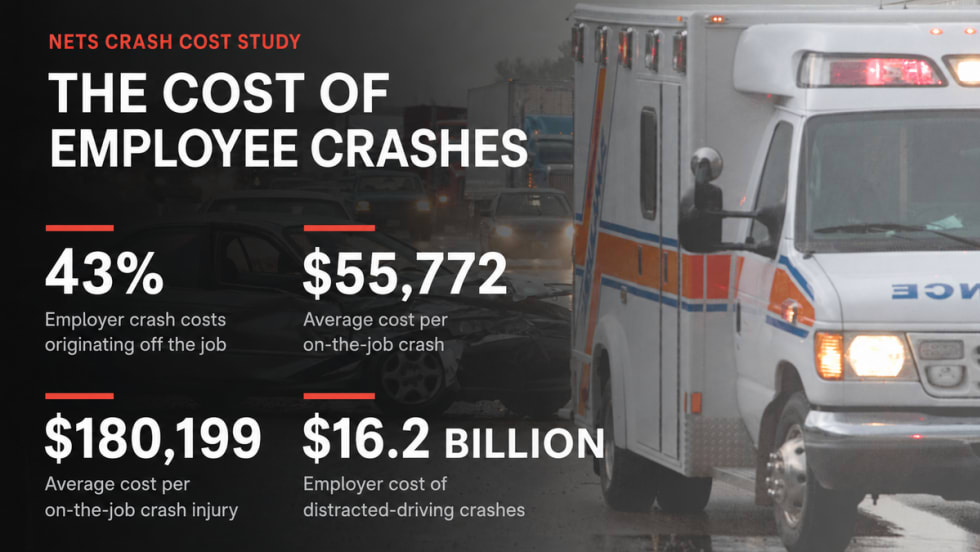
Off-the-Job Crashes Account for 43% of Employers’ $61.7 Billion Crash Burden
NETS quantifies costs dispersed across fleet, risk, HR, and other departments while providing new per-crash benchmarks for employers.
Read More →
Ram Recalls More Than 1.27 Million 1500 Pickups for Seat Belt Anchor Issue
The recall affects certain 2019-2026 Ram 1500 pickups that may have improperly attached second-row seat belt buckle anchors.
Read More →
How Better Visibility Cut Speeding Violations by 48%
Fleet leaders don't need more data, they need clearer visibility into what the data is saying. This case study explores how one utility replaced speeding-event counts with a single metric — miles driven in violation — to strengthen safety and significantly reduce speeding violations.
Read More →
Operation Safe Driver Week: Why the Industry's Oldest Safety Campaign Still Matters to Fleets
A look at how a 2007 enforcement initiative became one of the most consequential weeks on the fleet safety calendar, and what it means for your drivers in 2026.
Read More →